
Binary Options Scam Red Flags: 25 Signs a Broker Cannot Be Trusted
If you are new to binary options, the first thing you should learn is not strategy. It is not candlestick patterns, expiry timing, or indicator settings. The first thing you should learn is how to avoid a bad broker.
A weak strategy can cost you money. A dishonest broker can cost you your deposit, your profits, your personal documents, and your confidence in the market. That is why broker trust comes before everything else.
Many traders lose money not only because they make poor trading decisions, but because they deposit with a platform they never properly verified. A broker may look professional, promise fast withdrawals, offer huge bonuses, and show attractive payouts, while still creating serious problems once real money is involved. In many cases, the warning signs only become obvious after the first withdrawal request.
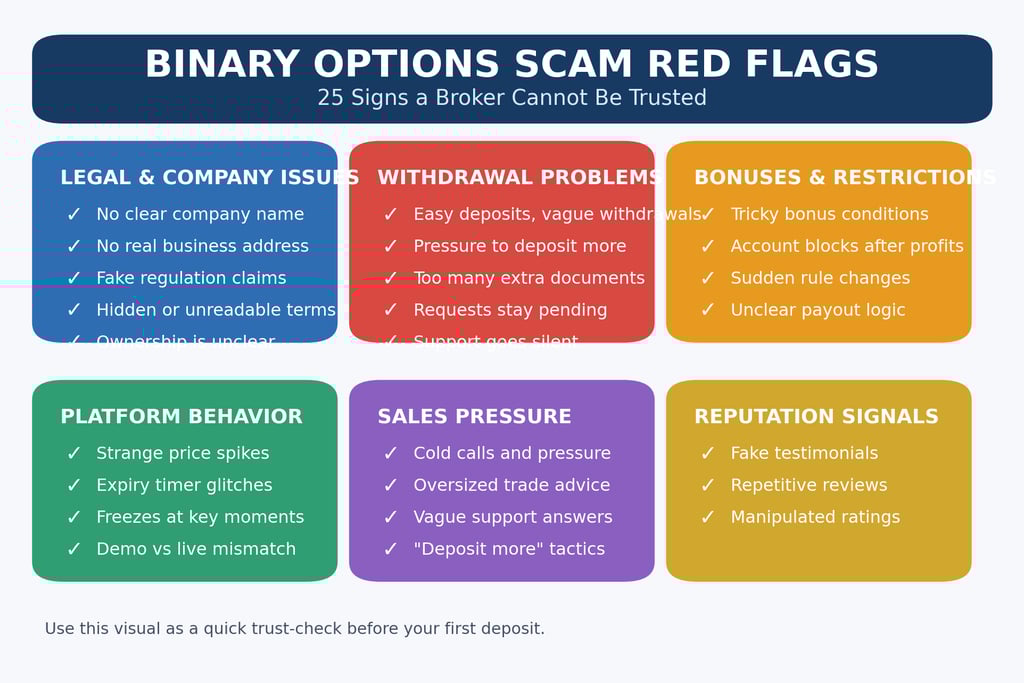
This guide explains the 25 most important scam red flags to watch for before you deposit. It is written for beginners, but it is practical enough for experienced traders who want a fast trust-check framework before opening an account.
Why Scam Detection Matters More Than Strategy at the Beginning
A trading strategy only matters if the platform itself is worth using. If the broker is dishonest, then even a profitable setup can become meaningless. You may win trades and still face problems when trying to withdraw. You may see attractive payouts and still discover hidden conditions later. You may even be asked to upload sensitive documents to a company you cannot properly identify.
That is why scam detection comes first. Before you think about trade entry, you should know who is behind the platform, how withdrawals are handled, whether the company is transparent, and whether the broker behaves like a service provider or like a high-pressure sales operation.
A trustworthy broker is not necessarily perfect. But it should be understandable, verifiable, and operationally consistent. If a broker fails those three tests, that alone is a reason to slow down.
The 25 Red Flags That Should Make You Stop and Recheck
1) Legal and Company Red Flags
1. No clear company name
If the website talks a lot about trading opportunities but does not clearly identify the operating company, that is a serious warning sign. A real financial service should not hide the entity behind the platform.
2. No verifiable business address
A vague “global office” statement is not enough. If there is no real business address, or the address cannot be connected to the company, trust should drop immediately.
3. Fake or unclear regulation claims
Some brokers use words like “regulated,” “licensed,” or “secure” all over the website without identifying the actual regulator, license number, or regulated entity. If the broker cannot be independently verified, the claim means very little.
4. Terms and Conditions are missing or unreadable
If the legal documents are hard to find, poorly written, or clearly incomplete, that is a major risk signal. A broker that wants your money should not hide its rules.
5. Ownership structure is impossible to understand
You should know who operates the platform, which company receives client payments, and which entity manages disputes or compliance. If every answer leads to another unclear name, be careful.
2) Deposit and Withdrawal Red Flags
6. Deposits are easy, withdrawals are vague
A scam broker often makes funding simple and frictionless, while giving only vague language around withdrawals. If the deposit page is detailed but the withdrawal policy is vague, that imbalance matters.
7. Withdrawal terms are buried in fine print
You should not need to dig through multiple pages just to understand how to withdraw your own money. If key conditions only appear in obscure legal text, that is a red flag.
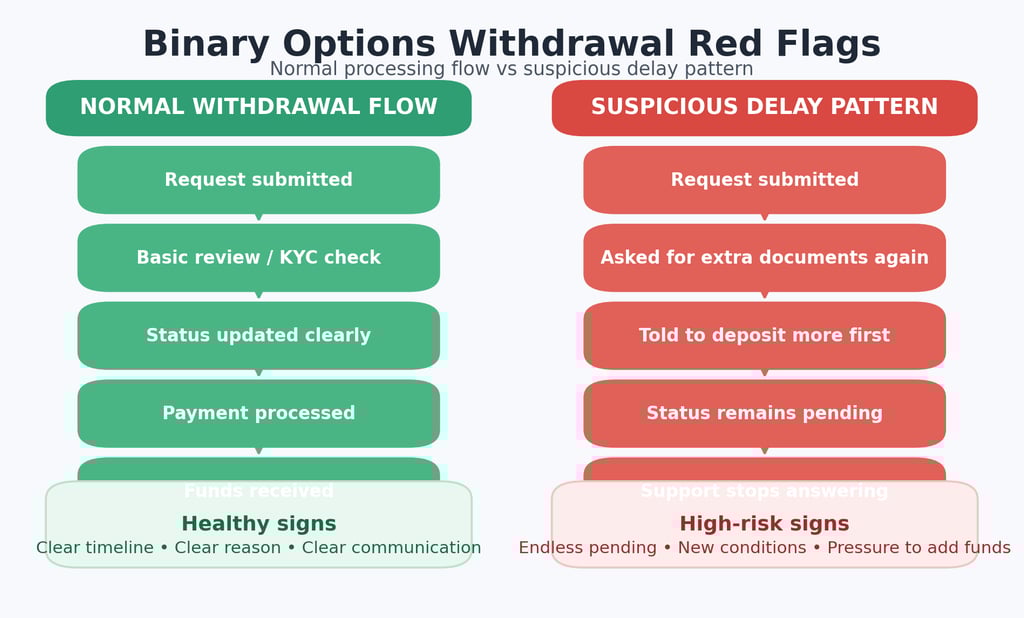
8. The broker pressures you to deposit more before withdrawing
This is one of the clearest danger signs. If support, a so-called account manager, or a sales agent tells you to deposit again before your current withdrawal can be processed, step back immediately.
9. The broker requires excessive documents without clear reason
KYC is normal. But repeated demands for extra documents, especially after a withdrawal request, can become a stalling tactic if the process is not clearly justified.
10. Payment-method matching rules appear only after funding
If the broker introduces new rules after your deposit, especially around card matching, wallet restrictions, or account ownership, that is a trust issue unless those rules were clearly disclosed beforehand.
11. Withdrawal requests stay pending for too long without explanation
A short review period may be normal. But repeated delays with no clear timeline, no reason, and no effective support response are a serious operational warning sign.
12. Support becomes slower after you request a withdrawal
A broker that replies quickly when you want to deposit but becomes difficult to reach after you request a payout is showing you exactly how it treats clients when money is flowing out instead of in.
3) Bonus and Account Restriction Red Flags
13. Bonus terms make withdrawals difficult
Bonuses often sound attractive to beginners, but they can be structured in ways that block or delay withdrawals until unrealistic trading volume is reached. If bonus conditions are complex, aggressive, or hard to calculate, be cautious.
14. The broker applies account restrictions without clear cause
If your account is suddenly “under review,” “temporarily limited,” or “paused for security reasons” right after you try to withdraw, that is a pattern worth taking seriously.
15. Payouts seem unusually high without explanation
Very high advertised payouts can be used to attract deposits, especially from new traders. But if the broker does not clearly explain how payouts are determined, you should treat that as a risk factor, not an advantage.
16. The broker changes terms too often
If the platform repeatedly updates bonus rules, inactivity clauses, or withdrawal limits in ways that seem one-sided, that weakens trust.
4) Platform Behavior Red Flags
17. Prices behave strangely during winning trades
If traders repeatedly report that prices spike unexpectedly, expiry behavior looks inconsistent, or winning trades seem to reverse in suspicious ways, do not ignore those complaints.
18. The expiry countdown feels unreliable
In short-duration trading, timing matters. If the countdown appears to lag, jump, extend, or behave inconsistently, that is a serious execution concern.
19. The platform freezes at sensitive moments
A one-time technical issue can happen anywhere. But repeated freezing near entry or expiry points deserves close attention.
20. Demo performance feels unrealistically different from live performance
A demo account should help you learn the platform. If the live environment feels drastically different in a way that consistently harms users, that deserves scrutiny.
5) Sales Pressure and Support Red Flags
21. You receive repeated cold calls or pressure messages
A broker should not need to pressure you into depositing more money. Aggressive calls, personal messages, or emotional sales tactics are a bad sign.
22. “Account managers” push oversized trades
If someone connected to the broker encourages you to increase your stake quickly, ignore your risk plan, or follow their signals blindly, that is not professional guidance. That is pressure.
23. Support avoids direct answers
When you ask simple questions about regulation, withdrawals, or company ownership, the answers should be clear. If support keeps changing the subject, trust should fall.
24. You are told your issue is “temporary” over and over again
A vague promise can be used to keep traders waiting. If every delay is described as temporary but nothing actually improves, the pattern speaks for itself.
6) Reputation and Proof Red Flags
25. Reviews look fake, repetitive, or manipulated
Do not trust five-star reviews blindly. If the wording looks repetitive, overly promotional, or disconnected from real platform details, treat it carefully. A trustworthy broker is built on operations, not on a wall of suspicious praise.
What a Trustworthy Broker Usually Does Instead
A trustworthy broker does not need to hide behind unclear language. It usually identifies the operating company, explains how deposits and withdrawals work, publishes legal documents clearly, and makes support reachable when real questions come up.
It also behaves consistently. The same broker that welcomes your deposit should remain responsive when you ask to withdraw. The same platform that advertises transparency should explain its trading terms in plain language. The same company that says it values clients should not need an aggressive account manager to keep money flowing in.
That is one reason editorial balance matters. A serious broker review should not only highlight strengths, but also show whether the platform behaves reasonably across the full user journey. If you want an example of how to assess platform quality from an execution and real-usage perspective, see our Pocket Option execution review.
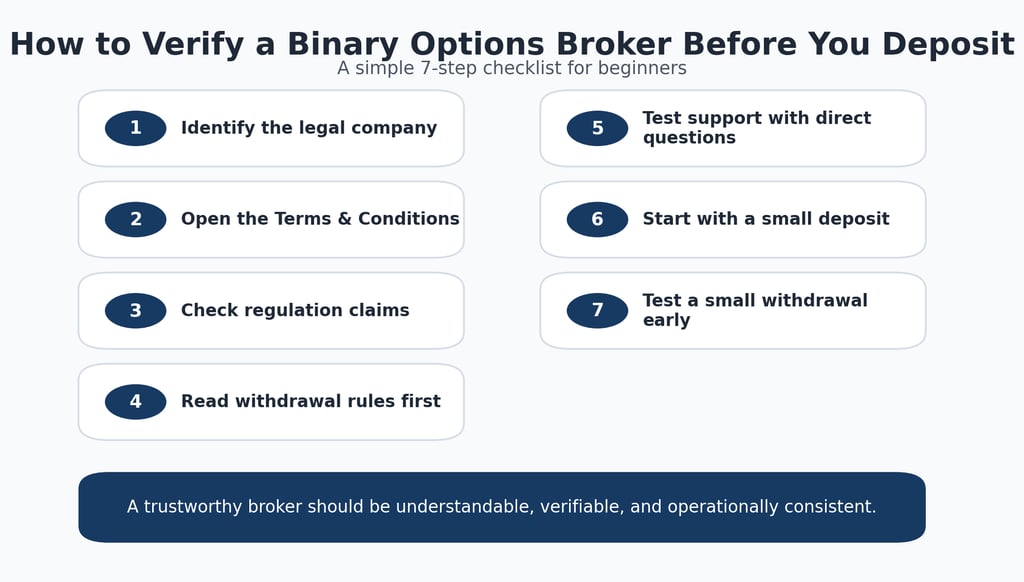
How to Verify a Broker in 10 Minutes Before You Deposit
You do not need a full legal investigation to reduce risk. A fast 10-minute check can already eliminate many bad options.
Step 1: Identify the company
Look for the legal entity, not just the brand name. Write it down.
Step 2: Find the Terms and Conditions
Open the legal pages and search for deposit rules, withdrawal rules, bonus terms, account suspension terms, and document requirements.
Step 3: Check whether regulation claims are verifiable
If the broker says it is regulated, find the exact regulator and license number. If that cannot be verified, treat the claim carefully.
Step 4: Read the withdrawal section before you fund
Do not wait until you want your money back. Read the rules first.
Step 5: Test support with direct questions
Ask who operates the platform, how withdrawals work, and what documents are required. Judge the clarity of the answers.
Step 6: Start with a small deposit
Even if the broker looks fine, test the operational flow with an amount you can afford to risk.
Step 7: Test a small withdrawal early
Do not wait until the account is large. A small early withdrawal tells you much more than a marketing page ever will.
What to Do If You Already Deposited With a Suspicious Broker
If you already funded an account and now have concerns, do not panic. Act carefully and document everything.
First, save screenshots of your balance, transaction history, open tickets, support chats, emails, and withdrawal requests. Second, stop sending additional money just because someone says it will unlock your withdrawal. Third, review the broker’s legal terms and record any conditions they are using to justify delays. Fourth, contact your payment provider if you believe you may be dealing with fraud and ask what dispute options exist.
The key point is simple: once a broker starts using confusion, pressure, or delay as a pattern, do not assume the next deposit will solve the problem.
Final Checklist Before Your First Deposit
Before you deposit with any binary options broker, ask yourself:
Do I know the legal company behind this platform?
Are the deposit and withdrawal rules easy to understand?
Can I verify any regulation claims?
Does support answer direct questions clearly?
Have I read the bonus terms?
Have I tested the platform with a small amount first?
Would I still trust this broker if I removed all marketing language from the website?
If the answer to several of those questions is no, you should not deposit yet.
Final Thoughts
The best way to avoid a binary options scam is to slow down before funding an account. Most scam signals appear early, but traders often ignore them because the platform looks polished, the payout seems attractive, or a sales representative sounds convincing.
A trustworthy broker should not force you to guess who runs it, how your money is handled, or what happens when you try to withdraw. If those answers are unclear, the safest decision is usually to step back.
In binary options, a good broker cannot guarantee profits. But a bad broker can guarantee unnecessary risk. That is why learning to detect red flags is one of the most valuable skills any trader can develop.