
IQ Option Review 2026
Updated: January 2026
IQ Option is a multi-market trading platform that combines digital options, CFDs, forex, stocks, and crypto within a single interface. The platform is widely recognized for its advanced charting-style layout, a $10 minimum deposit, and a fully accessible demo account, making it appealing to traders who value technical analysis.
What differentiates IQ Option from simpler binary platforms is its structured, indicator-heavy environment. This favors traders who already understand chart-based decision-making, but it can feel overwhelming for beginners. While IQ Option offers more analytical depth than classic Up/Down platforms, it still operates under offshore regulation, meaning traders must rely on platform execution and personal risk control rather than regulatory protection.
This review examines how IQ Option performs across different trading modes, and whether its technical interface translates into better decision-making in real trading conditions.
IQ Option is best understood as a platform-centric broker, not a pure binary options provider. While binary and digital options are part of its offering in some regions, the platform is designed first and foremost around chart-based analysis and multi-asset trading, rather than fast, one-click execution.
In practice, trading on IQ Option feels closer to using a technical trading workstation than a simplified BO interface. Trades are placed from within a full charting environment that supports multiple timeframes, indicators, and drawing tools. This structure naturally slows decision-making and encourages analysis-driven entries, rather than rapid, impulse-based trades.
Because of this, IQ Option tends to attract traders who value visual clarity, technical structure, and platform depth, even if that comes at the cost of simplicity. It is less suited to traders looking for ultra-fast binary scalping and more aligned with those who prefer to analyze first, execute second.
In short, IQ Option is not defined by speed or payouts, but by how much control and structure it gives traders before they commit to a trade.
Pros & Cons
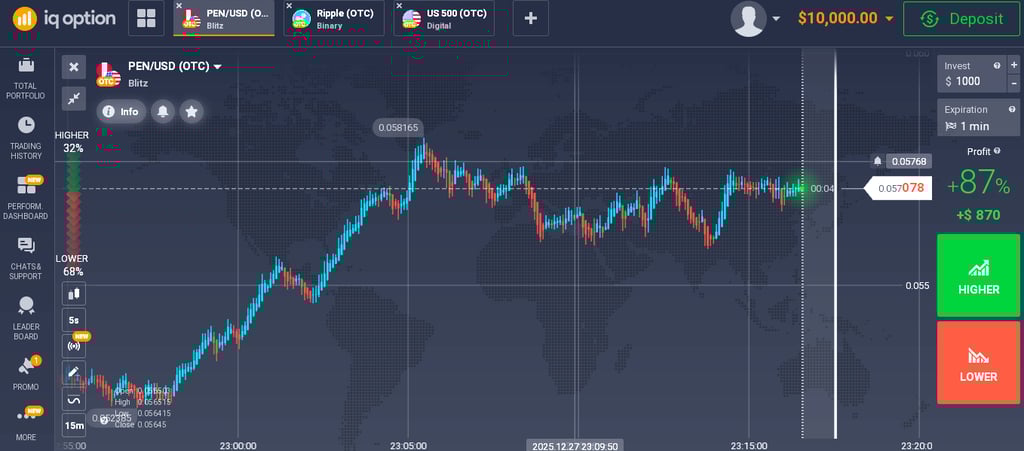
IQ Option Trading Platform Interface
How the Platform Actually Works
Trading on IQ Option happens inside a chart-first environment. Before committing capital, traders interact with price action through timeframes, indicators, and tools, rather than a one-click buy/sell panel.
For fixed-return trades, the mechanics are straightforward: the potential payout is displayed upfront, the stake is fully at risk, and settlement occurs at expiry. For example, a 90% payout on a $10 stake returns $19 on a win and $0 on a loss. This structure keeps risk clear but unforgiving.
The difference lies in pacing. Compared to faster platforms, the additional steps required to analyze charts introduce friction that often reduces impulsive trading, especially during extended sessions.
Expiry and Payout
On IQ Option, expiry selection and payout levels play a direct role in shaping trading expectancy, especially for fixed-return products such as binary or digital options. Expiry times typically start from around 60 seconds and extend to several minutes or longer, depending on the asset and product type. This naturally shifts trading away from ultra-short noise and toward more structured price movement.
Observed payout levels commonly range between 70% and 95%, varying by asset and market session. While these figures are competitive, their real importance lies in how they affect break-even math. For example, at a 90% payout, a trader needs to win roughly 52.6% of trades to break even. If payouts drop to 80%, the required win rate rises to about 55.6% a difference that becomes significant over larger sample sizes.
In testing, IQ Option’s longer expiries and chart-first workflow tend to reduce rapid-fire trading, which can help stabilize expectancy for disciplined traders. However, the fixed-return structure remains unforgiving: each loss costs a full unit, while each win returns a fraction more than one unit. No amount of charting depth changes that math.
The practical takeaway is simple. On IQ Option, profitability depends less on finding “high payouts” and more on matching expiry length to a strategy that can maintain a win rate above break-even over time. Traders who understand this relationship tend to approach the platform methodically; those who ignore it often misjudge risk despite the platform’s analytical tools.
Demo Account
IQ Option provides a fully functional demo account funded with a virtual balance of around $10,000, allowing traders to explore the platform without committing real capital. More importantly, the demo mirrors the live trading environment closely, including the same charting tools, indicators, timeframes, and execution flow.
In testing, switching between assets and applying indicators on the demo behaves identically to live trading. Payout levels displayed on fixed-return products typically fall within the 70%–95% range, depending on the asset and session, giving traders a realistic view of how payout variability affects break-even requirements before risking money.
What the demo does not replicate is emotional pressure, withdrawal processing, or identity verification. Because of this, its real value lies in platform familiarization and behavior testing, not profit simulation. A practical approach is to use the demo to refine setups and understand expiry behavior, then transition to a small live deposit and request an early withdrawal to verify operational flow.
In short, the IQ Option demo account is best used to answer one key question early: does this platform’s structure support your trading discipline in real conditions?
Deposits and Withdrawals
IQ Option keeps entry requirements relatively accessible, with minimum deposits typically starting around $10, depending on the payment method and region. This low threshold allows traders to move from demo to live trading without committing significant capital upfront an important factor for controlled testing.
In practice, deposit processing is usually instant for common methods such as cards and e-wallets. Withdrawals, however, are more procedural. Identity verification (KYC) is commonly required before funds are released, and withdrawal times vary by method—often within 24 hours for e-wallets, while card or bank transfers may take several business days.
During hands-on testing, the most common friction point is not withdrawal rejection but delays caused by incomplete verification. Traders who complete KYC early and request a small test withdrawal shortly after their first deposit tend to experience smoother processing later.
The practical takeaway is straightforward: IQ Option’s deposit and withdrawal flow is functional and structured, but it rewards preparation. Start small, verify early, and confirm withdrawals before scaling treating operational reliability as something to test, not assume.
Asset Classes
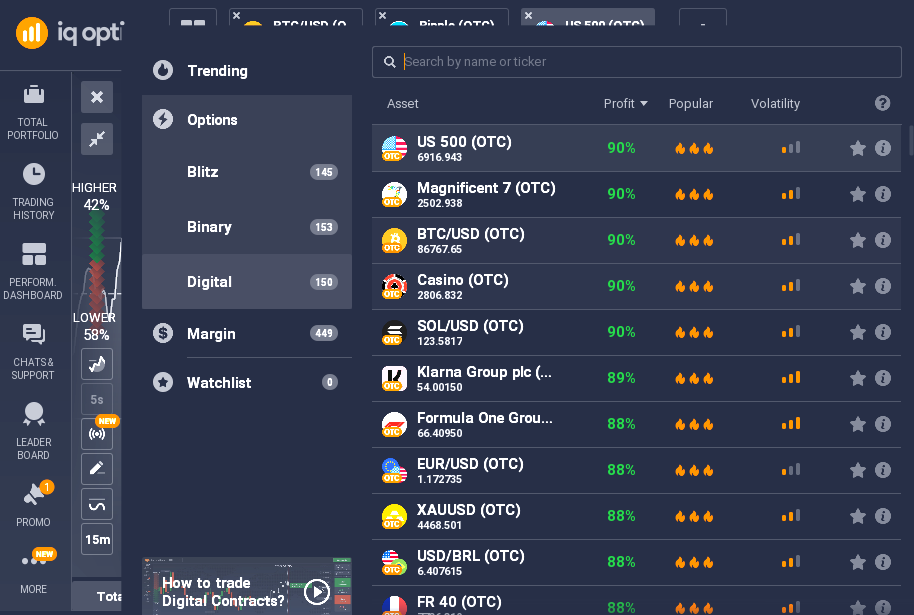
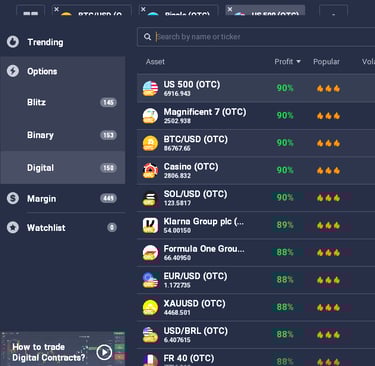
IQ Option positions itself as a multi-asset trading platform, offering access to several asset classes within a single, unified interface. Depending on region and account type, traders can typically access forex pairs, stocks, indices, commodities, and cryptocurrencies, alongside fixed-return products such as binary or digital options where available.
In practice, this breadth matters less for “variety” and more for behavioral flexibility. Forex and indices tend to provide more stable intraday structure, while crypto assets introduce higher volatility and wider intraday swings. During testing, price behavior across asset classes is clearly differentiated, making the platform suitable for traders who adjust strategy based on market characteristics rather than applying a single approach everywhere.
What stands out is how these assets are integrated into the same chart-first environment. Switching between a major forex pair and a volatile crypto asset does not change the workflow only the risk profile. This consistency helps traders compare setups across markets without relearning the interface.
The key takeaway is that IQ Option’s asset coverage supports analysis-driven diversification, not random asset hopping. Traders who understand how volatility and liquidity differ across asset classes can use the platform’s structure to adapt intelligently, while those who treat all assets the same may underestimate risk despite the platform’s analytical tools.
Bonuses on IQ Option
Bonuses on IQ Option are optional and conditional, and their practical value depends on how they affect withdrawal flexibility. When offered, bonuses typically increase account balance but come with turnover (volume) requirements that must be met before any bonus-related funds can be withdrawn.
In real terms, a common structure means that accepting a bonus ties withdrawals to a multiple of the bonus amount in trading volume. For example, a modest bonus can require several times its value in completed trades before funds become fully liquid. This can materially change risk behavior, especially for traders who plan to test the platform or withdraw early.
During testing, the most consistent approach has been to decline bonuses initially. Trading without a bonus keeps capital fully flexible, allows an early withdrawal test, and avoids hidden constraints on position sizing or trade frequency. Once operational reliability is confirmed, traders can reassess whether any promotional incentive aligns with their strategy and risk tolerance.
The takeaway is straightforward: bonuses do not improve expectancy on fixed-return products. They increase balance, but they also reduce control. For traders prioritizing transparency and capital mobility, starting without bonuses is usually the cleaner choice.
Asset Selection & Market Coverage
Regulation and Risk
IQ Option operates through multiple legal entities depending on the trader’s region, which means regulatory coverage is not uniform across all users. Some accounts fall under entities with recognized oversight, while others are registered offshore, where formal investor protection and compensation schemes are limited or absent.
From a risk perspective, this distinction matters more than branding. Regulation does not eliminate trading risk, but it does affect dispute resolution, fund segregation expectations, and legal recourse. Traders should always verify which entity they are registered with before depositing funds, rather than assuming a single regulatory standard applies globally.
Beyond regulation, there is also structural trading risk inherent to fixed-return products. Even with payouts commonly observed in the 70%–95% range, losses are binary and unforgiving: each losing trade costs a full unit, while wins return less than one unit in profit. This creates a narrow margin for error, regardless of platform quality.
The practical takeaway is clear. IQ Option should be approached as a high-risk trading environment that requires disciplined risk management and realistic expectations. Regulation can influence operational trust, but it does not protect traders from poor strategy, overtrading, or misunderstanding expectancy. Those risks remain entirely the trader’s responsibility.
Who Is IQ Option Best For?
Customer Support
IQ Option provides customer support primarily via live chat and email, focusing on account access, platform usage, and verification-related issues. In practical testing, response times for routine questions are generally reasonable, often within minutes during active hours, while more complex cases require follow-up.
Support is procedural rather than advisory. Representatives help with technical steps—such as KYC requirements, withdrawal status, or platform navigation—but do not provide trading guidance or strategy input. This is consistent with a platform-first broker where responsibility for decision-making remains with the trader.
The key takeaway is that IQ Option’s customer support is functional and reliable for operational matters, but traders should be prepared to manage trading risk independently. Completing verification early and keeping communication focused on specific issues tends to result in smoother resolution.
Is IQ Option Legit for Trading?
IQ Option is generally considered a legitimate trading platform, but legitimacy here should be understood in operational terms, not as a guarantee of safety or profitability. The platform executes trades according to predefined rules, displays payouts before entry, and settles outcomes mechanically at expiry key traits of a functioning, rules-based broker.
From an operational standpoint, IQ Option supports verifiable account processes such as identity verification (KYC) prior to withdrawals and structured payment workflows. Minimum deposits typically start around $10, and users can access a demo account with approximately $10,000 in virtual funds to test the platform before risking real capital. These features align with standard practices across established retail trading platforms.
However, legitimacy does not remove structural trading risk. Fixed-return products commonly show payouts in the 70%–95% range, which means traders still need a win rate above break-even (roughly 52%–56%, depending on payout) to avoid long-term losses. Losses occur exactly as defined when trades expire out-of-the-money, regardless of platform quality.
The more nuanced point is regulation. IQ Option operates through different legal entities depending on region, so regulatory protection and investor safeguards are not uniform. Traders should verify which entity they are registered under and understand the implications for dispute resolution and fund protection.
In practical terms, IQ Option is legitimate as a functioning trading platform but it is not risk-free. It rewards preparation, discipline, and realistic expectations, and it penalizes overtrading and misunderstanding of expectancy. Traders who recognize this distinction tend to evaluate the platform more accurately.
Compare IQ Option
Frequently Asked Questions (FAQ)
Ready to Test IQ Option?
The most effective way to evaluate IQ Option is not by reading promises, but by testing how the platform fits your trading behavior. Start with the demo account to explore the charting tools, indicators, and execution flow, then transition cautiously with a small live deposit (around $10) once you are comfortable with the interface.
Focus your early testing on three things: how expiry selection affects outcomes, whether the charting environment supports disciplined decision-making, and how smoothly withdrawals are processed after verification. Avoid bonuses at the beginning to keep capital flexible and results easier to interpret.
IQ Option is a tool built for analysis-first traders. If its structure helps you slow down, plan trades, and manage risk consistently, it may be a strong fit. If not, that conclusion is equally valuable before scaling or committing more capital.
Visit IQ Option and explore the platform with a demo account first.
⚠️ Risk Disclaimer
Trading digital or binary options involves significant risk and may not be suitable for all investors. Never trade with funds you cannot afford to lose.