
Exnova is a multi-asset trading platform offering fixed-time trades and CFD-style instruments, with a $10 minimum deposit and a readily available demo account. The platform emphasizes ease of access and a clean interface.
While Exnova lowers the barrier to entry, its simplified structure means traders must manage risk independently. This review evaluates how Exnova performs in practice and which trader profiles are most likely to benefit.
Exnova Review 2026
Updated: January 2026


What Kind of Broker is Exnova?
Exnova is an offshore, execution-focused trading platform built for short-term, fixed-outcome trades. Its structure emphasizes speed, simplicity, and low entry requirements, rather than regulated investing or portfolio-based trading.
From a classification standpoint, Exnova sits in the retail, high-variance segment of the market. Traders can start with relatively small deposits and trade sizes, which lowers the cost of testing but increases the importance of discipline, payout quality, and expectancy management.
The platform offers a streamlined interface with basic charting and manual trade execution, leaving strategy development and risk control entirely in the trader’s hands. There is little emphasis on research tools or investor safeguards.
In practical terms, Exnova is best viewed as a lightweight execution tool for self-directed traders who understand short-term trading mechanics and are evaluating usability and trade flow not as a regulated or protection-first brokerage.
Pros & Cons
How the Platform Actually Works?
Exnova follows a simple, execution-first workflow designed to reduce friction between market observation and trade entry. Traders select an asset, choose a direction (Up or Down), set an expiry time, define a stake amount, and place the trade all within a single, uncluttered interface.
Trades are structured as fixed-outcome contracts. Before entry, the platform displays the potential payout, which typically ranges from around 70% to 90%+, depending on the asset and market conditions. Once the trade is placed, it cannot be modified or closed early; the outcome is determined solely by the price at expiry.
Charting and indicators are intentionally basic, reinforcing Exnova’s focus on manual, short-term decision-making rather than strategy automation or multi-timeframe analysis. Execution is effectively instant, which suits fast trades but also increases sensitivity to timing and spread behavior.
In practical use, the platform is easy to learn but unforgiving. Performance depends almost entirely on entry precision, payout quality, and disciplined trade frequency, with little structural support from the platform itself.
Expiry Mechanics
Exnova uses a fixed-expiry trading model, where each position is resolved at a predefined time rather than managed through stop-loss or take-profit levels. Once a trade is placed, the expiry cannot be adjusted, and there are no early close options.
Expiry times generally range from short-term intervals (seconds to a few minutes) to longer intraday durations, depending on the selected asset and market session. Short expiries increase sensitivity to price noise, while longer expiries reduce micro-movements but retain a fixed-outcome structure.
Settlement is based on the price at the exact expiry timestamp compared to the entry level. Even a minimal price difference determines the result, making execution timing and price sourcing critical factors.
From an expectancy perspective, fixed expiries create asymmetric risk. Losses are typically 100% of the stake, while gains are capped by the payout percentage. As a result, long-term performance depends more on payout consistency and selective participation than on win rate alone.
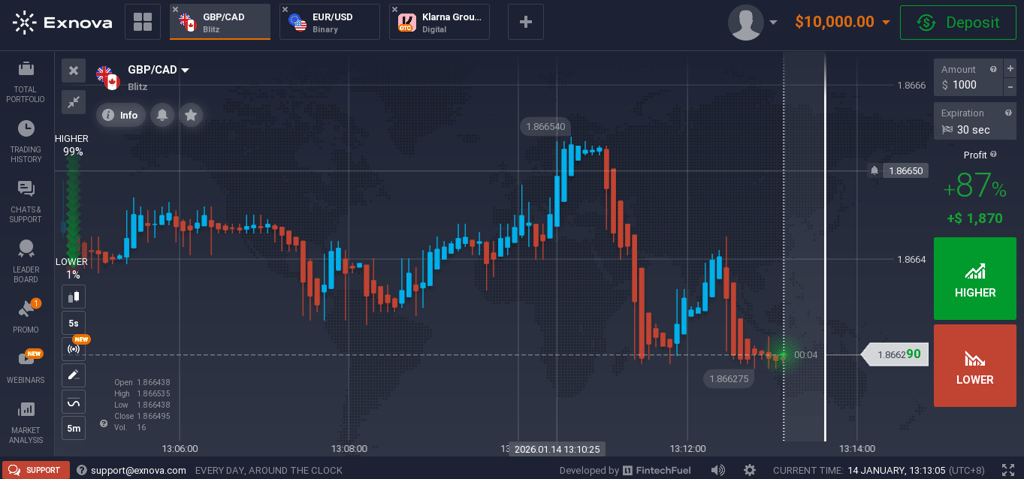
Exnova Trading Platform Interface
Demo Account
Exnova provides a free demo account that reflects the platform’s core mechanics, including fixed expiries, stake sizing, and payout display. Access is available without funding, making it easy to evaluate the interface and execution flow.
The demo is useful for testing expiry timing and order behavior, but it does not replicate live conditions. Payout availability, execution pressure, and withdrawal rules only apply once real money is involved, especially in short-term trades.
In practical terms, the demo serves as a mechanical learning tool, not a profitability test. Traders should use it to understand how contracts settle, then move to a small live deposit to assess real-world behavior.
Deposits and Withdrawals
Exnova supports basic funding and withdrawal methods aimed at fast onboarding rather than full banking flexibility. Minimum deposits typically start around $10, depending on the payment method and region, making it accessible for initial testing.
Deposits are usually processed instantly, allowing traders to begin trading without delay. Withdrawals require account verification (KYC) and are reviewed internally, with processing times commonly ranging from 1 to 3 business days before funds are released. Final delivery depends on the chosen payment channel.
In practice, withdrawal reliability is closely linked to account compliance. Incomplete verification or active bonus conditions are the most common reasons for delays, rather than technical issues.
From a risk perspective, Exnova’s funding system is functional but not designed for frequent cash movement. Traders are better served by starting small, verifying early, and treating withdrawals as a planned process rather than an on-demand feature.
Assets and Payout
Exnova offers a streamlined selection of tradable assets focused on liquidity and short-term price movement rather than breadth. The lineup typically includes major forex pairs, cryptocurrencies, commodities, and global indices, aligned with the platform’s fixed-outcome trading model.
Payout levels are dynamic and asset-dependent, commonly ranging from around 70% to 90%, with higher figures appearing only during favorable market conditions. Payouts are shown before trade entry and can change throughout the trading session, directly affecting trade expectancy.
In practical terms, payout quality matters more than asset count. Even a 5–10% change in payout can materially shift long-term results in fixed-return trading. As a result, traders using Exnova need to be selective, focusing on assets that offer acceptable risk–reward at a given time rather than trading broadly.
Overall, the asset offering is sufficient for tactical use, but long-term outcomes depend on payout consistency and disciplined participation, not the number of instruments available.
Bonuses on Exnova
Exnova may offer deposit bonuses from time to time, typically calculated as a percentage of the funded amount. These bonuses increase the displayed trading balance but are not withdrawable by default.
In practice, bonus funds are tied to turnover (volume) requirements, meaning traders must execute a predefined amount of trading volume before any related profits can be withdrawn. The required volume is often multiple times the bonus amount, which can materially affect trading behavior.
From a risk perspective, bonuses introduce withdrawal friction and can push traders toward higher frequency or larger position sizes than planned. For this reason, many experienced traders treat bonuses as optional and prioritize clean withdrawal conditions over short-term balance increases.
Used cautiously, bonuses can be a testing tool. Used without understanding the terms, they often become a constraint rather than an advantage.
Regulation and Risk
Exnova operates as an offshore trading platform and is not regulated by Tier-1 authorities such as the FCA, ASIC, or CySEC. This structure allows flexibility in product design and payouts, but it also means limited formal investor protection.
From a regulatory standpoint, traders should not expect safeguards such as statutory fund segregation, compensation schemes, or independent dispute resolution. Account security, withdrawals, and compliance checks are governed primarily by the platform’s internal policies rather than enforceable regulatory oversight.
Risk is further amplified by the fixed-outcome nature of short-term trades. Losses are typically capped at 100% of the stake, while gains are limited by payout percentages that often sit below 100%. This creates negative expectancy unless payout levels and trade selection are managed carefully.
In practical terms, using Exnova requires a self-managed risk approach. Traders should limit capital exposure, avoid bonus-linked constraints, and treat the platform as a speculative trading tool rather than a protected investment environment.
Who Is Exnova Best For?
Customer Support
Exnova provides basic customer support focused on account access and transaction-related issues rather than trading guidance. Support is typically available via live chat and email, with live chat being the primary channel for routine requests.
Response times are generally acceptable for simple matters such as login issues, verification steps, or deposit confirmations. More complex cases especially those involving withdrawals or bonus conditions may require additional review and longer resolution times.
In practical terms, Exnova’s support functions as an operational help desk, not an advisory service. It is sufficient for account management, but traders should document requests clearly and allow extra time when issues involve fund movements or compliance checks.
Is Exnova Legit for Trading?
Exnova is operationally legitimate, but not regulator-backed. The platform allows users to open accounts, place trades, and request withdrawals, yet it operates offshore without oversight from Tier-1 financial authorities.
There is no clear evidence that Exnova is a non-functioning or deceptive platform. However, investor protections are limited, and key processes such as withdrawals, bonus enforcement, and account reviews are governed by internal policies rather than external regulation.
The primary risk is structural rather than fraudulent. Fixed-outcome trading carries inherent risk, and offshore operation increases reliance on the trader’s own discipline and risk controls.
In short, Exnova works as a speculative trading venue, not a protected investment service. It may suit experienced, self-directed traders who accept regulatory trade-offs, but it is not appropriate for those seeking strong capital protection or formal regulatory safeguards.
Compare Exnova
Frequently Asked Questions
Ready to Test Exnova?
Exnova can be evaluated with minimal upfront risk, thanks to its demo account and low initial deposit requirements. For traders assessing execution speed, expiry behavior, and payout consistency, starting small is the most practical approach.
A sensible workflow is to use the demo first, then move to a small live deposit (around $10) to observe real-money conditions such as pricing at expiry and withdrawal handling. Bonuses are best avoided initially, and a test withdrawal should be requested early to confirm processing expectations.
Exnova should be approached as a speculative trading tool, not a protected investment service. If you understand the mechanics, accept the risks, and want to assess usability under live conditions, cautious testing can help determine whether the platform fits your trading style.
Visit Exnova to explore the platform under real trading conditions.
⚠️ Risk Disclaimer
Trading digital or binary options involves significant risk and may not be suitable for all investors. Never trade with funds you cannot afford to lose.