
Olymp Trade is a beginner-oriented fixed-time trading platform known for its low entry requirements and built-in educational guidance. Traders can start with a minimum deposit of $10, place trades from $1, and access a free demo account immediately, making Olymp Trade one of the more accessible platforms for new users.
What sets Olymp Trade apart is not just ease of use, but how its guided, beginner-first design influences trading behavior. By reducing technical complexity and emphasizing learning flow, the platform lowers friction which helps onboarding, but does not eliminate fixed-return risk. Understanding this balance is key to deciding whether Olymp Trade is the right fit for your trading style.
Olymp Trade Review 2026
Updated: January 2026
Pros & Cons
What kind of broker is Olymp Trade?
Olymp Trade operates as a fixed-time trading (FTT) and CFD-style platform, designed primarily for new and developing traders. The platform intentionally reduces complexity while adding educational scaffolding something many binary platforms ignore.
Key entry conditions illustrate this clearly:
Minimum deposit: $10
Minimum trade size: $1
Demo account: Available by default
These numbers matter. A $10 deposit lowers the financial barrier, while $1 trades make experimentation feel “safe.” However, Olymp Trade actively tries to slow users down through tutorials, account levels, and learning prompts, rather than encouraging rapid-fire execution. This is a meaningful distinction.


How the Platform Actually Works?
Olymp Trade operates around a fixed-time trading model designed to be simple and accessible. Traders choose an asset, set a trade amount, select an expiry time, and predict whether the price will be higher or lower at expiry. The outcome is binary: the trade either returns a predefined profit or the full stake is lost.
In practice, expiry times typically start from 1 minute and extend to several hours, depending on the asset and account mode. Payouts are shown before entry and commonly fall within the 70%–90% range, varying by asset, market conditions, and trading session. For example, a $10 trade at an 80% payout returns $18 on a win and $0 on a loss making risk clear but unforgiving.
The platform workflow emphasizes guided execution rather than speed. Trades are placed through a clean interface with limited configuration, which reduces complexity for new users but also limits advanced customization. Charting tools are present but intentionally simplified, encouraging directional decisions over multi-layer technical analysis.
Olymp Trade also integrates a demo account that mirrors live conditions, allowing users to test expiry behavior, payout variability, and execution flow without risking capital. However, as with any platform, the demo does not replicate emotional pressure or withdrawal processing.
The key takeaway is that Olymp Trade prioritizes clarity and ease of use over analytical depth or ultra-fast execution. It is built to help traders understand fixed-time mechanics quickly, while placing responsibility for risk management and expectancy firmly on the trader.
Expiry Mechanics
Expiry on Olymp Trade follows a fixed-time structure, meaning each trade settles at a predefined time rather than when a price target is hit. Traders select an expiry before entry, and the trade outcome is determined solely by whether the price is higher or lower than the entry level at that exact moment.
In practice, expiry times typically start from 1 minute and extend to several hours, depending on the asset and account mode. This places Olymp Trade firmly in the short-term trading category, but without the ultra-short, seconds-based expiries seen on speed-focused platforms. The absence of sub-minute expiries reduces execution noise but still requires precise timing.
Expiry length directly affects payout and expectancy. Shorter expiries increase sensitivity to random price fluctuations, while longer expiries allow trades more time to absorb intraday volatility. During testing, trades with expiries in the 5–15 minute range tend to reflect broader price direction more reliably than 1-minute trades, though payouts may vary by session.
A key characteristic of Olymp Trade’s expiry mechanics is predictability. Because expiry times are fixed and clearly displayed, traders always know when and how a trade will settle. There are no adjustable barriers or probability tweaks simplicity is the design choice. This makes the platform easier to understand, but it also limits flexibility for probability-based optimization.
The practical takeaway is that Olymp Trade treats expiry as a timing decision, not a strategic variable. Traders who align expiry length with realistic price movement and manage position size carefully tend to navigate this structure more effectively than those who rely on rapid, repeated entries.
Demo Account
Olymp Trade provides a fully functional demo account with a virtual balance typically set around $10,000, allowing users to experience the platform without committing real capital. The demo mirrors live trading closely in terms of expiry selection, payout display, and execution flow, making it suitable for understanding how fixed-time trades actually settle.
In practical testing, payouts shown on the demo usually fall within the 70%–90% range, depending on the asset and trading session. This gives traders a realistic view of break-even requirements before going live. For example, an 80% payout requires a win rate above 55.5% to remain profitable over time math that becomes clear quickly when trading the demo.
What the demo does well is platform familiarization. Users can test how different expiry lengths behave, how price moves near settlement, and how the interface supports (or limits) analysis. What it does not replicate is emotional pressure, withdrawal processing, or account verification factors that only appear in live trading.
The practical takeaway is that the Olymp Trade demo is best used as a mechanics and behavior test, not a profit simulator. Traders who use it to understand timing, payout math, and platform flow and then transition with a small live deposit tend to evaluate the platform more accurately than those who treat demo results as predictive.
Deposits and Withdrawals
Olymp Trade maintains a relatively low entry barrier, with minimum deposits typically starting from $10, depending on the payment method and region. This allows new users to move from demo to live trading without committing significant capital upfront. Deposits via common methods such as cards and e-wallets are usually processed instantly, enabling immediate access to live trades.
Withdrawals follow a more structured process. In practice, identity verification (KYC) is commonly required before the first withdrawal is approved. Once verified, withdrawal processing times vary by method often within 24 hours for e-wallets, while card or bank transfers may take several business days depending on the provider.
During testing and user feedback analysis, the most common source of friction is not failed withdrawals, but delays caused by incomplete verification or bonus-related conditions. Traders who complete KYC early and avoid bonuses during initial testing generally experience smoother withdrawal processing.
The practical takeaway is straightforward: Olymp Trade’s deposit system is fast and accessible, while withdrawals reward preparation. Starting with a small deposit, verifying early, and requesting a test withdrawal before scaling remains the most reliable way to assess operational reliability.
Assets and Payout
Olymp Trade offers a focused asset lineup built around fixed-time trading. Traders typically have access to forex pairs, indices, commodities, and cryptocurrencies, depending on region and account mode. The emphasis is on liquid, well-followed instruments, rather than an extremely broad catalog.
Payouts are displayed before trade entry and commonly fall within the 70%–90% range, varying by asset, market conditions, and trading session. For example, an 80% payout on a $10 trade returns $18 on a win and $0 on a loss. This makes the risk transparent but mathematically demanding: at 80% payout, a trader needs a win rate above 55.5% to break even over time.
In practical testing, payout levels tend to be more stable than on ultra-short-expiry platforms, but they still fluctuate across assets and sessions. This variability directly affects expectancy, meaning traders must adapt position sizing and trade frequency rather than assume a fixed edge.
The key takeaway is that Olymp Trade’s assets and payouts are designed for clarity and simplicity, not maximum returns. Traders who evaluate payout in relation to win probability and choose assets with consistent behavior tend to manage risk more effectively than those who focus solely on headline percentages.
Bonuses on Olymp Trade
Olymp Trade frequently offers deposit bonuses, usually calculated as a percentage of the initial deposit. While these bonuses increase account balance, they come with turnover requirements that must be met before withdrawals are allowed.
In practice, accepting a bonus ties your funds to a required trading volume multiple, which can significantly increase exposure and trading frequency. This does not improve expectancy on fixed-time trades and often limits withdrawal flexibility during early testing.
For this reason, many experienced traders choose to decline bonuses initially. Trading without a bonus keeps capital fully withdrawable, allows early withdrawal testing, and makes performance evaluation clearer.
The key takeaway is simple: bonuses on Olymp Trade are a promotional tool, not a trading advantage. For transparency and control, starting without a bonus is usually the cleaner approach.
Regulation and Risk
Olymp Trade operates under different legal entities depending on region, which means regulatory coverage and investor protection are not uniform for all users. Some accounts fall under formal oversight, while others are registered offshore with limited external safeguards. Traders should verify their account entity before depositing funds.
Beyond regulation, the primary risk is structural. Fixed-time trades settle at expiry with an all-or-nothing outcome: losses cost the full stake, while wins return a predefined payout (commonly 70%–90%). This creates a narrow margin for error and places heavy emphasis on discipline and win-rate management.
The takeaway is straightforward: regulation can support operational trust, but it does not reduce trading risk. On Olymp Trade, outcomes depend on expectancy, position sizing, and behavior not regulatory labels. Traders who approach the platform with realistic expectations and controlled risk tend to assess it more accurately.
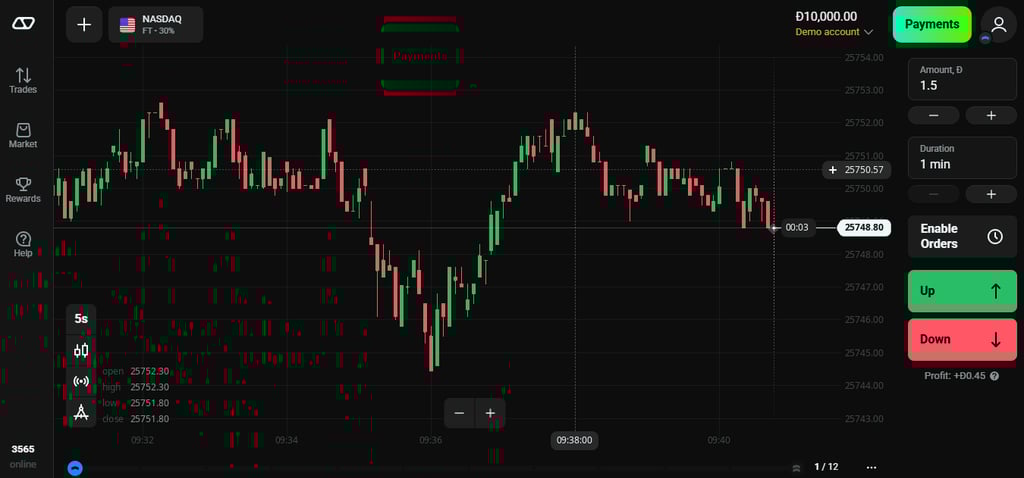
Olymp Trade Trading Platform Interface
Who Is Olymp Trade Best For?
Customer Support
Olymp Trade provides customer support mainly through live chat and email, focusing on account setup, platform usage, verification, and payment-related questions. In practical use, live chat is generally responsive for basic issues, while more complex requests may require email follow-up.
Support on Olymp Trade is operational rather than advisory. Agents assist with technical processes such as KYC status, deposit or withdrawal inquiries, and platform navigation but do not offer trading advice or strategy guidance. This aligns with the platform’s beginner-oriented, rule-based design.
One practical advantage is clarity. Because Olymp Trade uses fixed-time trades with simple rules, support interactions tend to be straightforward, especially for new users. Traders who complete verification early and provide clear information usually experience smoother resolution.
The takeaway is that Olymp Trade’s customer support works well as a help desk, not a safety net. It supports platform access and compliance, but effective trading outcomes still depend on the trader’s discipline and risk control.
Is Olymp Trade Legit for Trading?
Olymp Trade is a legitimate trading platform in the sense that it operates transparently, executes trades according to stated rules, and processes withdrawals when conditions are met. Trades settle mechanically at expiry, and payouts are shown before entry, allowing users to understand risk in advance.
However, legitimacy does not eliminate risk. Olymp Trade operates under different legal entities depending on region, with varying levels of regulatory protection. This means users should not expect institutional safeguards comparable to top-tier regulated investment brokers.
From a practical perspective, the main risk on Olymp Trade is structural, not operational. Fixed-time trades have an all-or-nothing outcome, payouts typically range from 70%–90%, and losses equal the full stake. Long-term results depend on win rate, discipline, and position sizing, not platform promises.
The takeaway is clear: Olymp Trade is legit as a trading platform, but it is not a low-risk environment. Traders who approach it as a short-term, speculative tool and manage risk accordingly are evaluating it realistically.
Compare Olymp Trade
Frequently Asked Questions (FAQ)
Ready to Test Olymp Trade?
Reviews provide context, but the most reliable evaluation comes from hands-on testing. Olymp Trade offers a demo account and low minimum trade sizes, making it possible to assess execution, payout behavior, and withdrawals before committing significant capital. If you decide to proceed:
Start with the demo account
Deposit a small amount
Trade minimal sizes
Avoid bonuses initially
Test a withdrawal early
Visit Olymp Trade to explore the platform under real trading conditions and decide whether its beginner-first approach fits your trading style.
⚠️ Risk Disclaimer
Trading digital or binary options involves significant risk and may not be suitable for all investors. Never trade with funds you cannot afford to lose.