
CloseOption is a binary-options–focused trading platform designed around low entry barriers and fast execution, offering fixed-time trades on a proprietary web interface. The platform supports a $5 minimum deposit, $1 minimum trade size, and a free demo account that can be opened quickly for practice. CloseOption emphasizes flexibility in trade duration, allowing expiry times from as short as 30 seconds up to longer multi-day or monthly expiries, depending on asset and market conditions, making it accessible for both short-term and experimental strategies.
While CloseOption’s low deposit and simple setup make it attractive to beginners, its high-payout, fast-outcome binary structure places full responsibility for risk management on the trader. This review assesses how CloseOption performs in real use—focusing on platform simplicity, expiry range, and demo-to-live behavior—and identifies the trader profiles most likely to benefit, typically new or demo-first users, small-stake binary traders, and cautious testers who start small, control position sizing, and confirm withdrawals early.
CloseOption Review 2026
Updated: January 2026


What Kind of Broker is CloseOption?
CloseOption is an offshore, binary-options–focused broker built around fixed-time trades on a proprietary web platform. It emphasizes low entry requirements (minimum deposit from $5) and fast execution, with expiry durations ranging from 30 seconds to longer-term expiries (up to weeks or months, asset-dependent), rather than regulated, long-term investing.
From a classification perspective, CloseOption sits firmly in the retail, high-risk trading segment. Its low minimum deposit and $1 trade size reduce the cost of testing, but the binary payout structure and rapid outcomes place full responsibility for risk management, payout variability, and discipline on the trader.
With a simple web-based platform, basic charting, and manual execution (no advanced analytics or automation), CloseOption functions primarily as a lightweight execution and practice environment. It is best suited for beginners and small-stake binary traders who understand fixed-time mechanics and want to evaluate platform behavior—not for investors seeking regulation, advanced tools, or built-in protection.
Pros & Cons
How the Platform Actually Works?
CloseOption operates on a fixed-time binary options model built for manual, short-term execution inside its proprietary web-based TradeRoom. Traders pick an asset, choose a direction (Call/Put), select an expiry, set a stake, and place the trade through a simple, streamlined interface.
Each position is a fixed-outcome contract. Before entry, CloseOption shows the payout percentage, which is not fixed and can change by asset, volatility, and trading conditions—with the broker and major reviews commonly highlighting payouts up to ~95% on some markets/sessions.
Once a trade is opened, it is generally held to expiry (classic binaries). CloseOption does document an “Early Quit” function, but it’s described as a contest-trader feature (risk control for contest balance), so most real-money binary trades should be treated as commitment until expiry.
In practice, the platform is easy to learn but unforgiving: outcomes depend heavily on entry timing, payout stability, and disciplined trade frequency, with limited structural risk tools compared to full-feature trading platforms.
Expiry Mechanics
CloseOption uses a fixed-expiry settlement system, meaning trades settle at a preset time rather than via stop-loss/take-profit management. Official tutorials and multiple independent reviews consistently cite an expiry range from 30 seconds up to 30 days (≈ 1 month), across ~15 preset intervals (asset-dependent).
Once selected, the expiry is treated as locked, and settlement is based strictly on whether the price at expiry is above or below the entry level—often by even a minimal difference.
From an expectancy standpoint, this creates asymmetric risk: losses are typically the full stake, while gains are capped by the displayed payout rate—so long-term results depend more on selective participation, payout quality, and strict position sizing than win rate alone.
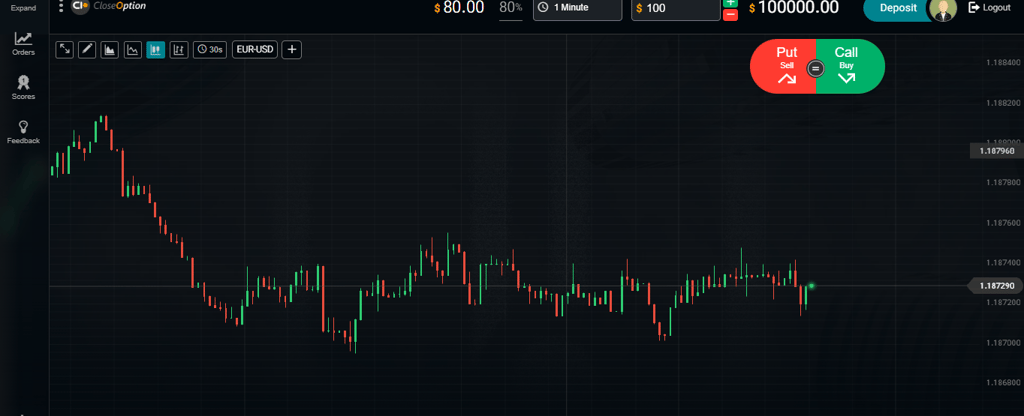
CloseOption Trading Platform Interface
Demo Account
CloseOption provides a free demo account that mirrors the platform’s core binary workflow (asset selection, expiry selection, stake sizing, and fixed-outcome settlement) and can be accessed under the same login used for Real/Contest accounts. This makes it useful for learning how CloseOption’s 30-second to 1-month contracts behave and for practicing basic Call/Put execution without funding first.
The demo is strong for understanding mechanics, but it won’t fully replicate live conditions (live payout fluctuations, real execution pressure, and withdrawal/verification rules only apply when you use real funds).
In practice, treat the demo as a mechanics training tool, then move to a small live deposit to validate real payout behavior and the withdrawal workflow early.
Deposits and Withdrawals
CloseOption is built around quick onboarding and low funding requirements. Most sources consistently cite a $5 minimum deposit for real accounts (with bank cards often starting higher, commonly listed at $20), while the typical minimum trade size is $1.
Deposits are generally described as instant (method-dependent), while withdrawals are processed internally and are commonly reported as taking up to ~72 hours depending on the payment method and verification status.
In practice, withdrawal reliability is most tied to account verification/compliance and any bonus conditions—so verify early, keep records clean, and avoid stacking constraints if you plan to withdraw soon.
Assets and Payout
CloseOption’s binary offering focuses on a relatively tight list of popular markets—primarily forex pairs and cryptocurrencies, with some coverage also commonly cited for gold. Several major review sources summarize this as a curated list rather than a huge multi-asset catalogue (often referenced around ~20+ instruments, depending on the review snapshot).
Payout is dynamic and asset/session-dependent, shown before entry and changing across trading conditions. Across official messaging and major reviews, CloseOption is frequently described as offering payouts up to ~95% in certain sessions/markets.
In practical terms, payout quality matters more than raw asset count: even small payout drops can significantly change long-run expectancy in fixed-outcome binaries, so selective participation is key.
Bonuses on CloseOption
CloseOption regularly advertises promotions (including deposit bonuses and contest-related incentives) through its promotions page, and major reviewers commonly reference a deposit bonus offer that can be enabled during funding.
In practice, bonuses can introduce withdrawal friction (eligibility rules and volume requirements are commonly cited, such as needing to meet a trading turnover threshold before bonus-related amounts become withdrawable). Many experienced traders prioritize clean withdrawals over bonus balance expansion.
Used carefully, a bonus can help testing; used blindly, it often becomes a constraint rather than an advantage.
Regulation and Risk
CloseOption operates as an offshore binary options broker and should not be treated as a Tier-1 regulated venue. Multiple independent broker databases and review outlets describe CloseOption as having no top-tier regulatory oversight, meaning investor protections are limited compared with FCA/ASIC/CySEC-style frameworks.
Risk is amplified by the fixed-outcome structure: losses are typically the full stake, while gains are capped by payout percentage—so expectancy depends on payout consistency, disciplined trade selection, and strict position sizing.
Who Is CloseOption Best For?
Customer Support
CloseOption provides customer support primarily for account access, verification/KYC, deposits, withdrawals, and platform issues, rather than trading guidance. Official pages and major reviews consistently list 24/7 coverage via live chat, email, and telephone (live chat is available from the website/TradeRoom).
Response times are generally fine for routine requests (login issues, basic verification steps, deposit confirmations). More complex cases—especially withdrawals, payment-method routing rules, fees, or bonus conditions—can take longer because they require internal review and compliance checks.
In practical terms, CloseOption’s support works best as an operational help desk. For anything involving funds, document everything (tickets/chat screenshots) and expect extra time if KYC or promo rules are involved.
Is CloseOption Legit for Trading?
CloseOption is operationally legitimate in the sense that users can open accounts, place binary trades, and request withdrawals—but it is not backed by Tier-1 regulation. CloseOption states its trading activities are permitted under a National Bank of Georgia license (license B 2-08/3647, cited on its FAQ), while major reviewers caution that this framework does not provide the same protections as FCA/ASIC/CySEC-style oversight.
There is no definitive public proof that CloseOption is “non-functioning,” but the key risk is structural: offshore-style operation + fixed-outcome binaries mean your experience depends heavily on internal payout policies, withdrawal handling, and dispute processes. U.S.-related risk flags also exist (e.g., the CFTC RED List entry), which reinforces the need for jurisdiction awareness and cautious sizing.
In short, CloseOption can function as a speculative fixed-time trading venue, not a protection-first brokerage. It may fit self-directed traders who accept the regulatory trade-offs—but it’s not ideal if you require strong investor safeguards and top-tier oversight.
Compare CloseOption
Frequently Asked Questions
Ready to Test CloseOption?
CloseOption can be evaluated with minimal upfront risk thanks to its free demo access and a low minimum deposit (from $5). For traders assessing binary execution flow, 30s–1 month expiry behavior, and payout variability, starting small is the most practical approach.
A sensible workflow is to use the demo first, then move to a small live deposit (around $5–$20, depending on payment method) to observe real-money conditions such as settlement at expiry, payout changes by asset/session, and withdrawal handling. Bonuses are best avoided at the beginning—CloseOption’s active promo commonly advertises a 44% deposit bonus with a 20× volume condition before bonus credit becomes withdrawable—so a test withdrawal + verification should be done early.
Visit CloseOption to explore the platform under real trading conditions.
⚠️ Risk Disclaimer
Trading digital or binary options involves significant risk and may not be suitable for all investors. Never trade with funds you cannot afford to lose.