
Deriv is a contract-based trading platform offering binary options, multipliers, and CFDs, built for traders who want clear risk definitions before entering a trade. With a minimum deposit from around $5, trades starting below $1, and access to 24/7 synthetic indices, Deriv appeals to active traders seeking flexibility beyond classic binary setups.
Unlike simple Up/Down platforms, Deriv displays maximum loss and potential profit upfront for every contract. This structure shifts decision-making toward probability and risk control rather than speed alone. However, that added flexibility also increases the learning curve.
This review plores whether Deriv’s contract-first design offers a real advantage in live trading, or simply more complexity.
Deriv Review 2026
Updated: January 2026


Deriv is best described as a contract-driven, multi-product broker rather than a classic binary options platform. Its core identity is built around clearly defined contracts each with stated risk, payout, and settlement logic spanning options, CFDs, multipliers, and proprietary synthetic indices.
In practice, Deriv places structure before speed. For fixed-return options, traders see the maximum loss and potential profit before entry, and trades are settled mechanically at expiry. Minimum deposits typically start from $5, and certain products allow sub-$1 trade sizes (often around $0.35), lowering the barrier for controlled testing. Expiry ranges are wide from seconds to months (and up to 365 days on some contracts) which supports both short-term tactics and longer, probability-based approaches.
A defining feature is Deriv’s synthetic indices, available 24/7 with algorithmically controlled volatility. These markets remove news and session effects, making them attractive for systematic testing and rule-based strategies. However, because they are proprietary, performance depends entirely on understanding the contract rules and volatility profiles not on external market drivers.
In short, Deriv is not a speed-first BO broker. It is a logic-first trading platform designed for traders who want explicit risk parameters, flexible contract design, and the ability to test expectancy across different instruments. Whether that’s an advantage depends on a trader’s preference for structure and probability over simplicity and impulse.
Pros & Cons
How the Platform Actually Works
On Deriv, the trade is the contract. With live accounts, minimum stakes typically start around $0.35, and minimum deposits are usually $5–$10 depending on payment method. Before you place a trade, Deriv shows numerically the maximum loss and maximum profit. Once confirmed, settlement is mechanical: the outcome follows the stated rule, with no discretionary adjustment after entry.
This matters because Deriv removes ambiguity. There’s no “soft expiry” or hidden buffer. If the contract is mispriced for your idea, the result exposes that mistake clearly.
Expiry Mechanics
Expiry on Deriv is contract-dependent, not standardized around a single short-term window like most binary options platforms. Depending on the product and market, expiry durations can range from as short as 15 seconds to several months, and in some cases extend up to 365 days.
In practical testing, this wide expiry range fundamentally changes trading behavior. Short expiries are available for tactical, momentum-based setups, but they are not the platform’s primary focus. Instead, Deriv encourages traders to think in terms of probability and contract logic, where expiry is selected to match the expected price behavior rather than to chase rapid outcomes.
For fixed-return options, expiry length directly affects both payout and win probability. Shorter expiries typically offer higher sensitivity to noise, while longer expiries reduce random fluctuation but require more patience and capital discipline. Because Deriv displays maximum loss and potential profit before entry, traders can immediately see how changing expiry alters expectancy.
Expiry selection becomes even more relevant on synthetic indices, which operate 24/7 with algorithmically controlled volatility. Here, expiry choice is often driven by strategy rules rather than market sessions or news, making longer and more consistent testing possible.
The key takeaway is that Deriv treats expiry as a strategic variable, not a default setting. Traders who align expiry duration with contract structure and probability tend to use the platform effectively; those who apply short-term BO habits without adjustment often misunderstand the risk profile.
Demo Account
Deriv offers a fully functional demo account that closely mirrors live trading conditions across its products, including options, CFDs, multipliers, and synthetic indices. New users typically receive a virtual balance around $10,000, which is sufficient to test position sizing, contract selection, and platform flow without financial risk.
In testing, the demo replicates pricing logic, contract rules, and settlement mechanics accurately. This is especially valuable on Deriv because every contract displays maximum loss and potential profit upfront, allowing traders to observe how expectancy changes across different payouts, barriers, and expiries before going live. For products with small minimum stakes often below $1 on certain contracts (≈$0.35) the demo helps validate whether fine-grained risk control feels practical.
Where the demo is particularly useful is with synthetic indices, which operate 24/7 with algorithmically controlled volatility. Traders can run repeated tests without session constraints, making the demo effective for systematic and rule-based strategy validation.
As with any platform, the demo does not replicate psychological pressure, withdrawal processing, or KYC requirements. Its real purpose is to confirm platform fit and contract understanding. A practical workflow is to demo-test contract logic, then move to a small live deposit and verify withdrawals early before scaling.
Deposits and Withdrawals
Deriv keeps entry requirements relatively low, with minimum deposits typically starting from $5, depending on the payment method and account currency. This allows traders to transition from demo to live trading with limited initial exposure. Deposits via common methods including cards, e-wallets, and cryptocurrencies are generally processed instantly, enabling quick access to live markets.
Withdrawals on Deriv are procedural and method-dependent. In practice, e-wallet and crypto withdrawals are often completed within 24 hours, while card or bank transfers may take several business days. Identity verification (KYC) is commonly required before the first withdrawal, and completing it early helps avoid unnecessary delays.
A notable operational difference on Deriv is that withdrawals are not typically constrained by bonus turnover, as promotional bonuses are limited or absent compared to many BO-focused platforms. This simplifies early testing: traders can deposit a small amount, place a limited number of trades, and request a test withdrawal without navigating complex rollover conditions.
The practical takeaway is straightforward. Deriv’s deposit flow is fast and accessible, while withdrawals reward preparation and verification. For traders who prioritize capital mobility and transparency, the platform’s relatively clean withdrawal structure is a meaningful advantage.
Assets and Payout
Deriv offers one of the broadest asset and product mixes among platforms commonly associated with binary options. Traders can access forex pairs, global indices, stocks, cryptocurrencies, and Deriv’s proprietary synthetic indices, alongside multiple contract types such as options, CFDs, and multipliers.
In practice, payout on Deriv is contract-driven rather than headline-driven. Instead of advertising a single “maximum payout,” the platform displays potential profit and maximum loss before entry for each trade. On fixed-return options, this can result in payouts that approach 100% on certain contracts, but more commonly vary depending on expiry, barrier distance, and market conditions.
During testing, this structure shifts focus away from chasing high payout percentages and toward expectancy management. A tighter barrier may offer higher potential return but reduces win probability, while wider barriers lower payout but improve hit rate. This explicit trade-off is visible before execution, allowing traders to evaluate risk-reward objectively rather than reacting to promotional figures.
Synthetic indices add another layer to asset selection. Operating 24/7 with algorithmically controlled volatility, they remove news and session effects, making payouts more consistent in structure but entirely dependent on understanding the contract logic rather than external market drivers.
The key takeaway is that on Deriv, assets and payouts are tools for probability-based decision-making, not marketing incentives. Traders who evaluate payout in relation to win probability and contract rules tend to use the platform effectively; those who focus only on headline returns often misunderstand the risk profile.
Bonuses on Deriv
Unlike many binary-focused platforms, Deriv does not rely heavily on deposit bonuses as a core promotional tool. In most regions, traders will find no aggressive bonus offers tied to large turnover requirements, and promotional incentives when available are usually limited or conditional.
From a practical standpoint, this absence of bonuses simplifies trading operations. Without bonus funds attached to the account, deposits remain fully withdrawable, and traders can test the platform with small amounts often starting from $5 without worrying about rollover constraints. During testing, this makes it easier to evaluate execution, contract behavior, and withdrawal processing independently of promotional conditions.
This structure aligns with Deriv’s contract-driven approach. Because each trade clearly displays maximum loss and potential profit before entry, bonuses would add little value to expectancy and could even distort risk behavior. By minimizing bonus dependency, Deriv places responsibility back on position sizing, probability, and strategy, rather than balance inflation.
The takeaway is straightforward: Deriv prioritizes capital transparency over promotional appeal. For traders who value withdrawal flexibility and clean testing conditions, the lack of bonuses is not a drawback it is a practical advantage.
Regulation and Risk
Deriv operates through multiple legal entities across different jurisdictions, which means regulatory coverage varies by region. Some users trade under entities with formal oversight, while others are registered offshore where investor compensation schemes and external dispute resolution may be limited or unavailable. As a result, traders should always verify which entity their account falls under before depositing funds.
From an operational perspective, regulation influences procedural trust such as KYC requirements, withdrawal processing, and compliance standards but it does not eliminate trading risk. Deriv mitigates some operational ambiguity by displaying maximum loss and potential profit upfront for each contract, allowing traders to understand exposure before entry. Minimum deposits commonly start from $5, enabling controlled testing without large capital commitment.
Beyond regulation, the primary risk on Deriv is structural, not technical. Fixed-return options, multipliers, and CFDs all carry asymmetric risk profiles where losses can accumulate quickly if probability and position sizing are misunderstood. Synthetic indices, available 24/7, remove news and session risk but introduce model risk, as price behavior is algorithmically generated and must be approached with rule-based discipline.
The practical takeaway is clear: Deriv is a legitimate, rules-based platform, but it remains a high-risk trading environment. Regulation can support operational reliability, yet long-term outcomes depend entirely on how well traders manage probability, sizing, and expectancy. Preparation and testing not regulatory labels are what ultimately determine risk on Deriv.
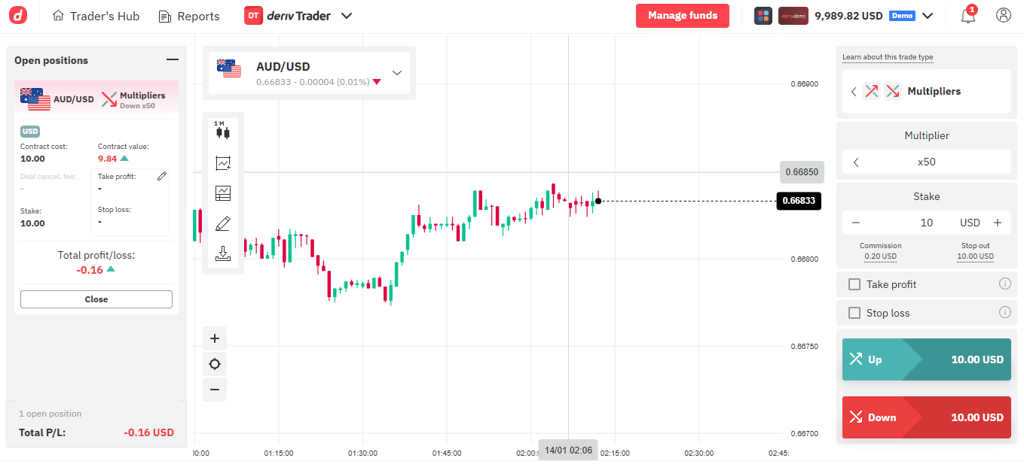
Deriv Trading Platform Interface
Who Is Deriv Best For?
Customer Support
Deriv provides customer support primarily through live chat and email, focusing on account setup, platform usage, verification, and payment-related issues. In practical testing, live chat responses are generally prompt for routine questions, especially during active hours, while more complex cases may require follow-up via email.
Support on Deriv is procedural rather than advisory. Representatives assist with technical and operational matters such as KYC requirements, contract mechanics, or withdrawal status but do not offer trading advice or strategy recommendations. This aligns with Deriv’s contract-driven model, where responsibility for risk and decision-making remains fully with the trader.
One notable advantage is clarity. Because Deriv uses explicit contract rules and transparent risk parameters, support interactions tend to be more straightforward compared to platforms where conditions are less clearly defined. Traders who complete verification early and communicate specific issues usually experience smoother resolution.
The practical takeaway is that Deriv’s customer support functions well as an operational help desk, not a safety net. It supports platform use and compliance, but disciplined trading and risk control must come from the trader not the support team.
Is Deriv Legit for Trading?
Yes, Deriv is a legitimate trading platform used by millions of traders worldwide, offering clearly defined contracts, transparent pricing, and a long operational history in the fixed-return trading space.
One of Deriv’s strongest advantages is clarity before execution. Every trade shows the exact potential profit and loss in advance, allowing traders to understand risk upfront rather than after the fact. This level of transparency is one of the main reasons Deriv continues to attract both new and experienced traders.
While Deriv operates under offshore regulation rather than Tier-1 authorities, it compensates by providing stable platforms, consistent trade settlement, and accessible demo accounts that allow users to evaluate the system before committing real funds.
For traders who take a structured approach starting with demo trading, using small position sizes, and testing withdrawals early Deriv offers a reliable environment to explore fixed-return and contract-based trading.
Compare Deriv
Frequently Asked Questions (FAQ)
Ready to Test Deriv?
Reading reviews helps, but the most reliable way to judge any trading platform is hands-on testing.
Deriv offers a free demo account and low minimum trade sizes, allowing traders to evaluate execution, contract behavior, and withdrawals before committing meaningful capital.
Visit Deriv to open a free demo account and decide whether its contract-based trading approach fits your style.
⚠️ Risk Disclaimer
Trading digital or binary options involves significant risk and may not be suitable for all investors. Never trade with funds you cannot afford to lose.