
Binary Options Scam Red Flags: How to Spot an Untrustworthy Broker
If you are new to binary options, your first job is not to find a strategy. It is to avoid the wrong broker.
A weak strategy can lose money. A bad broker can do much worse. It can trap your deposit, delay your withdrawal, hide behind vague terms, and turn every simple question into confusion. That is why broker trust comes before chart patterns, signals, or payout numbers.
Many traders do not lose only because they make poor entries. They lose because they fund platforms they never properly checked. A broker may look polished, offer attractive payouts, and promise fast withdrawals, yet still become difficult the moment real money needs to come back out.
This is why scam detection matters. Before you compare platforms, start with top binary options brokers. Before you trust a broker, learn how to verify a binary options broker before you deposit. And before you assume a platform is safe, know the warning signs.
Why Scam Detection Matters More Than Strategy
A trading setup only matters if the platform itself is usable and trustworthy.
If the broker is weak, even a good trader can end up in a bad situation. You may win trades and still face problems when trying to withdraw. You may see strong payouts and still discover bonus restrictions, hidden account limits, or endless document requests later. In practice, this is where many traders realize too late that they judged the broker by appearance instead of structure.
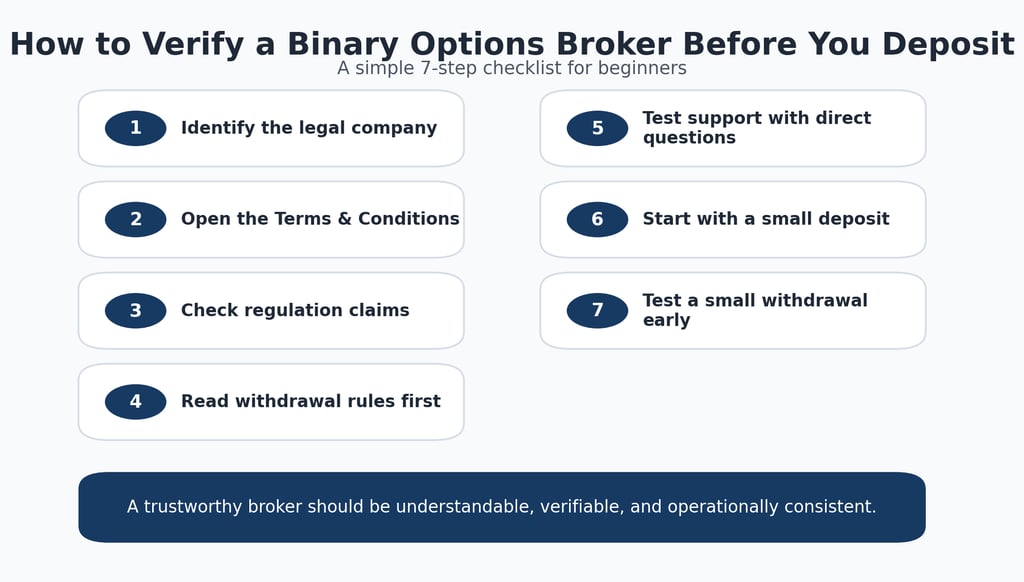
A trustworthy broker is not perfect. But it should be understandable, verifiable, and operationally consistent. If the company behind the platform is unclear, the rules are vague, and support becomes evasive when money is involved, that is already enough reason to slow down.
The Red Flags That Matter Most
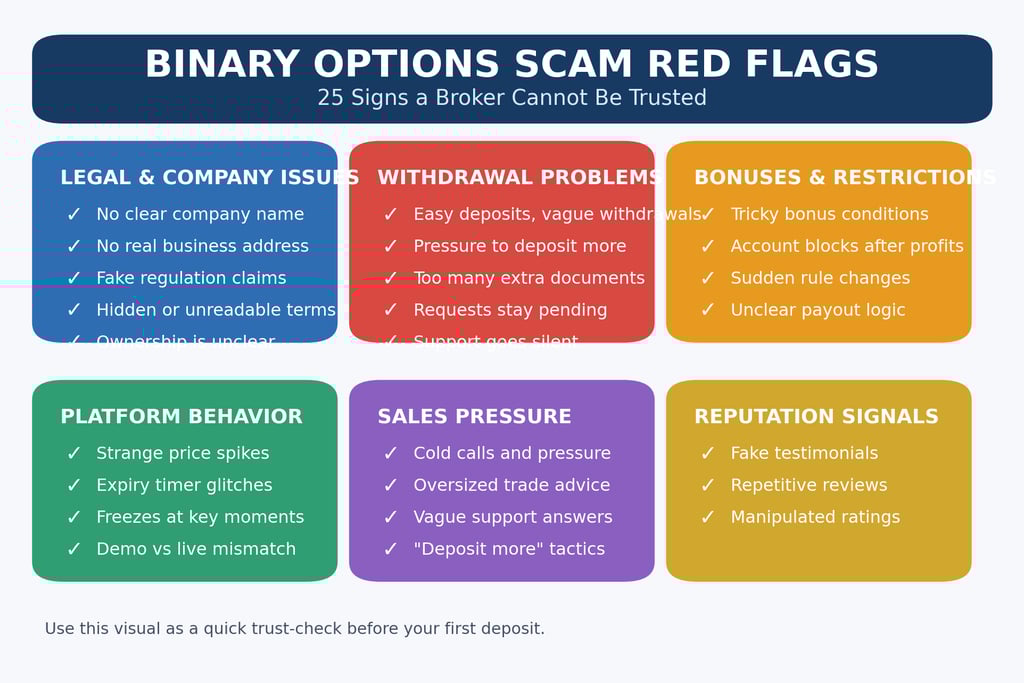
The clearest scam signals usually appear in six areas.
The first is company clarity. If the website talks constantly about opportunity but fails to clearly identify the legal company, business address, or real operating entity, trust should drop immediately. A financial platform should not feel anonymous.
The second is regulation language. Some brokers use words like “regulated,” “licensed,” or “secure” everywhere, yet never identify the actual authority, license number, or legal structure behind the claim. When a regulation statement cannot be checked, it has little value.
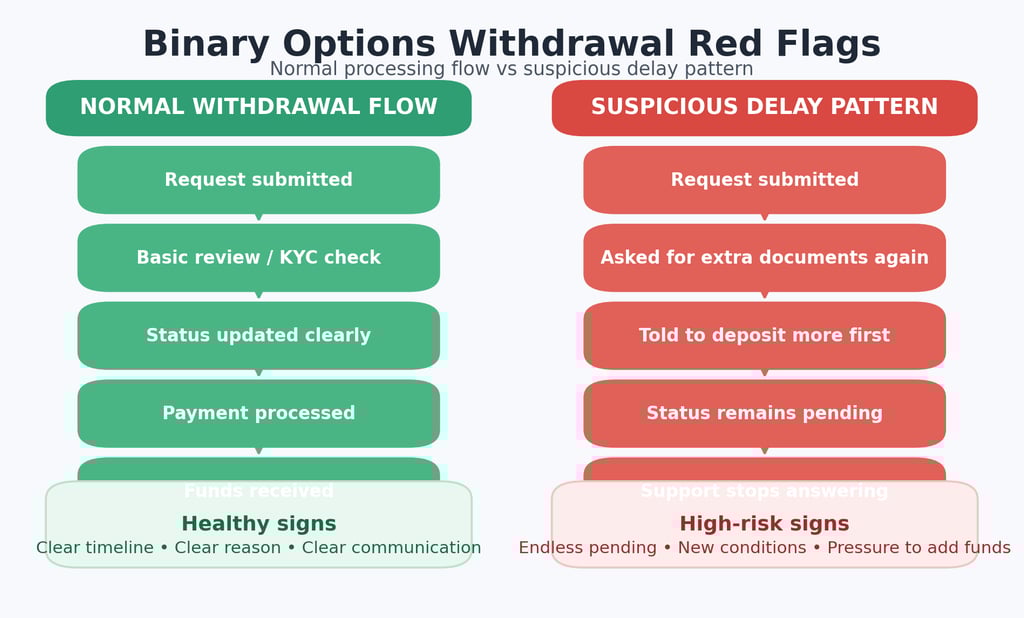
The third is withdrawal behavior. This is where bad brokers often reveal themselves. Deposits may be quick, smooth, and heavily encouraged, while withdrawal rules are vague, buried, or operationally frustrating. If a broker becomes slower, more demanding, or more confusing only after you request a payout, that is not a minor issue. It is one of the strongest trust signals in the entire business.
The fourth is bonus and account friction. Bonuses can sound attractive, but they often become a reason to delay or restrict withdrawals. If a broker suddenly places the account under review, adds new limitations, or points to complicated turnover rules only after profits appear, the problem is not just policy. The problem is that the trader was never given a clean and transparent path from the start.
The fifth is platform behavior. If prices behave strangely during winning trades, expiry timing feels unreliable, or the platform repeatedly freezes at sensitive moments, traders should not dismiss those patterns too quickly. A platform does not have to be obviously broken to be risky. It only needs to behave inconsistently enough to weaken confidence and distort outcomes.
The sixth is sales pressure. A serious broker should not need emotional pressure, cold calls, repeated deposit requests, or so-called account managers pushing larger trades. Once support starts behaving more like a sales team than a service team, the quality of the relationship changes.
Why Withdrawal Friction Is the Most Important Signal
Many traders focus too much on entry and not enough on exit.
But the moment of withdrawal often tells you more about broker quality than the moment of deposit ever can. A weak platform can still look efficient while money is coming in. The real test begins when the trader asks for money to leave.
This is why any serious trader should read binary options withdrawal problems before funding an account. A withdrawal delay does not always prove fraud, but repeated friction, vague explanations, changing conditions, or support silence should never be treated lightly.
A broker that is easy at the beginning and difficult at the end is showing you its true priorities.
What a Strong Broker Usually Does Differently
A stronger broker does not hide behind marketing. It explains who operates the platform, how money moves, what rules apply, and what the trader should expect before funding the account.
It also behaves consistently. The same platform that welcomes your deposit should remain responsive when you ask to withdraw. The same broker that advertises transparency should be able to explain its terms in plain language. The same company that claims to value clients should not rely on pressure tactics to keep deposits flowing.
That is why real broker comparison should begin with trust, not with payout. If you want a stronger process for that, read compare binary options brokers and use a structured framework instead of judging by the homepage alone.
How to Check a Broker Quickly Before You Deposit
You do not need a full legal investigation to reduce risk. A quick and disciplined check is often enough to eliminate many weak options.
First, identify the legal company, not just the brand. Then read the sections that govern deposits, withdrawals, bonus conditions, and account restrictions. After that, test whether any regulation claim can be independently verified. Finally, contact support with direct questions and judge the clarity of the answers, not just the friendliness of the tone.
If the platform already feels vague before you deposit, it is unlikely to become clearer later.
This is also why trust and execution should be viewed together. If you want an example of a platform review that looks at real usage rather than generic marketing, see our Pocket Option execution review.
What to Do If You Already Deposited
If you already funded an account and now have concerns, the right response is not panic. It is structure.
Save screenshots. Keep records of balances, chats, emails, and withdrawal requests. Stop sending new money just because someone claims another deposit will unlock the current payout. Review the broker’s terms carefully and document any clauses being used to justify delays. If needed, contact the payment provider and ask what dispute options exist.
The key point is simple: once confusion, pressure, and delay become a pattern, do not assume the next step will solve the problem.
Final Thoughts
The best way to avoid a binary options scam is to slow down before you fund an account.
Most warning signs appear early. Traders usually miss them not because the signals are invisible, but because the platform looks professional enough to create false confidence. That is why scam detection is not a side topic. It is one of the foundations of survival in this market.
A good broker cannot guarantee profits. But a bad broker can create avoidable losses, unnecessary friction, and risks that have nothing to do with market direction. That is why learning scam red flags is not pessimism. It is process.
Top Brokers
⚠️ Trading is speculative and involves risk. Consider your financial situation carefully before trading.
Related Articles
Binary Options Scam Red Flags: How to Spot an Untrustworthy Broker