
How Payout Affects Profitability in Binary Options
Most binary options traders pay attention to direction first. They ask whether the trade will finish higher or lower. More experienced traders may also think about timing, execution, and market conditions. But one variable is often underestimated even though it directly controls long-term performance: payout.
Payout is not just a platform detail. It is one of the main factors that determines whether a trading method is actually profitable over time. Two traders can use the same setup, have the same win rate, and still end up with completely different results simply because they are trading at different payout levels.
That is why serious traders should not only compare entries. They should also compare the payout environment they are trading in. If you are still evaluating providers, review top binary options brokers, then compare binary options brokers, and only after that decide whether a platform’s trading conditions are good enough for your method.
Why Payout Matters More Than Many Traders Realize
In binary options, the loss on a losing trade is usually larger than the profit on a winning trade. That is the core reason payout matters.
If you risk $100 and the payout is 80%, a winning trade earns $80, while a losing trade still costs the full $100. So even if you win more trades than you lose, the math may still work against you.
This is why traders should stop asking only, “How often do I win?” and start asking, “How much do I win when I am right compared with how much I lose when I am wrong?”
Profitability depends on both.
The Break-even Idea Traders Must Understand
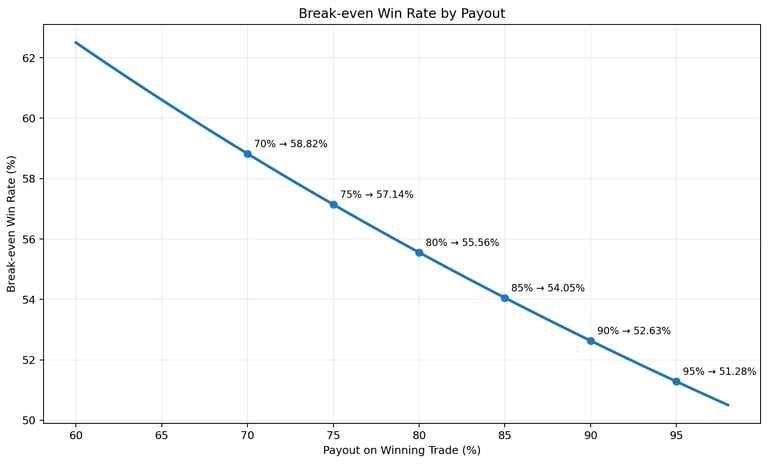
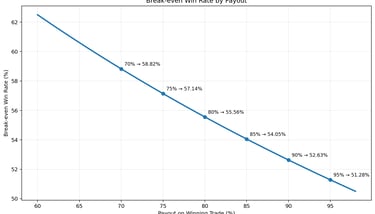
Every payout level creates its own break-even win rate.
The formula is simple:
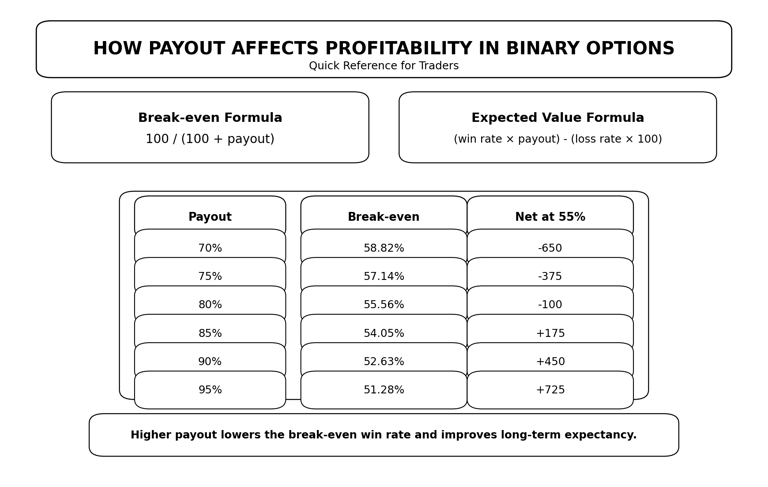
Break-even win rate = 100 / (100 + payout)
That means:
at 70% payout, break-even is 58.82%
at 75% payout, break-even is 57.14%
at 80% payout, break-even is 55.56%
at 85% payout, break-even is 54.05%
at 90% payout, break-even is 52.63%
at 95% payout, break-even is 51.28%
This is one of the most important concepts in binary options. A trader may believe a strategy is good because the win rate looks respectable, but if the payout is too low, that same strategy may still lose money.
That is exactly why you should also read why a 55% win rate can still lose money in binary options before judging whether a system really has an edge.
Why Payout Changes the Outcome
Let us use one simple example.
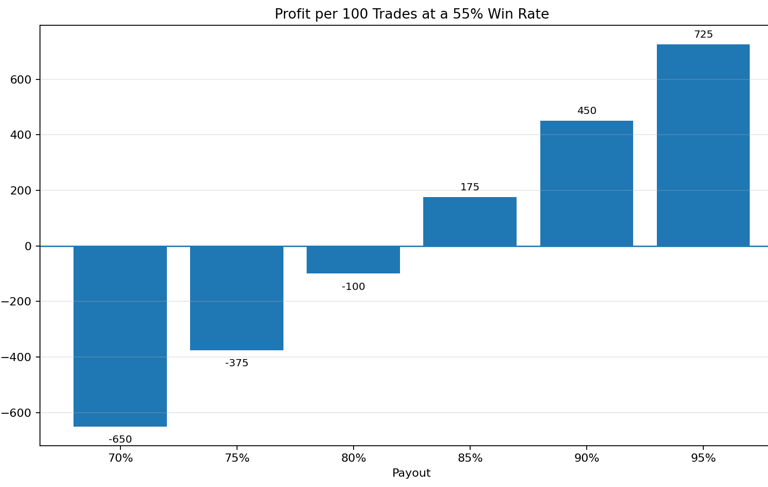
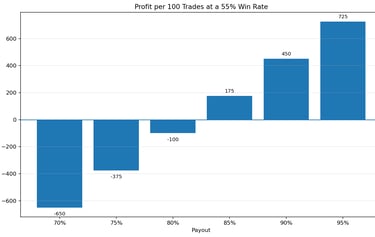
Assume you risk $100 per trade and your win rate is 55% over 100 trades.
At 80% payout
55 winning trades × $80 = $4,400
45 losing trades × $100 = $4,500
Net result = -$100
At 90% payout
55 winning trades × $90 = $4,950
45 losing trades × $100 = $4,500
Net result = +$450
The strategy did not change.
The trader did not change.
The win rate did not change.
Only the payout changed.
That is how powerful payout really is.
Expected Value Explains the Real Difference
A useful way to think about payout is through expected value.
Expected value shows what each trade is worth on average over time. A strategy with positive expected value should make money over a large enough sample. A strategy with negative expected value will usually lose over time, even if it feels accurate in short bursts.
The formula is:
Expected Value = (win rate × payout) - (loss rate × 100)
This matters because many traders judge performance emotionally. They remember good entries, winning sessions, or streaks. But profitability is not determined by confidence. It is determined by the math.
If payout is weak, expected value weakens too. That is why a decent win rate can still produce disappointing long-term results.
Why Traders Often Misjudge Payout Risk
There are three common mistakes.
1. They focus only on win rate
Win rate matters, but without payout, it tells only half the story.
2. They ignore that payout changes by asset, time, or platform
A setup that seems profitable under one payout level may become negative under another. This is especially important when traders move between assets or compare platforms.
3. They do not track average payout across enough trades
Some traders know their win rate but have no idea what their average payout really was. That makes performance analysis incomplete.
This is one reason platform comparison matters. If you are choosing where to trade, do not compare only interface and marketing. You should compare binary options brokers with attention to execution, payment flow, and actual payout conditions.
Payout Is Not Separate From Broker Quality
Payout is a math issue, but it is also a broker-quality issue.
Two platforms may both advertise attractive conditions, yet still offer different trading realities once you look at consistency, asset coverage, execution quality, and risk controls. A payout level that looks strong on paper means less if the execution environment is unstable or if the trader does not trust the withdrawal process.
That is why payout analysis should not be isolated from platform analysis. If you want to see how execution and trading conditions fit into real broker evaluation, see our Pocket Option execution review. And if you are still at the trust-check stage, review how to verify a binary options broker before you deposit before focusing too heavily on strategy optimization.
What Smart Traders Should Track
A smarter trader should record more than wins and losses.
At minimum, performance review should include:
total trades
win rate
average payout
total profit from winning trades
total loss from losing trades
expected value
break-even win rate for the payout actually traded
This creates a more honest view of whether the system is working.
Without payout data, a trader can easily think the strategy is better than it really is.
What This Means for Beginners
For beginners, the lesson is straightforward:
Do not assume a strategy is profitable just because it wins more than half the time.
Before deciding whether a method works, ask:
what payout am I trading?
what break-even win rate does that payout require?
what is my actual average payout, not just the best number I saw?
am I trading in an environment I trust?
These questions matter more than excitement, streaks, or short-term confidence.
The Practical Bottom Line
A higher payout lowers the break-even win rate.
A lower payout raises the break-even win rate.
That is the relationship traders must remember.
Once you understand that, several things become clearer:
why some strategies look good but still fail,
why the same setup performs differently across brokers,
and why payout should always be part of platform selection.
This is also why payout-focused educational content tends to attract backlinks naturally. It gives traders, reviewers, and forum discussions a simple framework they can cite when explaining profitability.
Final Thoughts
Payout is not a minor platform detail. It is one of the foundations of profitability in binary options.
A trader can have decent timing, a respectable win rate, and good discipline, yet still struggle if the payout environment is too weak. On the other hand, a stronger payout can materially improve the long-term expectancy of the exact same strategy.
That is why serious decision-making in binary options should connect three things:
strategy quality
payout quality
platform quality
If you understand that relationship early, you will make better choices about both your trading method and the broker you use.
Top Brokers
⚠️ Trading is speculative and involves risk. Consider your financial situation carefully before trading.
Related Articles
Binary Options Scam Red Flags: How to Spot an Untrustworthy Broker