
Regulated vs Offshore Binary Options Brokers: What Traders Need to Understand
Many traders compare binary options brokers by payout, interface, or minimum deposit. But one question matters even earlier than all of those:
Is the broker operating inside a clear regulatory framework, or is it mainly an offshore OTC platform?
This distinction changes everything. It affects how easy the broker is to verify, how clearly the product fits the local retail market, how disputes may be handled, and how much trust a trader must place in the platform’s own behavior. In markets like the UK and Australia, retail binary options have been banned outright; in the U.S., legal access is tied to regulated venues rather than the typical offshore OTC model.
That is why traders should not jump from marketing directly to deposit. First, review top binary options brokers. Then compare binary options brokers. After that, ask the more serious question: is this broker easier to verify because it sits inside a clearer market structure, or does it ask me to accept a much higher level of offshore platform risk?
What “Regulated” Really Means in Binary Options
In this niche, “regulated” is often used loosely. Traders should be much more precise.
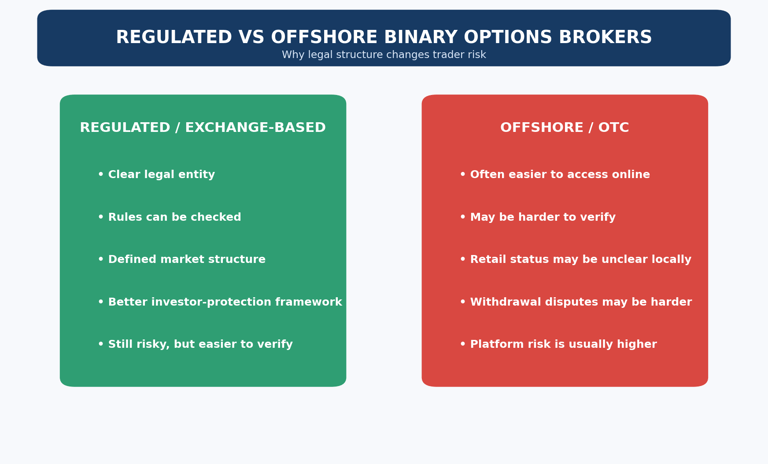
A broker or venue should not be treated as meaningfully regulated just because the website uses reassuring words like “licensed,” “secure,” or “trusted.” A stronger standard is this: can the legal entity, applicable framework, and route of retail access actually be checked?
In the U.S., for example, the CFTC says there are registered binary options exchanges, and warns that if a platform is soliciting U.S. residents without proper registration, it is likely fraudulent. That is very different from the typical offshore website model.
So when traders say “regulated broker,” what really matters is not the label alone. What matters is whether the structure is clear enough to verify.
What “Offshore” Usually Means in Practice
“Offshore” does not automatically mean fraudulent. But it usually means the trader is carrying more uncertainty.
An offshore binary options broker is often:
easier to access online,
harder to classify legally,
harder to verify in practical terms,
and more dependent on the broker’s own policy quality, support behavior, and withdrawal discipline.
This is especially important in markets where retail binary options are restricted or banned locally. A trader may still see an offshore site online, but availability is not the same as local retail suitability. Regulators have repeatedly warned that many online platforms operating outside clear registration frameworks may create serious consumer risks, including withdrawal problems, denied reimbursements, and software manipulation.
That is why offshore access should be treated as a risk signal to evaluate carefully, not as proof that the trader has found a good alternative.
Why Legal Structure Changes Trader Risk
Legal structure shapes risk in three important ways.
1. Verification risk
A clearer structure makes it easier to check who operates the platform and under what framework. A weaker offshore structure often means more guesswork.
2. Dispute risk
If something goes wrong, a trader usually has a stronger starting point when the product sits inside a recognized framework than when the platform exists mainly through offshore accessibility.
3. Withdrawal risk
Withdrawal quality is not determined by regulation alone, but weak legal clarity often increases the practical difficulty of resolving payment disputes. That is why this article should be read together with binary options withdrawal problems and how to verify a binary options broker before you deposit.
Why Offshore Access Feels Easy but Carries More Risk
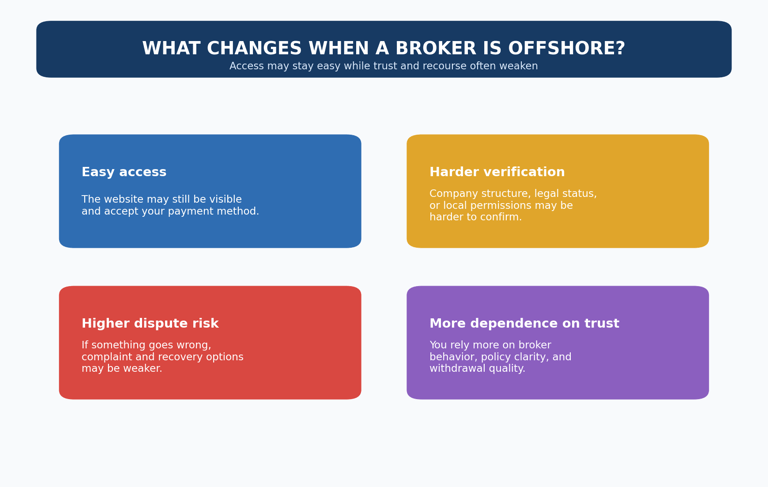
Offshore platforms often feel easy at the beginning.
They may:
accept your payment method,
translate the site into your language,
allow quick registration,
and present a smooth trading interface.
But the ease of access can hide a deeper issue: the broker may be asking you to trust the platform more than the surrounding legal environment.
This is where many traders get confused. They assume that if a broker looks professional and accepts customers from their country, it must be broadly suitable. That is not a reliable conclusion. FCA, ASIC, and U.S. regulators have all taken strong positions against retail binary options risks, and official warnings consistently show that “available online” is not the same thing as “appropriate and protected for retail traders.”
Why Traders Still Choose Offshore Brokers
The answer is simple: access, simplicity, and availability.
In practice, many traders turn to offshore brokers because:
local retail access is blocked or heavily restricted,
offshore onboarding feels easier,
account opening is fast,
and the platform appears designed for retail convenience.
But convenience is not the same as lower risk.
A trader may still choose to use an offshore platform, but that decision should be made with clearer eyes. The burden of verification becomes heavier. The importance of policy clarity becomes higher. The need to test withdrawals early becomes much more serious.
That is exactly why the binary options scam red flags guide matters. Offshore access does not prove a platform is bad, but it does mean the trader should raise the quality of due diligence.
What the Major Regulatory Examples Teach Us
The most useful way to understand this topic is not through slogans, but through real market examples.
The UK FCA made its retail binary options ban permanent from 2 April 2019. The ASIC ban for retail clients in Australia now runs to 1 October 2031. At the EU level, ESMA used product-intervention powers to prohibit the marketing, distribution, or sale of binary options to retail investors during the intervention period, which also influenced national approaches. In the U.S., the CFTC’s message remains clear: binary options may be lawful only in properly regulated structures, while unregistered online platforms targeting U.S. users are a major danger area.
The lesson is not that every trader everywhere faces the same rule. The lesson is that serious regulators have repeatedly viewed retail binary options as a product category requiring strong intervention, restriction, or very careful control.
That should change how traders think about broker choice.
A Better Way to Compare Regulated and Offshore Brokers
The wrong way to compare them is by asking only:
which one has the higher payout,
which one is easier to open,
or which one looks more modern.
The better way is to ask:
which structure is easier to verify,
which one fits my country’s retail reality more clearly,
which one gives me a better chance of understanding the rules before I fund,
and which one leaves me less exposed if a dispute appears.
That is why platform selection should be layered.
Start with where binary options are banned, restricted, or unregulated. Then check how to verify a binary options broker before you deposit. Then compare execution, payouts, withdrawals, and usability. If you want an execution-focused example, see our Pocket Option execution review.
What Traders Should Do Before Depositing
The right sequence is simple.
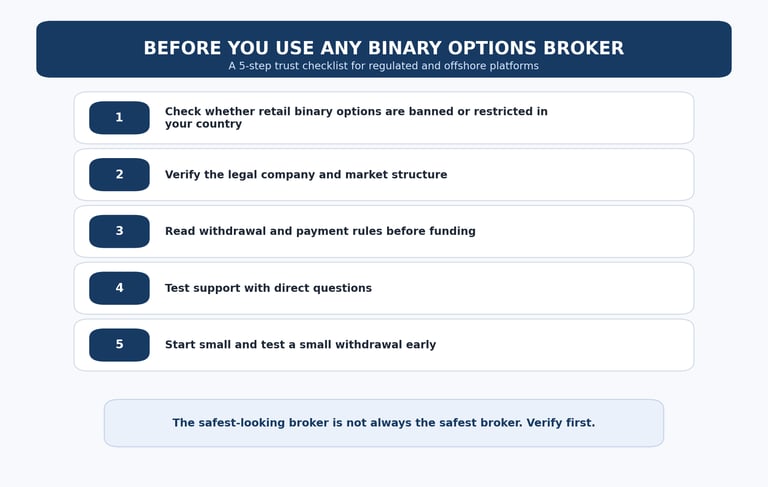
Check whether retail binary options are banned or restricted in your country.
Verify the legal company and market structure behind the broker.
Read withdrawal and payment rules before funding.
Test support with direct questions.
Start small and test a small withdrawal early.
These steps matter for both regulated and offshore platforms. But they matter even more when the platform sits in an offshore or mixed-status environment.
The Practical Bottom Line
A regulated or exchange-based route usually gives the trader a clearer framework to verify. An offshore route may still be usable in practice, but it usually demands more caution, stronger due diligence, and a higher tolerance for platform risk.
That is the real difference.
This is not just a legal distinction. It is a trust distinction.
Final Thoughts
The safest-looking binary options broker is not always the safest broker. What matters is whether the legal structure, retail status, and platform behavior can be understood clearly enough before money goes in.
In a product category where major regulators have imposed bans, restrictions, and repeated fraud warnings, traders should stop treating “regulated vs offshore” as a minor technical detail. It is one of the first filters that should shape broker selection.
If you understand that early, you will make better decisions long before payout, strategy, or interface start to matter.
Top Brokers
⚠️ Trading is speculative and involves risk. Consider your financial situation carefully before trading.
Related Articles
Binary Options Scam Red Flags: How to Spot an Untrustworthy Broker