
Why a 55% Win Rate Can Still Lose Money in Binary Options
Many binary options traders believe one simple idea: if they can win more than half of their trades, they should be profitable.
At first glance, that sounds logical. Winning 55 trades out of 100 feels like an edge. But in binary options, a win rate above 50% does not guarantee profit. The missing factor is payout.
This is one of the most misunderstood concepts in binary options trading. A trader can feel accurate, disciplined, and consistent, yet still lose money because the payout structure is working against them. Traders who are still evaluating the wider market should also review our Top Brokers and detailed Broker Reviews to understand how broker conditions can affect real results.
That is why this topic matters. If you understand it early, you avoid one of the most common beginner mistakes: confusing a decent win rate with a profitable system.
Why Win Rate Alone Does Not Tell the Full Story
In many forms of trading, win rate feels like the most important number. More winning trades should mean more money. But binary options work differently because a winning trade usually pays less than a losing trade costs.
If you risk $100 on a trade and the payout is 80%, a win earns $80, not $100. A loss still costs the full $100.
That creates an uneven payoff structure. You are not trading in a one-to-one environment. Your losses are often larger than your wins. This is why so many traders overestimate their edge and underestimate the importance of payout, platform conditions, and broker quality. For side-by-side analysis of platform differences, readers can also explore our Broker Comparisons.
The Simple Math Behind the Problem
The math is straightforward.
Assume you risk $100 per trade, your payout is 80%, and your win rate is 55%. Over 100 trades, you win 55 and lose 45.
Your winning trades generate $4,400. Your losing trades cost $4,500. Your final result is a $100 loss.
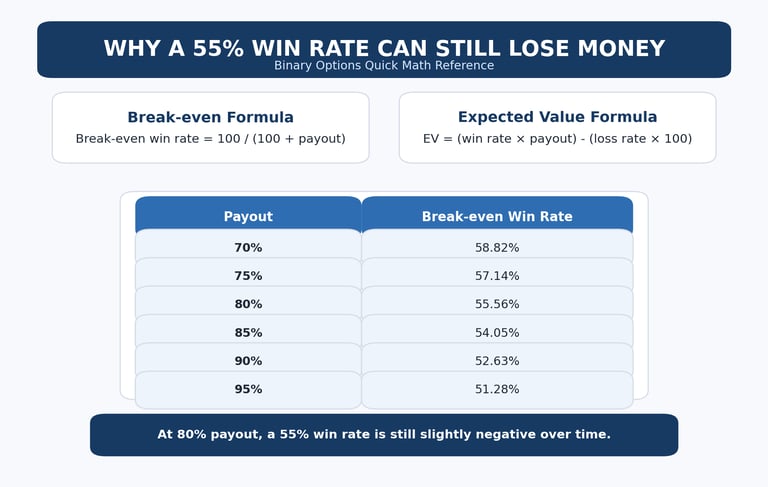
That means a 55% win rate still loses money at an 80% payout.
This surprises many traders because psychologically, 55% feels strong. Mathematically, it is still below break-even.
The Break-even Win Rate Formula
The break-even win rate in binary options is simple:
Break-even win rate = 100 / (100 + payout)
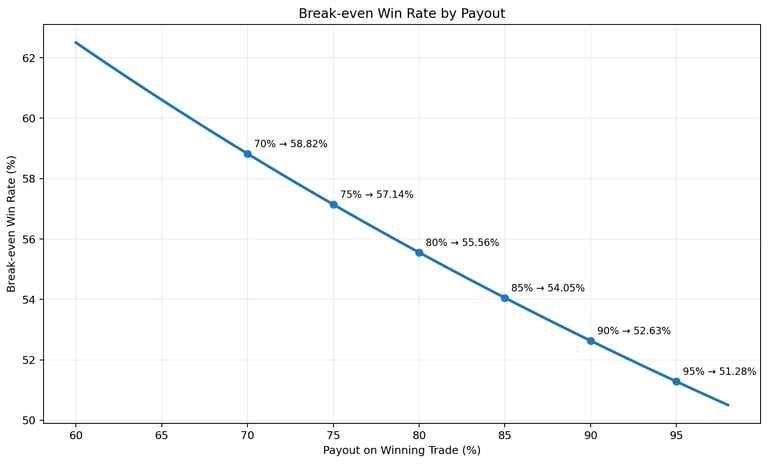
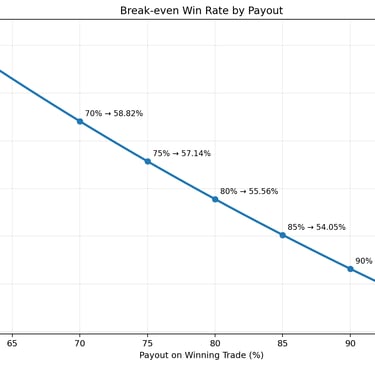
Using that formula, the break-even level is 58.82% at a 70% payout, 57.14% at 75%, 55.56% at 80%, 54.05% at 85%, 52.63% at 90%, and 51.28% at 95%.
This is why payout matters so much. The lower the payout, the more accurate you need to be just to avoid losing money.
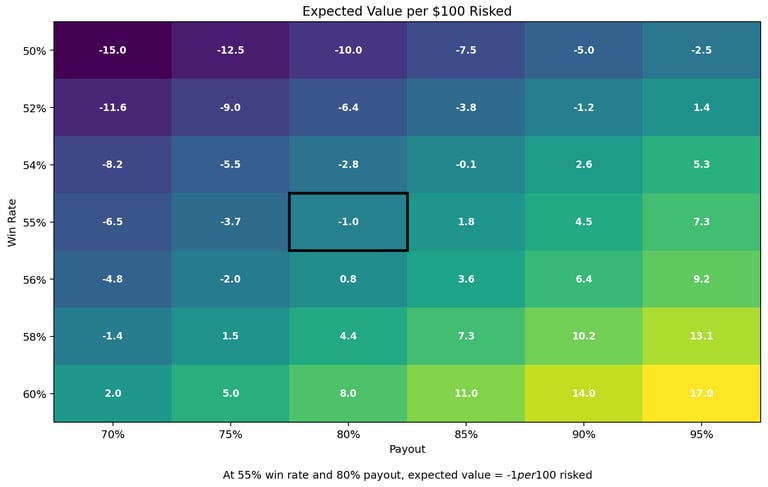
A 55% win rate may still lose at 80% payout, sit near break-even at 85%, and become profitable at 90%. The strategy did not change. The payout did.
Why This Matters So Much in Real Trading
This is not just theory. It changes how traders should judge performance.
Many traders say they win more than they lose, their entries are good, or their accuracy is above 50%. All of that may be true, but none of it automatically means the strategy is profitable.
In binary options, profit depends on the relationship between win rate, payout, execution quality, position sizing, and discipline. That is why some traders stay confused for months. They think the problem is chart analysis, when the real issue is that the payout math was never strong enough to support the system they were using.
Expected Value Is More Important Than Confidence
A smarter way to evaluate performance is through expected value, not emotion.
Expected value tells you what each trade is worth on average over time. The formula is simple:
Expected Value = (win rate × payout) - (loss rate × 100)
If your win rate is 55%, your payout is 80%, and your loss rate is 45%, the result is:
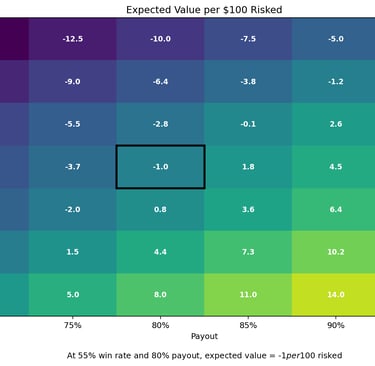
(0.55 × 80) - (0.45 × 100) = 44 - 45 = -1
That means you lose $1 on average for every $100 risked.
It does not feel dramatic on one trade. Over hundreds of trades, it becomes very real.
Why Many Traders Misread Their Results
Most traders misread this issue for three reasons.
First, they focus on win rate alone and ignore payout. Second, they overlook the fact that payout changes across assets, sessions, and brokers. Third, they judge performance from a small sample size and assume short-term results prove long-term profitability.
That is why proper tracking matters. If you do not measure both win rate and payout, you are only seeing part of the picture.
What a Smarter Trader Should Track
A serious performance review should track more than wins and losses. It should include the total number of trades, average payout, average stake, total gains, total losses, expected value, and the true break-even rate for the payout actually traded.
This gives a much more honest view of performance. A strategy is not good because it feels right. It is good when the numbers support it.
The Hidden Role of Execution and Platform Quality
There is another layer many traders ignore.
Even if your math is close to break-even, poor execution can push you further into negative territory. Small delays, unclear pricing, unstable payout display, and weak trading conditions can turn a marginal strategy into a losing one.
That is why profitability is not only about entries. It is also about where you trade. If you want a practical example of how execution affects live trading conditions, see our Pocket Option execution review. And if you want to reduce broker risk before focusing on strategy, read How to Verify a Binary Options Broker Before You Deposit.
What This Means for Beginners
For beginners, the lesson is simple: do not assume you are profitable just because your win rate is above 50%.
Before judging any strategy, ask what payout you are actually trading, what win rate you need to break even, whether your sample size is large enough, and whether your broker is helping or hurting your results.
Those questions are far more useful than chasing a win percentage without context.
A Quick Reference You Should Remember
If you remember only one thing, remember this:
A 55% win rate is not a guarantee of profit in binary options.
Profit depends on whether that win rate is high enough for the payout structure you are trading. That single idea can save traders from false confidence, weak systems, and avoidable losses.
Final Thoughts
Binary options is a game of math before it becomes a game of psychology.
A trader can feel skilled, disciplined, and accurate, yet still lose money if the payout structure does not support the win rate. That is why serious traders should stop judging performance by win percentage alone.
The better approach is to evaluate win rate, payout, expected value, execution quality, and disciplined review together. Once you understand that, your analysis becomes more realistic. And realistic traders make better decisions.
Top Brokers
⚠️ Trading is speculative and involves risk. Consider your financial situation carefully before trading.
Related Articles
Binary Options Scam Red Flags: How to Spot an Untrustworthy Broker