
Where Binary Options Are Banned, Restricted, or Unregulated
Many traders ask the same question in different ways: Are binary options legal in my country?
The problem is that this question often sounds simpler than it really is. Binary options are not governed in one uniform way across the world. In some markets, they are banned for retail traders. In others, they are restricted to regulated exchange-traded products. In many places, the practical reality is even more confusing: offshore platforms may still be accessible online, but that does not mean they are clearly authorized for retail clients in that jurisdiction.
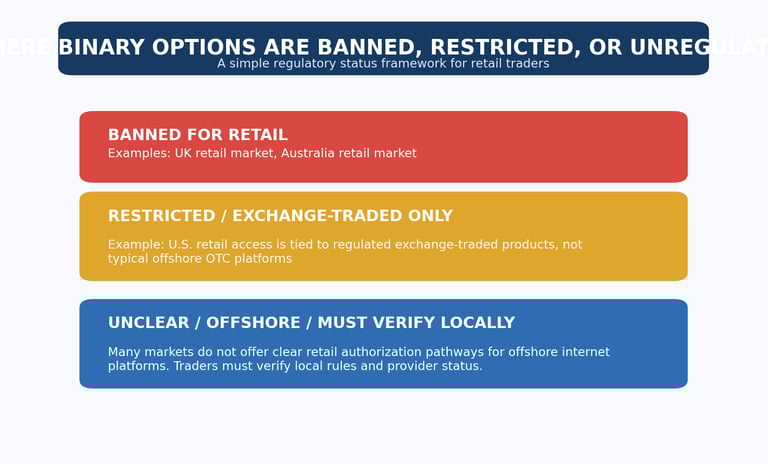
That is why traders should stop thinking in binary terms such as “legal” or “illegal” alone. A more useful framework is this: banned, restricted, or unregulated.
This article explains the difference, why it matters, and how to think about country risk before you choose a platform. If you are still comparing providers, start with our guide to top binary options brokers before moving on to country-specific risk checks.
Why Country Status Matters More Than Most Traders Think
A broker can look professional, offer attractive payouts, and still operate in a market environment that is not meant for ordinary retail traders.
That matters because country status affects more than just legal wording. It affects:
whether the product can be marketed to retail clients,
whether local investor protections apply,
whether the platform is exchange-traded or offshore OTC,
and how much recourse a trader may realistically have if a dispute appears.
This is also why broker selection should never begin with payout alone. Before comparing platforms, traders should first understand whether the product itself is banned, restricted, or effectively pushed offshore in their jurisdiction.
If you are still evaluating brokers, see how to verify a binary options broker before you deposit and our binary options scam red flags guide.
Banned, Restricted, and Unregulated Mean Different Things
These three words are often mixed together, but they should not be.
Banned
A banned market means retail sale, marketing, or distribution is prohibited.
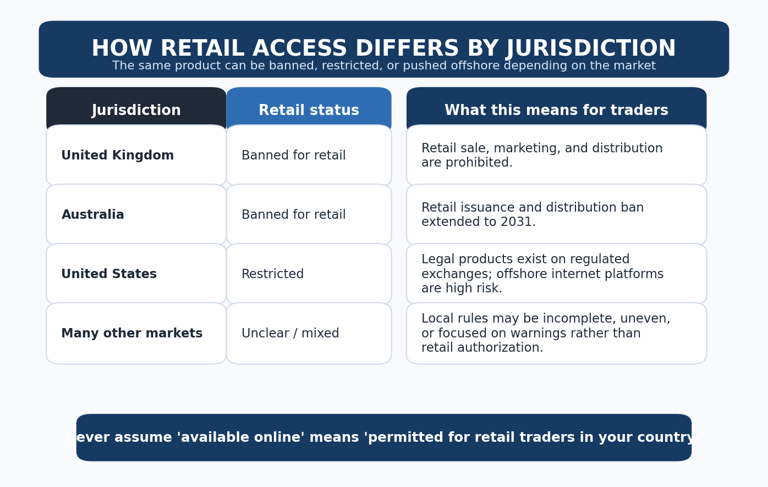
In the United Kingdom, the FCA confirmed a permanent ban on the sale of binary options to retail consumers, effective 2 April 2019.
In Australia, ASIC extended its retail binary options ban until 1 October 2031, continuing the prohibition on issuing and distributing binary options to retail clients.
Restricted
A restricted market means binary options may still exist, but access is limited to specific structures, venues, or rules.
In the United States, binary options can be legal only when traded on regulated U.S. exchanges, while many internet-based platforms operate outside applicable U.S. requirements. The CFTC and SEC have also warned that many online binary-options sites may be unregistered and fraudulent.
Unregulated or Unclear
This is often the most dangerous category for retail traders.
In many jurisdictions, offshore platforms remain visible online, but the local regulatory position may be incomplete, mixed, weakly enforced, or focused mainly on warnings rather than clear retail authorization pathways. In practical terms, that often means the trader carries more platform risk than they realize.
Where Binary Options Are Clearly Banned for Retail Traders
The clearest examples today are the UK and Australia.
The FCA’s UK ban is permanent and applies to firms acting in or from the UK when selling, marketing, or distributing binary options to retail consumers.
ASIC’s Australian intervention is also direct: binary options are banned for retail clients, and the current extension runs until 1 October 2031.
For traders, the key takeaway is simple: in these markets, the question is no longer which retail binary options broker is best. The more relevant question is whether a trader is being pushed toward offshore providers that sit outside the intended local retail framework.
That is a major trust issue.
Where Binary Options Are Restricted Rather Than Broadly Available
The United States is the best example of a market that should be described as restricted, not casually described as “open.”
The CFTC states that binary options are legal and available to trade in the U.S., but they must be traded on a regulated U.S. exchange. That is very different from the typical offshore OTC model promoted on many internet platforms. At the same time, U.S. regulators warn that a large part of the online binary-options market may not be complying with applicable U.S. requirements.
This distinction matters because many traders incorrectly assume that if a website is accessible from the U.S., then it is suitable for U.S. retail traders. That assumption can be very dangerous.
Europe: Why Traders Should Verify Country Rules Carefully
Europe pushed strongly against retail binary options during the ESMA product intervention period. In 2018, ESMA adopted a prohibition on the marketing, distribution, or sale of binary options to retail investors across the EU as a temporary product intervention measure.
The most practical lesson for traders today is not to assume that “Europe” is one simple category. The safer approach is to verify the current national position and retail rules in the specific country involved.
In other words, Europe should be treated as a high-verification region, not a place where you guess based on a single headline.
What “Unregulated” Usually Means in Practice
For retail traders, “unregulated” usually does not mean there are no rules anywhere. It usually means something more practical and more dangerous:
the platform may be offshore,
the legal route for retail distribution may be unclear,
local investor protections may be weak or hard to enforce,
and dispute recovery may be limited even if the site looks polished.
That is why “available online” should never be treated as proof of legitimacy.
A broker can be accessible, translated into your language, accept your local payment method, and still sit outside the main regulatory framework that would normally protect local retail traders.
If you want to compare platforms more carefully, use compare binary options brokers only after you have checked the legal and country-status layer first.
What Traders Should Do Before Depositing
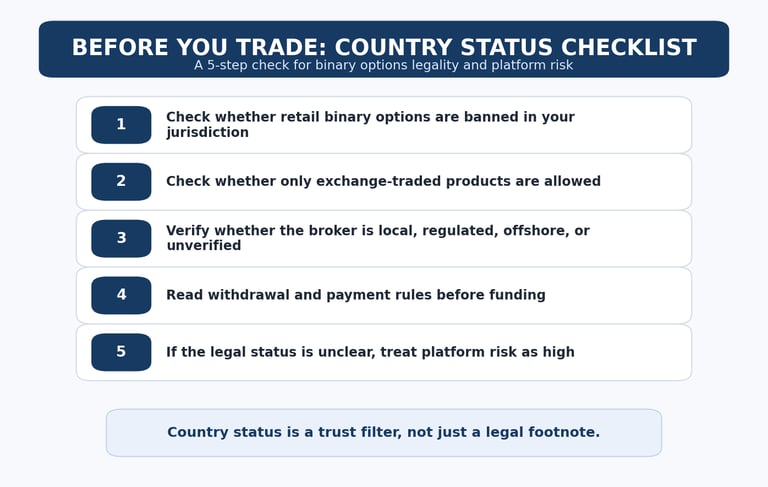
The right process is not complicated, but it must be disciplined.
First, check whether retail binary options are banned in your country.
Second, check whether only exchange-traded products are allowed, as in the U.S. model.
Third, verify whether the broker is local, regulated, offshore, or simply hard to classify.
Fourth, read payment and withdrawal rules before sending funds.
Fifth, if the country status is unclear, treat platform risk as high, not low.
This is where country status becomes more than a legal note. It becomes a trust filter.
Final Thoughts
Binary options are not regulated in one simple global pattern.
Some jurisdictions clearly ban them for retail traders. Some restrict them to regulated exchange environments. Others leave traders in a much more uncertain position, where offshore availability can create the illusion of legitimacy without offering the protections of a clearly authorized local retail market.
That is why the smartest question is not only, “Can I access this platform?” The smarter question is, “What does my country’s status imply about risk, authorization, and my ability to protect myself if something goes wrong?”
If you start there, you will make better decisions before you ever compare payout, strategy, or broker features.
Top Brokers
⚠️ Trading is speculative and involves risk. Consider your financial situation carefully before trading.
Related Articles
Binary Options Scam Red Flags: How to Spot an Untrustworthy Broker