
How to Verify a Binary Options Broker Before You Deposit
Before you study a strategy, compare payout rates, or choose an expiry time, you should understand one thing first: how to verify the broker.
In binary options trading, broker quality shapes the entire experience. A weak platform can damage results even when the trader is disciplined, understands the market, and manages risk correctly. If the broker is unclear, inconsistent, or difficult to trust, unnecessary problems can appear long before strategy becomes the issue.
That is why broker verification is one of the most important early skills in binary options. Many beginners judge a broker by its homepage, design, or advertised payout. That is a mistake. A broker should never be judged by presentation alone. It should be judged by whether it is understandable, verifiable, and operationally consistent. Traders who want a broader market overview should also review our top binary options brokers page and compare detailed insights across our broker reviews.
This guide explains how to verify a binary options broker before you deposit. It is written as a practical framework that both beginners and experienced traders can apply before sending money to any platform. For readers who are still evaluating multiple choices side by side, our broker comparisons section can also help place each platform in a clearer decision-making context.
Why Broker Verification Matters More Than Most Traders Think
The market already carries enough risk on its own. Traders should not add avoidable platform risk on top of market risk.
When broker verification is skipped, the problems that follow are often predictable. The platform may have vague company ownership, unclear withdrawal conditions, weak support, aggressive bonus clauses, or a major gap between what it promises and how it actually behaves once money is involved.
Verification is not about finding a perfect broker. It is about reducing avoidable uncertainty before capital is committed. A trustworthy broker should not force users to guess who operates it, how withdrawals are handled, or what happens when a dispute appears.
That is why broker verification comes before strategy. A platform that fails basic trust checks does not deserve a deposit, no matter how attractive its marketing looks. This principle also connects closely with our guide on how to choose a binary options broker, because broker selection and broker verification are really part of the same decision.
What You Should Verify Before You Fund Any Account
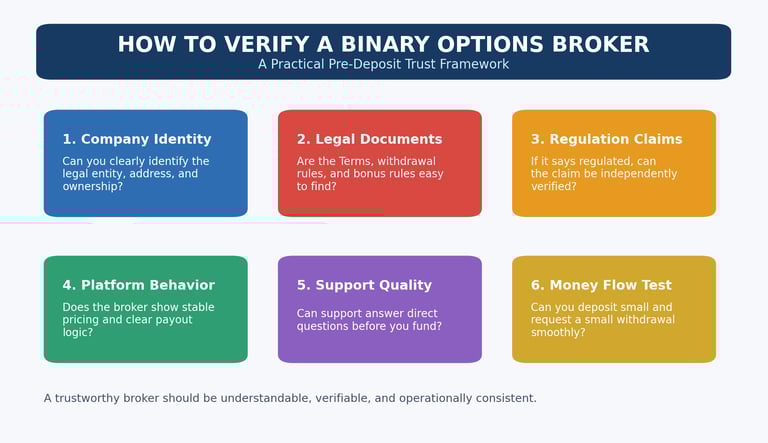
A serious broker should be evaluated across several areas: company identity, legal terms, regulation claims, platform behavior, support quality, and real money flow.
No single weakness automatically proves that a broker is unusable. But when several weak signals appear together, trust should decline quickly. The goal is not to make the process complicated. The goal is to confirm that the broker behaves like a real service provider rather than a sales page designed only to collect deposits.
1. Verify the Company Behind the Platform
The first question is simple: who actually operates the broker?
Do not stop at the brand name. Look for the legal company name, business address, and any ownership details the broker provides. A serious platform should make this information available without forcing users to search too deeply.
A broker does not become trustworthy because it looks polished. If the legal entity behind it is vague or difficult to identify, uncertainty already exists at the most basic level. That matters because every later issue, whether it involves withdrawal delays, terms disputes, or complaints, eventually leads back to the company operating the platform.
If the company behind the broker is unclear, the trader begins from a weak position.
2. Read the Legal Documents Before You Deposit
Most traders read the legal documents too late. They only open the terms after a problem appears, and by then the broker may already be pointing to clauses the trader never reviewed.
Before you fund an account, read the sections covering withdrawals, deposits, account verification, bonus conditions, account restrictions, and inactive account policies. You do not need to read every line like a lawyer, but you do need to understand the rules that affect your money.
A trustworthy broker should not make these pages difficult to find or unnecessarily difficult to understand. If the legal language is buried, incomplete, or clearly written to discourage real reading, that alone is a useful warning sign.
3. Check Whether Regulation Claims Can Be Verified
Many brokers use words like “regulated,” “licensed,” or “secure” in ways that sound reassuring but reveal very little.
If a broker claims to be regulated, ask a direct question: regulated by whom, under which entity, and where can that claim be checked? A real claim should be specific and traceable. It should not rely on vague wording or force the user to guess which jurisdiction applies.
Regulation is not the only factor that matters, but honesty about regulation matters a great deal. A broker that exaggerates, obscures, or loosely frames something this important is already showing weak trust behavior.
4. Study the Withdrawal Rules Before You Fund the Account
This is one of the most important checks in the entire process.
Most brokers work hard to make deposits feel fast and easy. That is expected. The real trust test usually begins on the withdrawal side. Before sending money, understand how withdrawal requests are submitted, how long the broker says the process takes, what verification is required, whether withdrawals must return through the original payment method, and whether there are extra conditions tied to bonuses, profits, or account activity.
A trader should not become suspicious only after making money. The right time to understand withdrawal rules is before the first deposit, not after the first successful trade. This is also why withdrawal-related pages are among the most important internal resources on any serious broker review site. For a broader perspective, readers can compare this topic with our guide to binary options broker withdrawals.
5. Test Support With Direct Questions
Support quality reveals a great deal about how a broker operates when the trader asks something practical.
Do not ask generic questions such as whether the platform is good. Ask direct questions about the legal company, withdrawal procedures, verification requirements, bonus restrictions, and the broker’s normal withdrawal time. A trustworthy broker should be able to answer practical questions clearly, not hide behind vague or promotional language.
Support matters because it often exposes the gap between marketing and reality. If support avoids direct answers before a deposit is made, there is little reason to expect better communication later.
6. Evaluate the Platform Itself
Broker verification is not only about legal documents. It is also about how the platform behaves in real use.
Ask whether payout is clearly shown before the trade is placed, whether the interface is easy to understand, whether price presentation feels stable, and whether the platform seems built for real trading rather than just fast signup. Trust is not only legal. It is operational as well.
A platform that feels unclear, unstable, or awkward during ordinary use will be even more frustrating once real money is involved. That is why execution-focused reviews matter. A good example is our Pocket Option execution review, which looks at platform quality from a practical trading perspective rather than from marketing language alone.
The 10-Minute Verification Process
A full investigation is not always necessary. In many cases, a disciplined ten-minute review can already remove a large amount of avoidable risk.
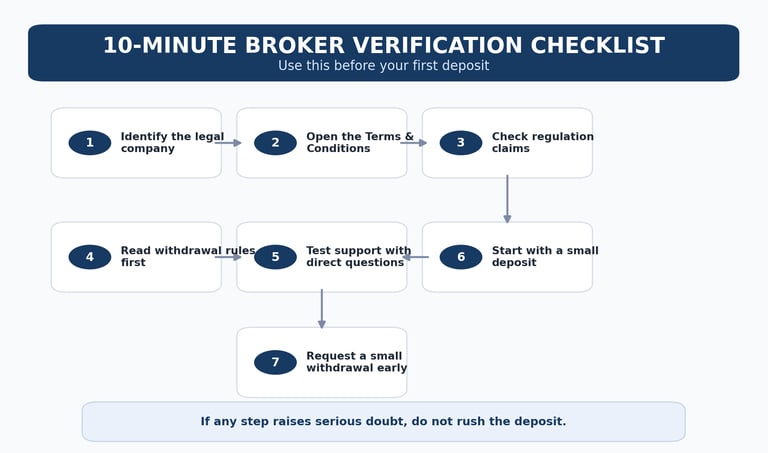
Start by identifying the legal company behind the broker. Then open the terms and conditions and scan the sections related to withdrawals, KYC, account restrictions, and bonuses. After that, check whether regulation claims can be independently verified. Read the withdrawal section carefully, contact support with one or two direct questions, and begin with a small deposit rather than a large one. Finally, test a small withdrawal early.
This process is simple, but it is far more effective than relying on design, slogans, or payout percentages.
Why a Small Withdrawal Test Matters So Much
Many traders wait too long before testing the most important operational step: getting money back out.
That is a serious mistake.
A broker may feel smooth while the account is being opened, the dashboard is being explored, and trades are being placed. But trust is not confirmed when money goes in. Trust is confirmed when the process works properly in both directions.
A small withdrawal test is one of the clearest practical checks a trader can perform. It does not guarantee the future, but it reduces uncertainty in a way that no polished homepage, review headline, or advertised payout ever can.
This is also why scam-awareness content matters so much in broker verification. Traders who want to sharpen that judgment further should read our guide to binary options scam red flags.
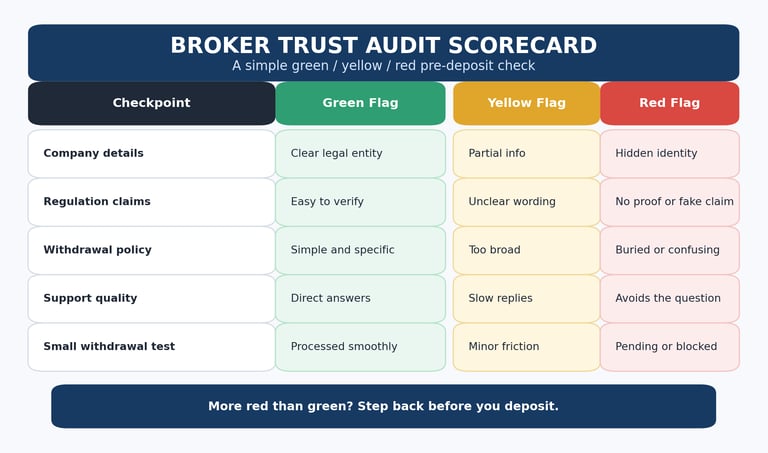
A Simple Trust Audit Before You Deposit
Before funding any account, a trader should be able to answer a few basic questions with confidence.
Is the company identity clear? Are the legal rules easy to find and understand? Are regulation claims specific and checkable? Are the withdrawal terms understandable? Does support answer directly? Can the platform be tested with a small amount? Can a small withdrawal be requested without confusion?
The more positive answers you have, the stronger the broker’s trust profile becomes. The more uncertainty remains, the more cautious you should be. Verification does not need to be emotional. It should be structured.
Common Mistakes Traders Make When Verifying Brokers
One of the most common mistakes is trusting design too much. A polished interface can create a false sense of safety, but design is not the same as transparency.
Another mistake is reading reviews without looking for patterns. Reviews can be useful, but they should support direct verification, not replace it. Traders should look for recurring signals rather than isolated praise or isolated complaints.
A third mistake is ignoring withdrawal rules until later. This is often one of the most expensive errors because many traders focus on entry and profits while paying too little attention to the actual payout process.
Starting with too much money is another avoidable mistake. Even when a broker looks promising, a large first deposit increases risk unnecessarily. A small test is always more intelligent.
Finally, many traders confuse fast signup with real trust. A quick registration process may improve convenience, but it says very little about long-term broker quality.
What a Trustworthy Broker Usually Looks Like
A trustworthy broker usually has several traits in common. It identifies the company behind the platform clearly. It publishes legal documents that can actually be read. It explains payment and withdrawal conditions in a way traders can understand. It answers direct questions without hiding behind sales language. And it behaves consistently across the full user journey, not only at the deposit stage.
That does not mean the broker is perfect. It means the broker is easier to verify, easier to understand, and easier to test responsibly. That is exactly what traders should want before committing larger capital.
For newer users, this point also ties directly into broader educational content on binary options for beginners and risk management in binary options, because broker verification is part of risk control, not separate from it.
Final Thoughts
The best time to verify a broker is before you deposit, not after a problem appears.
A good broker should not force you to guess who runs the platform, what the rules are, or how withdrawals work. If those answers are unclear, the trader should slow down immediately.
Binary options trading already demands discipline, patience, and risk control. Broker verification is part of that discipline. It is not separate from trading. It is one of the first real trading decisions you make.
If you verify carefully, start small, and test the money flow early, you create a much stronger foundation for every decision that follows. And if you are still comparing platforms, it also makes sense to review a broader best binary options brokers comparison so you can place trust, usability, and withdrawal behavior in a wider context.
Top Brokers
⚠️ Trading is speculative and involves risk. Consider your financial situation carefully before trading.
Related Articles
Binary Options Scam Red Flags: How to Spot an Untrustworthy Broker