
Binary Options Money Management: How Much Should You Risk Per Trade?
Before a trader focuses on entry timing, payout, or broker features, one question matters first: how much should you risk per trade?
In binary options, money management determines whether a trader can survive long enough for skill to matter. A weak position-sizing plan can destroy an account even when the strategy itself is decent. That is why serious traders do not begin by asking how much they want to make. They begin by asking how much they can afford to lose without damaging the account. Readers who are still exploring the market can start with our Top Brokers and full Broker Reviews before choosing where to trade.
For most traders, the safest starting point is simple: risk a small percentage of the account on each trade. In practice, that usually means around 1% per trade for beginners and up to 2% per trade for disciplined traders with more consistency. In binary options, where losses are fixed and trades can happen quickly, that discipline matters even more.
Why Money Management Matters in Binary Options
Many beginners focus on win rate first. That is understandable. Winning feels like progress. But in real trading, survival comes before growth.
Money management is what keeps one bad session from becoming a serious account problem. If a trader risks too much on each position, even a workable method can collapse under a normal losing streak. This becomes even more important in binary options because payout is often lower than the amount risked. That is why money management connects directly with How Payout Affects Profitability in Binary Options and Why a 55% Win Rate Can Still Lose Money in Binary Options.
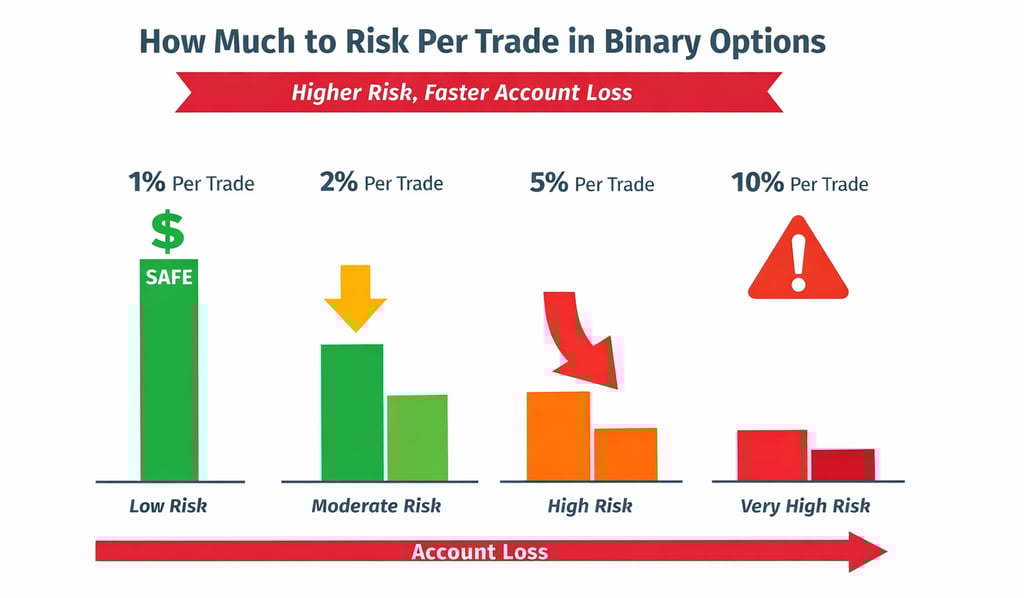
A trader who risks 10% per trade can damage the account very quickly. A trader who risks 1% or 2% has more room to stay calm, review results, and improve.
What Risk Per Trade Actually Means
Risk per trade is not the amount you hope to win. It is the amount you are willing to lose if the trade ends unsuccessfully.
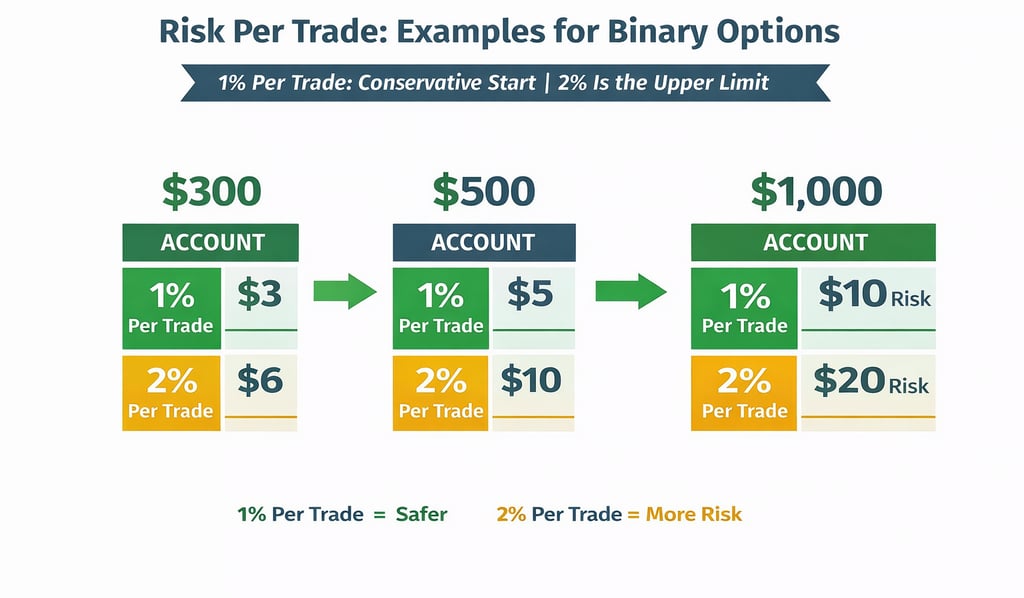
If your account balance is $500 and you risk 1% per trade, your maximum loss is $5. If your account balance is $1,000 and you risk 2% per trade, your maximum loss is $20. The amount changes with the balance, but the discipline stays the same.
This is why percentage-based sizing is more effective than random fixed staking. It keeps risk proportional to account size and prevents traders from oversizing just because a setup looks attractive.
How Much Should You Risk Per Trade?
For most beginners, 1% per trade is the best starting point. It protects the account, lowers emotional pressure, and gives the trader time to collect real performance data.
For traders with stronger discipline and proven consistency, 2% per trade can still be reasonable. Beyond that level, risk rises too quickly. In binary options, aggressive staking is especially dangerous because a short losing streak can arrive fast and tempt traders into revenge trading.
In practical terms, that means a $300 account risking 1% puts $3 at risk per trade. A $500 account risking 2% puts $10 at risk per trade. A $1,000 account risking 1% to 2% means risking $10 to $20 per trade.
That may feel small, but small is the point. The goal is not to win big from one trade. The goal is to stay in the game long enough for skill and discipline to matter.
Why High Risk Per Trade Usually Ends Badly
Large position sizes feel attractive because they create larger short-term outcomes. They also create faster account damage.
A trader risking 5% or 10% per trade does not need many losses to create serious pressure. Even a strong strategy will experience losing streaks. The problem is not whether losses happen. The problem is whether the account can survive them.
In binary options, this risk is even more dangerous because traders can place trades quickly, react emotionally, and increase size after losses. That combination often turns a manageable drawdown into a destructive one.
Why Small Risk Improves Decision-Making
Good money management is not only about account math. It is also about psychology.
When the amount at risk is too large, traders stop reading the market and start watching their balance. Fear increases. Impatience increases. The urge to recover losses becomes stronger. That is where discipline begins to break.
Smaller risk creates mental space. It allows traders to follow a plan, review performance honestly, and improve without panic. This is one reason Binary Options for Beginners: Safe Start Guide matters so much. A safe start is not only about choosing a broker. It is also about using a stake size that protects decision-making.
Why Payout and Broker Quality Still Matter
Money management in binary options cannot be separated from payout and broker quality.
If payout is low, the trader needs a higher win rate just to break even. If execution is weak, price display is unclear, or withdrawals become a problem, performance can get worse even when the position size looks disciplined on paper.
That is why traders should combine money management with strong broker selection and execution awareness. If you are comparing platforms, our Broker Comparisons can help. If you want a practical example of execution-focused analysis, see Pocket Option Execution Review 2026.
A Simple Risk Framework for Beginners
A practical framework is simple. Start with 1% risk per trade. Move toward 2% only when the account is stable, the trading journal is real, and emotional control is consistent.
Do not increase size because of excitement. Do not increase size because of frustration. And do not increase size just because the last few trades won.
A $400 account risking 1% starts at $4 per trade. That may look modest, but it gives the trader room to survive a bad run and learn from it. A trader who starts with $20 or $40 per trade on the same balance is not managing risk. They are accelerating account damage.
Why Broker Verification Belongs Inside Money Management
Risk per trade is your decision, but broker quality still affects results.
Weak execution, unstable platform conditions, unclear payout display, or poor withdrawal handling can make disciplined traders perform worse than expected. That is why money management should be part of a wider protection system that includes payout analysis, broker verification, and withdrawal awareness.
To reduce broker-related risk, read How to Verify a Binary Options Broker Before You Deposit and Binary Options Withdrawal Problems: Why Traders Get Stuck.
Final Thoughts
Binary options money management is simple in theory, but it requires real discipline.
Most traders do not fail because they never found a setup. They fail because they risked too much before they had enough proof that their system actually worked. In binary options, where payout is uneven and losing streaks are unavoidable, position size matters as much as strategy.
For most beginners, the best answer is clear: start at 1% per trade, treat 2% as a disciplined ceiling, and increase only when your results justify it. Smart traders protect capital first. Everything else comes after that.
Top Brokers
⚠️ Trading is speculative and involves risk. Consider your financial situation carefully before trading.
Related Articles
Binary Options Scam Red Flags: How to Spot an Untrustworthy Broker