
Binary Options OTC Markets Explained: What Traders Should Know Before Trading Weekend Assets
OTC markets are one of the most misunderstood parts of binary options trading. Many retail traders first notice them on weekends, when normal market sessions are closed but some platforms still offer tradable assets. That creates an obvious question: what exactly are you trading if the underlying market is not open in the usual way?
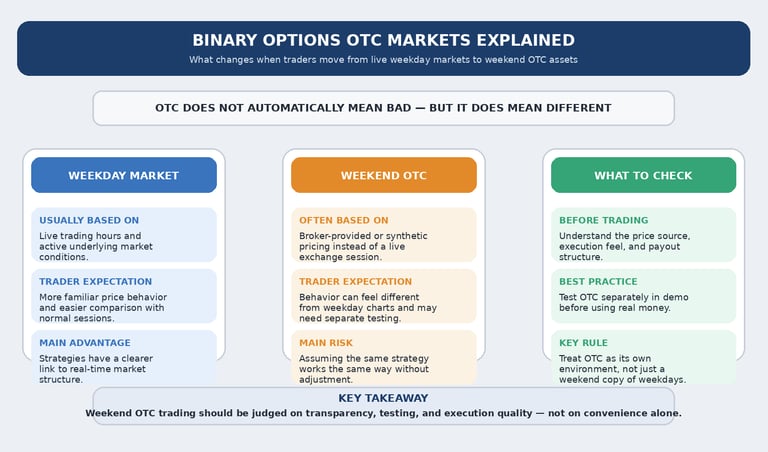
This matters because OTC trading changes the context of the trade. In normal weekday conditions, traders usually work with assets linked to active market sessions and familiar price behavior. Weekend OTC assets are different. On many retail platforms, they are based on broker-provided or synthetic pricing rather than a live central exchange session. That does not automatically make them unsafe or dishonest, but it does mean traders should not treat them as a simple extension of weekday trading.
If you are researching broker quality before using OTC products, start with our Top Brokers, then review execution quality in Broker Reviews and side-by-side differences in Broker Comparisons. This topic also connects closely with Pocket Option Execution Review 2026: Why It Stands Out as a Leading Binary Options Platform, Binary Options Scam Red Flags: How to Spot an Untrustworthy Broker, How to Verify a Binary Options Broker Before You Deposit, and Regulated vs Offshore Binary Options Brokers: What Traders Need to Understand.
What OTC means in binary options
OTC stands for over-the-counter. In broad financial language, that usually refers to trading that happens outside a centralized exchange. In the binary options world, the term is often used more loosely. On retail platforms, OTC assets commonly refer to instruments offered directly by the platform, especially when normal market hours are closed.
For traders, the important point is practical rather than semantic. OTC assets should be understood as a different trading environment. Price behavior may not reflect the same conditions you see during live weekday sessions. The structure can feel smoother, more erratic, or simply unfamiliar compared with regular trading hours. That is why strategies built on weekday behavior should never be assumed to work the same way on OTC assets.
Why weekend OTC trading attracts so much attention
Weekend OTC markets are attractive because they offer access when most other markets are quiet or unavailable. For retail traders, that convenience can feel valuable. A trader who is busy during the week may see weekend OTC as an easy way to stay involved. Platforms also know that always-available trading increases user engagement.
The problem is that convenience can lower standards. Traders may assume that because the chart is moving, the opportunity is real in the same way as a normal weekday session. That assumption is often where mistakes begin. OTC markets can be tradable, but they need to be judged on their own terms, not by the fact that they are available.
This is especially important for beginners. Someone still learning timing, market structure, and execution quality may find OTC charts harder to interpret because they do not always behave like the market conditions described in most trading education. That is one reason Binary Options for Beginners: Safe Start Guide remains an important reference point before traders move into more specialized environments.
What changes when you move from weekday assets to OTC assets
The biggest change is context. During a live weekday session, price behavior is shaped by active market participation, scheduled trading hours, and the broader conditions affecting the underlying asset. OTC trading often operates under a different model. Even when the interface looks familiar, the environment behind the chart may not be the same.
This affects how traders should think about setup quality. A signal that works during active weekday volatility may become less reliable in OTC conditions. Support and resistance can behave differently. Momentum may look cleaner or less trustworthy. Expiry choices that made sense during the week may suddenly feel too fast or too slow. In other words, OTC is not just a different time to trade. It is often a different environment to interpret.
That is why execution quality matters so much. If you are evaluating a platform that offers OTC instruments, pay close attention to chart behavior, contract handling, expiry flexibility, and how transparent the broker is about what you are trading. This is where articles like Pocket Option Execution Review 2026: Why It Stands Out as a Leading Binary Options Platform and Binary Options Broker Comparison Framework: How to Compare Brokers Properly become especially useful.
OTC does not automatically mean scam, but it does require more caution
One of the biggest mistakes traders make is treating OTC as either completely normal or automatically fraudulent. The reality is more nuanced. OTC availability by itself is not proof that a broker is dishonest. At the same time, OTC offerings do deserve more scrutiny because the trader is relying heavily on the platform’s own environment, pricing model, and execution standards.
That is why trust matters more here than in many other situations. Traders should understand who they are dealing with, how transparent the broker is, whether withdrawals work reliably, and whether the platform explains its products clearly enough to support informed decisions. If those answers are weak, OTC becomes even more questionable.
This is exactly why OTC trading should be reviewed alongside Binary Options Scam Red Flags: How to Spot an Untrustworthy Broker, How to Verify a Binary Options Broker Before You Deposit, and Binary Options Withdrawal Problems: Why Traders Get Stuck. Weekend access can be attractive, but it should never distract from broker reliability.
How traders should evaluate OTC assets before using real money
The best approach is to treat OTC as its own category. Do not assume that weekday results transfer directly. Test it separately. Review how the chart behaves, how expiry timing feels, and whether your setup still makes sense in that environment. A strategy that works during normal sessions may produce very different results on OTC instruments, even when the chart appears similar at first glance.
This is where demo testing matters. Traders should use a demo account to compare weekday assets and OTC assets rather than blending them together in one set of assumptions. Watch how price moves, how quickly momentum fades, and whether your normal entry standards still hold up. That is why Best Binary Options Demo Accounts: What Traders Should Test Before Going Live is directly relevant here.
A second layer of evaluation is broker trust. Traders should ask simple but important questions. Is the platform clear about the product? Does execution feel stable? Are the payout structures reasonable? Does the broker already have signs of poor transparency elsewhere? OTC trading is much easier to approach professionally when the rest of the broker passes basic trust and execution checks first.
When OTC trading makes more sense, and when it does not
OTC may make sense for traders who already understand their platform well, test carefully, and treat weekend assets as a separate environment. It can also make sense for traders who value flexibility and are disciplined enough not to confuse access with quality. In those cases, OTC can be one more category to evaluate rather than something to avoid automatically.
It makes much less sense for traders who are still struggling with basics. If a trader already has problems with timing, overtrading, emotional decision-making, or broker selection, OTC is unlikely to solve any of that. In fact, it may amplify those weaknesses because the environment can feel more opaque and less familiar than normal weekday conditions.
For many beginners, the better path is to master core foundations first: broker verification, demo testing, expiry selection, volatility awareness, and market condition reading. Once that base is stronger, OTC can be evaluated more objectively.
Final thoughts
OTC markets in binary options are not automatically good or bad. What matters is how they are understood and how carefully they are used. Weekend OTC assets can offer convenience and extra trading access, but they should never be treated as a simple copy of weekday markets. They are often a different environment, and that difference matters.
The safest mindset is to stay skeptical without becoming simplistic. Do not assume OTC is normal just because it is available. Do not assume it is fraudulent just because it is OTC. Instead, judge it through execution quality, transparency, demo testing, and broker trust. That is the standard serious traders should use before risking real money.
For the next step, continue through our Trading Guides, review broker quality in Broker Reviews, and compare platforms systematically through Broker Comparisons.
Top Brokers
⚠️ Trading is speculative and involves risk. Consider your financial situation carefully before trading.
Related Articles
Binary Options Scam Red Flags: How to Spot an Untrustworthy Broker