
How to Choose the Right Expiry Time in Binary Options
Expiry time is one of the most overlooked factors in binary options trading. Many traders spend too much time searching for the perfect entry and not enough time thinking about how long the trade needs to work. In binary options, direction alone is not enough. You also need the market to move in your favor before the contract closes.
That is why expiry time should never be treated as a secondary setting. It is part of the trade setup itself. A solid idea can fail with an expiry that is too short, while a moderate setup can become more reliable when the timing better matches the market structure. Traders who are still building a foundation should first review our Top Brokers, compare platforms in Broker Comparisons, and explore more practical lessons in our Trading Guides. If you are still testing before going live, our guide on Best Binary Options Demo Accounts: What Traders Should Test Before Going Live is also worth reading.
Why Expiry Time Matters
Every binary options trade has a fixed ending point. Once the contract expires, the result is decided immediately. This creates a very different dynamic from other forms of trading. The market may eventually move in the direction you expected, but if it happens after expiry, the trade still loses.
That is why timing matters so much. Expiry determines how much room price has to develop after entry. If the expiry is too short, even normal market noise can invalidate a good trade. If it is too long, the market may have enough time to reverse, lose momentum, or wander into uncertainty before settlement. The goal is to choose an expiry that matches the logic of the setup, not one that simply looks attractive on the platform.
The Difference Between Short, Medium, and Long Expiry
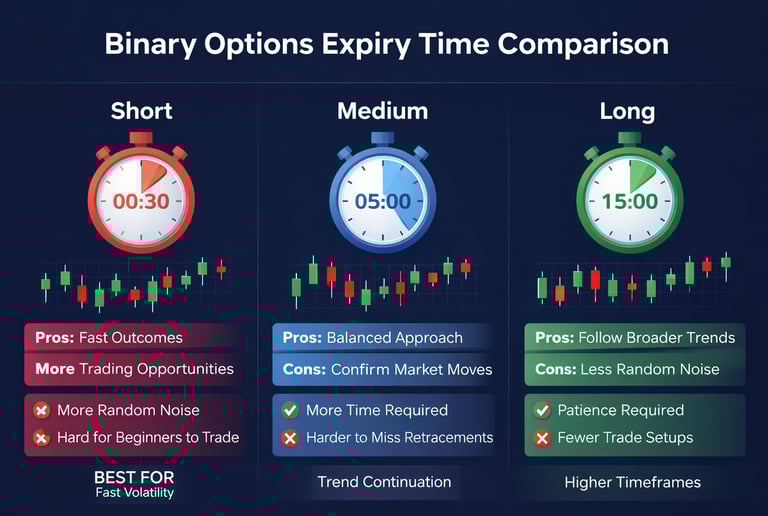
Short expiry contracts, often between 30 seconds and 2 minutes, appeal to traders because they offer fast results. In strong momentum, they can work well. The problem is that they are also the most vulnerable to random price fluctuations. A small retracement or a brief pause in momentum can easily turn a winning setup into a loss. For that reason, short expiries are usually the hardest to trade consistently.
Medium expiry contracts, often between 3 and 15 minutes, tend to offer a more balanced structure. They give price enough time to confirm a move without exposing the trade to too much extra uncertainty. For many traders, especially those still building consistency, this range is often the most practical.
Longer expiries work better when the trade idea is based on a broader trend, session structure, or higher-timeframe support and resistance. They reduce the effect of short-term noise, but they require more patience and cleaner trade selection. They are not necessarily easier, but they are often more logical when the setup is based on a wider market view.
How to Match Expiry Time to the Setup
The best way to choose expiry time is to align it with the reason you entered the trade. If the setup is built around immediate momentum on a lower timeframe, the contract should not last so long that the original edge disappears. On the other hand, if the trade is based on a higher-timeframe level or a broader continuation pattern, a very short expiry may not give the market enough time to work.
This is where many traders make mistakes. They choose expiry based on emotion, speed, or habit rather than market logic. Some copy another trader’s timing without understanding the strategy behind it. Others switch from 5-minute to 1-minute expiries after a few losses, hoping that faster outcomes will fix the problem. In most cases, this only creates more inconsistency.
A better approach is to test the same setup with different contract durations in a demo account. That is often the fastest way to see whether your edge depends on the entry itself or on the timing of the contract. Broker quality also matters here, which is why it helps to compare execution conditions across platforms like Pocket Option Review, Quotex Review, and IQ Option Review.
Expiry Time, Market Conditions, and Payout
The best expiry can also change with market conditions. In a strong trend, medium or slightly longer expiries often make more sense because price needs time to continue in the dominant direction. In a choppy market, short expiries may look attractive, but they often become unreliable because price keeps moving back and forth without clean follow-through.
Payout should also be considered, but never on its own. A higher payout is not automatically better if the expiry time makes the trade less reliable. In many cases, a slightly lower payout paired with better timing can produce a stronger long-term result. That idea is explored further in How Payout Affects Profitability in Binary Options.
News periods are another special case. Sudden spikes and reversals can distort any normal timing logic. Even a setup that looks obvious can fail when volatility becomes erratic. In those moments, avoiding the trade is often smarter than forcing an expiry decision.
What Expiry Time Is Best for Beginners?
For most beginners, medium expiries are usually the best place to start. They are less random than ultra-short contracts and give price action more time to develop naturally. A trader using 3 to 5 minute expiries will often learn more about market behavior, timing, and discipline than someone jumping straight into 30-second trades.
This does not mean medium expiries are always best. It simply means they are often the most useful for building a stable process. The real objective is not to trade faster. It is to trade with an expiry that gives the setup a fair chance to work.
Final Thoughts
There is no universal best expiry time in binary options. The right choice depends on the setup, the timeframe, and the way the market is behaving at that moment. Traders who treat expiry as a strategic decision usually perform better than those who treat it as a random platform setting.
In the end, the goal is simple. Choose the contract duration that gives your trade idea the highest probability of finishing correctly. Once you start thinking about expiry in that way, your entries become more logical, your testing becomes more useful, and your overall trading process becomes much more professional.
For the next step, continue through our Trading Guides, compare execution environments in Broker Reviews, and use our Top Brokers page to narrow down the platforms that best support your trading style.
Top Brokers
⚠️ Trading is speculative and involves risk. Consider your financial situation carefully before trading.
Related Articles
Binary Options Scam Red Flags: How to Spot an Untrustworthy Broker