
How to Choose the Right Expiry Time in Binary Options
Volatility is one of the biggest hidden forces behind binary options results. Many traders focus on direction first and only think about expiry later, but in fixed-time trading, timing is part of the setup itself. A trade can have the right bias and still lose because price did not move far enough before the contract closed. In other cases, the market may move too aggressively, creating noise that destroys a good entry before expiry.
That is why volatility matters. It affects how fast price moves, how clean that movement is, and how much time a setup needs to develop. In quiet markets, very short contracts often close too early. In highly active markets, short timing can work, but only when price action is structured rather than chaotic. Traders who ignore that difference often blame strategy quality when the real problem is mismatched timing.
If you are still building your broker shortlist, start with our Top Brokers, compare execution environments in Broker Comparisons, and review platform-specific conditions in our Broker Reviews. This article also works closely with our guides on How to Choose the Right Expiry Time in Binary Options, How Payout Affects Profitability in Binary Options, and Best Binary Options Demo Accounts: What Traders Should Test Before Going Live.
Why volatility changes trade timing
Volatility is simply the speed and intensity of price movement over time. In binary options, that matters more than many beginners realize because every contract has a fixed deadline. You are not just forecasting where price might go. You are forecasting whether it can get there before expiry.
When volatility is low, price often moves more slowly and with less range. A setup may still be valid, but the contract needs more room to work. Traders who keep using very short expiries in those conditions often lose not because the idea was wrong, but because the time window was too tight.
When volatility is high, price can travel quickly, which makes shorter contracts look attractive. Sometimes that is correct, especially when momentum is clean and directional. But high volatility can also mean sharp reversals, unstable candles, and random spikes that turn short-term trades into a coin flip. Fast movement does not automatically mean good trading conditions.
Low volatility vs high volatility
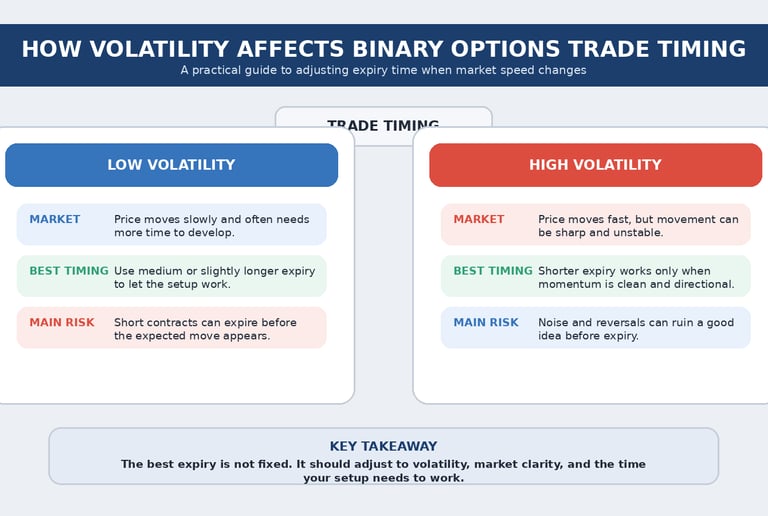
In lower-volatility conditions, medium or slightly longer expiries usually make more sense. The market is not doing enough in a very short window, so the setup needs time to develop naturally. This is often the better environment for patient traders who prefer cleaner structure over constant action.
In higher-volatility conditions, the decision becomes more selective. If the market is moving quickly in one clear direction, shorter timing can work well because price reaches the target area faster. But if volatility is aggressive and messy, shorter expiry becomes much less reliable. A setup may look perfect at entry and still get invalidated by a sudden snapback before the trade ends.
The key distinction is not just whether the market is moving fast or slow. It is whether the movement is tradable. That is the point many traders miss.
The link between volatility and expiry
Expiry should reflect the environment the trade is happening in. In calm markets, a short contract often leaves no room for price to reach the expected move. In stronger and cleaner markets, the same setup may work better with less time. But when volatility becomes too unstable, simply shortening expiry is not a solution. In many cases, the smarter choice is to trade less, wait for cleaner structure, or skip the setup entirely.
This is why there is no universal best expiry time. A fixed 1-minute or 5-minute habit across all sessions usually leads to inconsistent results. Traders improve faster when they start asking a better question: what contract duration fits this market condition right now?
That logic connects directly to expiry selection. Our guide on How to Choose the Right Expiry Time in Binary Options explains the timing side in more depth, but volatility is often the variable that tells you whether a shorter or longer contract is justified in the first place.
Volatility, payout, and trade quality
Payout should never be judged in isolation. Some traders see active price action, notice a strong payout, and assume the opportunity is better. But a higher payout in unstable volatility can still produce worse long-term results if trade quality drops.
This is why serious traders look at timing, structure, and payout together. A slightly lower payout in a cleaner market is often better than forcing trades in unstable conditions just because the numbers look attractive. That idea becomes even clearer when you review How Payout Affects Profitability in Binary Options.
Broker conditions also matter here. Chart responsiveness, available expiry choices, and execution flow can all affect how well traders handle different volatility environments. That is one reason it helps to compare brokers such as Pocket Option Review, Quotex Review, and IQ Option Review.
What beginners should do
Most beginners make the same mistake with volatility. They assume more movement always means more opportunity. In reality, both extremes can be difficult. Slow markets can suffocate short contracts, while violent markets can make quick trades dangerously random.
For newer traders, the best approach is usually to avoid extremes and focus on stable conditions where price has enough movement to develop, but not so much instability that execution becomes chaotic. That also makes demo testing more useful. If you want to see how the same setup performs under different market speeds, revisit Best Binary Options Demo Accounts: What Traders Should Test Before Going Live.
Final thoughts
Volatility changes trade timing more than most binary options traders think. It influences how quickly price moves, how much noise enters the chart, and whether a setup needs more time or less. Traders who ignore volatility often end up using the same expiry everywhere, then wonder why their results never feel stable.
The better approach is simple. Read the market first, then choose timing that fits the environment. Once volatility becomes part of your decision-making process, expiry selection becomes more logical, trade quality becomes easier to judge, and your overall approach becomes much more professional.
For the next step, continue through our Trading Guides, study execution differences in Broker Reviews, and compare platforms side by side in Broker Comparisons.
Top Brokers
⚠️ Trading is speculative and involves risk. Consider your financial situation carefully before trading.
Related Articles
Binary Options Scam Red Flags: How to Spot an Untrustworthy Broker