
How to Read Market Conditions Before Entering a Binary Options Trade
Reading market conditions is one of the most important skills in binary options trading. Many traders focus too quickly on finding an entry signal, but strong entries usually begin with a correct reading of the environment. A setup that works in a clean trend can fail badly in a choppy session. A reversal idea that performs well inside a range can become dangerous when momentum starts building in one direction.
This is why market conditions should be assessed before every trade. In binary options, you are not only choosing direction. You are choosing direction within a fixed amount of time. That means the structure of the market affects everything else: entry quality, expiry selection, payout expectations, and overall trade reliability.
If you are still comparing platforms, begin with our Top Brokers, then review execution differences in Broker Reviews and side-by-side Broker Comparisons. For deeper practical education, continue through our Trading Guides, especially How to Choose the Right Expiry Time in Binary Options and How Volatility Affects Binary Options Trade Timing.
Why market conditions matter so much
A good trading idea is never isolated from the environment around it. The same pattern can produce completely different results depending on whether price is trending, ranging, or moving without structure. Traders who ignore that often end up using the same setup in every session and then wonder why performance feels inconsistent.
Market conditions shape the probability behind the trade. In a trending market, continuation setups usually become more logical because price already has directional pressure. In a range, the better opportunities are often near support and resistance boundaries rather than in the middle of the move. In a choppy market, even technically correct entries can fail because price lacks follow-through.
This is also why many traders overtrade. They see movement and assume opportunity, even when the market has no clean structure. But not every active chart offers a good trade. Sometimes the best reading of the market is that no trade should be taken yet.
The three conditions traders should identify first
Most binary options traders can simplify market reading into three broad environments: trending, ranging, and choppy. You do not need a complicated framework to identify them, but you do need discipline.
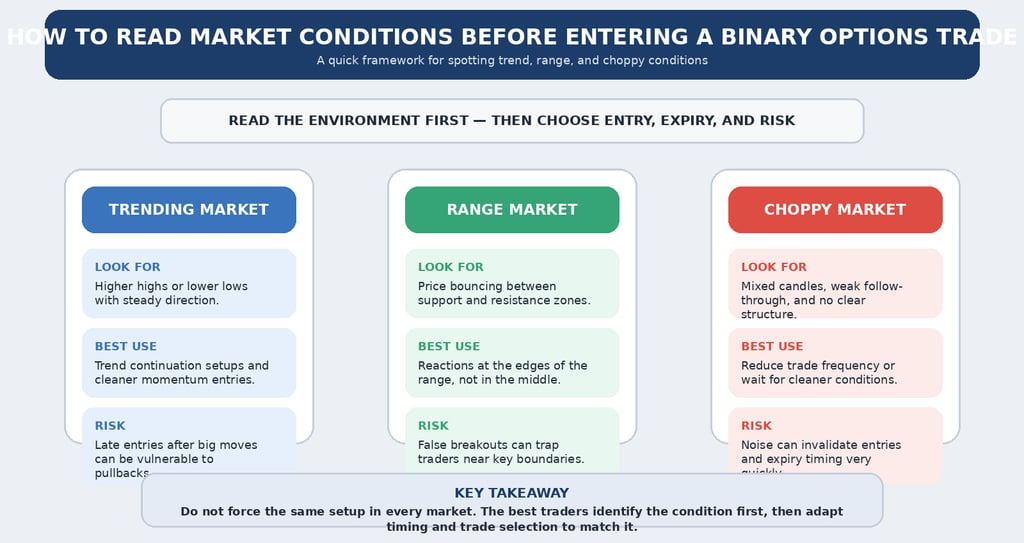
A trending market shows directional structure. Price keeps making higher highs and higher lows in an uptrend, or lower highs and lower lows in a downtrend. Candles generally have follow-through, and pullbacks tend to respect the dominant direction. In this kind of market, continuation entries usually make more sense than trying to call reversals too early.
A range market behaves differently. Price moves back and forth between visible support and resistance zones without building strong directional momentum. In these conditions, the cleaner opportunities often appear near the edges of the range, where price is reacting to established boundaries. Entries in the center of the range are usually weaker because the reward structure becomes less clear.
A choppy market is often the hardest to trade. Price has no stable direction, momentum fades quickly, and candles overlap without clean structure. Many false signals appear in this environment because price keeps shifting without commitment. This is where traders often lose the most, not because they are always wrong on direction, but because the market itself is not offering enough clarity.
How to read the chart before entering
The first question is simple: is price moving with structure or without it? That should come before indicators, before payouts, and before execution speed. If the chart shows clean directional movement, your strategy can be aligned with continuation logic. If price is respecting clear horizontal levels, range logic may be more appropriate. If neither is true, the market may be too unstable for a high-quality trade.
The second question is whether the market is moving cleanly enough for your expiry choice. A trend may exist, but if candles are too erratic, short expiry contracts can still become unreliable. A range may be well defined, but if price is sitting in the middle of it, the entry may still be weak. This is why market reading connects directly to timing. Our article on How to Choose the Right Expiry Time in Binary Options becomes much more useful once you first understand what kind of market you are trading.
The third question is whether volatility supports the setup. Even a correct market read can fail if volatility is either too weak or too unstable. That is why this topic works closely with How Volatility Affects Binary Options Trade Timing. Structure and volatility should be read together, not separately.
Common mistakes when reading market conditions
A common mistake is assuming that all movement equals momentum. A market can be active but still chaotic. Fast candles often tempt traders into short expiry contracts, but if those candles do not follow through, the trade becomes far less reliable than it first appears.
Another mistake is forcing trend logic inside a range. Traders see one strong candle and assume a breakout is underway, even though price is still trapped inside a wider horizontal structure. The opposite also happens. Some traders keep fading a market that has already moved from range behavior into genuine trend behavior.
A third mistake is ignoring market context because of payout. Higher payouts can attract attention, but payout should never override structure. A trade with an attractive payout in poor conditions is still a poor trade. That is also why How Payout Affects Profitability in Binary Options should be read as part of the broader process rather than as a stand-alone metric.
Why beginners should keep this process simple
Most beginners do not need a complex market-classification system. In fact, too much complexity often creates hesitation and confusion. A simpler process usually works better: identify whether the market is trending, ranging, or choppy, then decide whether your setup actually matches that condition.
This approach also improves demo testing. Instead of measuring a strategy across random sessions, traders can test how it performs in specific environments. That makes the results far more useful. If you are still working in a simulated account, revisit Best Binary Options Demo Accounts: What Traders Should Test Before Going Live. Demo testing becomes much more meaningful when it includes market condition analysis rather than random trade collection.
Final thoughts
Reading market conditions before entering a binary options trade is not optional. It is one of the foundations of consistent trade selection. Traders who understand the environment first usually make better decisions on timing, strategy, and discipline. Traders who ignore it often end up forcing the same approach into markets that do not support it.
The goal is not to predict every move. The goal is to understand what kind of market you are looking at before you commit capital. Once you start doing that consistently, entries become more selective, expiry decisions become more logical, and weak trades become easier to avoid.
For the next step, continue through our Trading Guides, compare broker environments in Broker Reviews, and use Broker Comparisons to see which platforms best fit your trading style.
Top Brokers
⚠️ Trading is speculative and involves risk. Consider your financial situation carefully before trading.
Related Articles
Binary Options Scam Red Flags: How to Spot an Untrustworthy Broker