
Best Timeframes for Binary Options Trading Strategies
Timeframe selection is one of the most misunderstood parts of binary options trading. Many traders spend too much time looking for indicators and not enough time thinking about the chart speed behind the setup. In practice, timeframe changes everything. It affects signal quality, market noise, trade frequency, expiry logic, and the kind of trader a strategy suits.
That is why there is no universal best timeframe in binary options. A lower timeframe can create more opportunities, but it also creates more randomness. A higher timeframe can improve structure, but it also reduces frequency and requires more patience. The goal is not to find the fastest chart. The goal is to find the chart that best matches the strategy, market condition, and expiry you are trying to trade.
If you are still building your platform shortlist, start with our Top Brokers, then compare execution environments in Broker Comparisons and review broker-specific conditions in Broker Reviews. This topic also connects naturally with How to Choose the Right Expiry Time in Binary Options, How Volatility Affects Binary Options Trade Timing, and How to Read Market Conditions Before Entering a Binary Options Trade.
Why timeframe matters so much
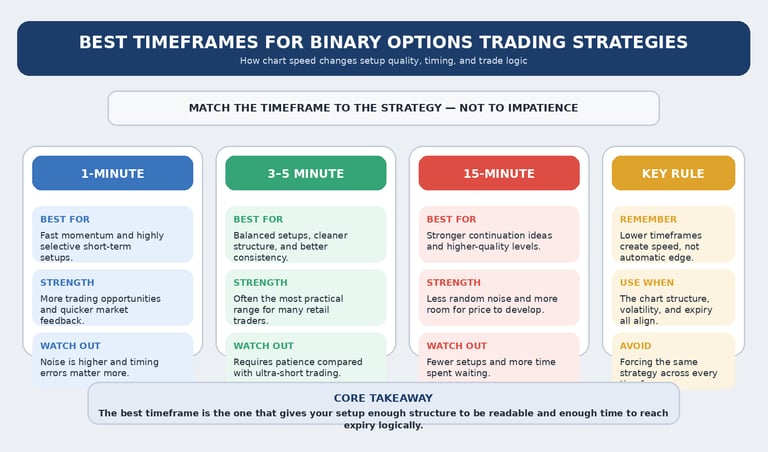
Timeframe determines how price is presented on the chart. A 1-minute chart compresses the market into fast-moving candles and creates a much more reactive environment. A 5-minute or 15-minute chart slows things down and usually makes structure easier to read. The same market can look chaotic on one timeframe and far more logical on another.
That matters because binary options depend on fixed-time outcomes. If the timeframe is too fast for the setup, the trader may be reacting to noise rather than real structure. If the timeframe is too slow, the signal may come too late or not fit the intended expiry. In both cases, the problem is not always the strategy itself. Often, it is the mismatch between the chart timeframe and the type of move the trader is trying to capture.
The role of lower timeframes
Lower timeframes, especially the 1-minute chart, appeal to traders because they create speed. More candles appear, more setups seem to emerge, and results come faster. That can be useful for short-term momentum traders or for strategies that depend on immediate reactions. It can also help experienced traders see market shifts quickly.
The problem is that lower timeframes contain more noise. Small reversals, candle wicks, and brief bursts of activity can look meaningful when they are not. This is why many beginners struggle on very fast charts. They mistake movement for quality and end up taking trades in conditions that have little real structure behind them.
Lower timeframes are not bad. They are simply less forgiving. They usually require stronger execution discipline, more selective entries, and better control over emotion.
Why medium timeframes are often the most practical
For many retail traders, the 3-minute to 5-minute chart is often the most practical range. It offers a better balance between speed and clarity. Price action is still active enough to provide opportunities, but not so fast that every candle becomes a source of confusion.
This is where many traders begin to improve. Market structure becomes easier to read, expiry selection becomes more logical, and the connection between setup quality and outcome becomes clearer. That does not mean medium timeframes are always best, but they often create a more stable environment for learning and consistency than ultra-fast charts.
This is especially true when combined with disciplined expiry selection. Our guide on How to Choose the Right Expiry Time in Binary Options becomes far more useful once traders stop treating every setup like a 1-minute trade.
What higher timeframes do better
Higher timeframes, such as the 15-minute chart, usually reduce random noise and make key levels easier to trust. Trends look cleaner, support and resistance zones become more meaningful, and trade ideas often have a stronger structural basis. That makes higher timeframes attractive for traders who prefer fewer but more deliberate decisions.
The tradeoff is that higher timeframes naturally produce fewer setups. They also require more patience and stronger trade selection. A trader who moves to a higher chart without adjusting expectations may become frustrated by the lower frequency and start forcing trades that are not really there.
Still, higher timeframes are often useful for traders who want better structure and less emotional overreaction. In many cases, they also pair better with calmer decision-making and cleaner market reading.
Matching timeframe to strategy
The best timeframe is the one that fits the logic of the strategy. A fast momentum setup may need a lower timeframe because the trade depends on immediate movement. A continuation strategy built around cleaner structure may work better on a medium chart. A trader who relies on stronger support and resistance zones may find better quality on a higher timeframe.
This is why timeframe should never be chosen out of habit. It should be chosen because it gives the setup enough structure to be readable and enough time to work before expiry. Timeframe selection is really a decision about context. It should reflect the strategy, the market condition, and the trader’s ability to stay disciplined within that environment.
That is also why this subject connects closely with How Volatility Affects Binary Options Trade Timing and How to Read Market Conditions Before Entering a Binary Options Trade. A timeframe that works in a stable trend may become much less reliable when volatility becomes erratic or when the market turns choppy.
Common timeframe mistakes
One of the most common mistakes is assuming that lower timeframes are automatically better because they create more action. More action does not always mean more edge. In many cases, it simply means more temptation to overtrade.
Another mistake is copying someone else’s timeframe without understanding the strategy behind it. A trader watching a 1-minute chart may be using a completely different style from someone trading 5-minute or 15-minute structure. The timeframe is part of the method, not just a visual preference.
A third mistake is constantly switching timeframes after a few losses. Traders often jump from fast to slow charts, or from slow to fast charts, without collecting meaningful data. That usually creates more confusion rather than better decision-making. A better approach is to test the same setup on one timeframe long enough to see whether the edge is real. That is where Best Binary Options Demo Accounts: What Traders Should Test Before Going Live becomes especially valuable.
What beginners should use
For most beginners, medium timeframes are usually the best place to start. They create enough market movement to keep the chart useful, but not so much speed that every decision becomes reactive. A 3-minute or 5-minute chart often gives new traders a better chance to understand structure, timing, and discipline than jumping directly into 1-minute trading.
That does not mean beginners should never study faster charts. It simply means the learning process is often more stable when the timeframe is not working against them. The goal is not to trade as fast as possible. The goal is to understand why a setup works, when it works, and how the chosen expiry fits the chart being used.
Final thoughts
The best timeframe for binary options trading strategies depends on the trade logic behind the setup. Lower timeframes create speed but also more noise. Medium timeframes often offer the best balance between opportunity and structure. Higher timeframes can improve clarity, but they reduce frequency and demand patience.
The strongest traders do not choose a timeframe because it feels exciting. They choose it because it supports the way they read the market and the kind of move they are trying to capture. Once timeframe is treated as part of the strategy rather than a random preference, trade quality becomes easier to evaluate and consistency becomes much more realistic.
For the next step, continue through our Trading Guides, compare broker execution conditions in Broker Reviews, and use Broker Comparisons to see which platforms best suit your trading style.
Top Brokers
⚠️ Trading is speculative and involves risk. Consider your financial situation carefully before trading.
Related Articles
Binary Options Scam Red Flags: How to Spot an Untrustworthy Broker