
Binary Options Break-Even Rate Explained: The Hidden Number Traders Ignore
Break-even rate is one of the most important numbers in binary options trading, yet many traders barely think about it. They focus on win rate because it feels intuitive. If a strategy wins more often than it loses, it should be good, right? Not necessarily. In binary options, win rate only tells part of the story. The missing part is payout, and break-even rate is the number that connects the two.
This matters because a strategy can look better than it really is when traders judge it by wins alone. A 55% win rate may sound solid, but if payouts are too low, that result can still lose money over time. On the other hand, a strategy with a lower win rate may still be viable if the payout structure is stronger. That is why break-even rate deserves far more attention than it usually gets.
If you are still comparing brokers, start with our Top Brokers, then review platform conditions in Broker Reviews and compare payout environments through Broker Comparisons. This topic also connects directly with Why a 55% Win Rate Can Still Lose Money in Binary Options, How Payout Affects Profitability in Binary Options, Binary Options Money Management: How Much Should You Risk Per Trade?, How to Test a Binary Options Strategy Before Using Real Money, and Binary Options Trade Journal: What to Track and Why.
What break-even rate actually means
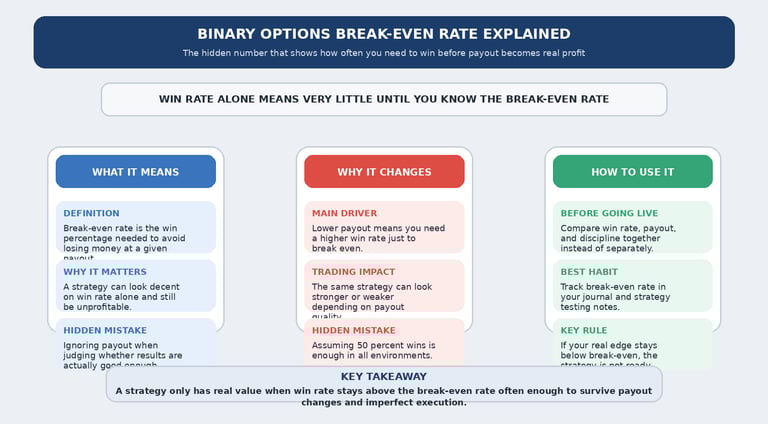
Break-even rate is the minimum percentage of trades you need to win in order to avoid losing money over time at a given payout level. It is not a target for strong profitability. It is simply the line between losing and not losing. That is what makes it so important. If your real win rate stays below break-even, the strategy is not viable no matter how convincing a few short-term results may look.
This is where many traders go wrong. They think in simple terms: win more than half, make money. But binary options payouts are usually less than 100% of the stake. That changes the math immediately. When you lose, you usually lose the full amount risked. When you win, you usually gain less than that amount in profit. That imbalance means you often need to win more than 50% just to stay flat.
Once traders understand that, performance becomes easier to judge honestly. A strategy is not profitable because it “wins a lot.” It is profitable only when its win rate stays high enough relative to payout.
Why payout changes the whole picture
Payout is what makes break-even rate so important. The lower the payout, the higher the win rate required to break even. That means two traders can use very similar strategies and get very different results depending on the payout environment they are trading in.
This is why payout quality should never be treated as a side detail. It directly affects whether your edge is strong enough to survive. A trader may believe the strategy is failing when the real issue is that the payout structure is too weak to support the current win rate. Another trader may overestimate the strategy because recent payouts happened to be unusually favorable.
That is exactly why How Payout Affects Profitability in Binary Options belongs so close to this article. Payout does not just improve returns when things go well. It changes the minimum performance required to avoid slow losses in the first place.
Why break-even rate matters more than raw win rate
Win rate is useful, but on its own it can be dangerously misleading. It tells you how often you are right, but not whether being right often enough is actually profitable. Break-even rate solves that problem by putting win rate into financial context.
This is especially important in binary options because many traders are emotionally influenced by streaks. A short run of wins can make a strategy feel stronger than it is. A short run of losses can make a valid strategy feel broken. Break-even rate helps neutralize some of that emotion by giving traders a more objective standard.
It also explains why two win rates that look similar may not mean the same thing. One trader winning 56% of trades in a weaker payout environment may still be struggling. Another trader winning 56% in a stronger payout environment may be doing much better. Without break-even rate, both situations can be misread.
Why many traders underestimate this number
The main reason is that break-even rate feels less intuitive than win rate. Traders naturally count wins and losses because those are visible and emotionally immediate. Break-even rate requires one more step of thinking. It asks whether the current payout environment makes those wins sufficient. Many traders never do that calculation seriously enough.
This is one reason poor strategies can survive in a trader’s mind for too long. The trader remembers the good streaks, sees a decent raw win rate, and assumes the edge is real. But if the strategy is operating too close to break-even, even small drops in payout or small drops in execution quality can make the entire approach unprofitable.
That is exactly why Why a 55% Win Rate Can Still Lose Money in Binary Options is such a strong companion piece. It gives the practical version of the same idea. Break-even rate gives the underlying logic behind it.
How traders should actually use break-even rate
The best use of break-even rate is not as a one-time calculation. It should be part of strategy evaluation, journaling, and broker comparison. Traders should know the approximate win rate their setup needs at typical payout levels, then compare that requirement with real performance over a meaningful sample.
This makes strategy testing much more honest. Instead of asking only whether the strategy produced a decent win rate, the trader can ask whether that win rate stayed high enough above break-even to leave real room for error, payout variation, and imperfect execution. That is why this topic belongs closely with How to Test a Binary Options Strategy Before Using Real Money.
It also belongs in a trade journal. A journal should not only record wins and losses. It should help reveal whether the strategy stays comfortably above break-even or only survives during good stretches. That is one more reason Binary Options Trade Journal: What to Track and Why fits so naturally here.
Break-even rate and money management
Break-even rate is not the same as money management, but the two are closely connected. A trader with weak risk discipline may never get a clean enough sample to judge whether the strategy truly stays above break-even. Emotional size changes, chasing losses, and inconsistent execution distort the numbers.
This is why good risk habits still matter. Break-even rate helps reveal whether the edge exists, but money management helps preserve the ability to measure that edge honestly. When position size is unstable, performance becomes harder to interpret because part of the result comes from emotional behavior rather than from the strategy itself.
That is exactly why Binary Options Money Management: How Much Should You Risk Per Trade? and How to Manage Risk in Binary Options Without Chasing Losses support this topic so well. Math matters, but only when the trader behaves consistently enough for the math to mean something.
Common mistakes traders make with break-even rate
The first mistake is ignoring payout variation. Traders often use one fixed assumption in their mind, even though actual payout conditions may shift across assets, sessions, or brokers. That can create a false sense of security.
The second mistake is thinking that being slightly above break-even is enough. In reality, a strategy that sits too close to the break-even line may still be fragile. Small changes in market condition, discipline, or execution can wipe out the edge quickly. Serious traders usually want more cushion than that.
The third mistake is using break-even rate without reviewing the process behind the results. A win rate that looks acceptable on paper may come from poor discipline, lucky timing, or a sample that is too small to trust. Break-even rate helps evaluate performance, but it does not replace structured review.
What beginners should understand first
For beginners, the most important lesson is simple: a strategy is not profitable just because it wins more often than it loses. It must win often enough for the payout environment you are actually trading in. That is the core purpose of break-even rate.
This is also why beginners should test carefully before going live. A few good sessions prove very little. A real sample, combined with payout awareness and disciplined journaling, is what shows whether the edge is real. That is one more reason Best Binary Options Demo Accounts: What Traders Should Test Before Going Live remains so important inside this cluster.
Final thoughts
Break-even rate is the hidden number many binary options traders ignore because win rate feels easier to understand. But once payout enters the equation, win rate by itself is not enough. Break-even rate shows whether your current performance is actually good enough to avoid long-term losses.
The real value of this number is not academic. It helps traders stop confusing activity with edge and stop trusting results that only look strong on the surface. Once break-even rate becomes part of strategy testing, journaling, and broker evaluation, performance analysis becomes much more honest.
For the next step, continue through our Trading Guides, review broker conditions in Broker Reviews, and compare payout environments through Broker Comparisons.
Top Brokers
⚠️ Trading is speculative and involves risk. Consider your financial situation carefully before trading.
Related Articles
Binary Options Scam Red Flags: How to Spot an Untrustworthy Broker