
How to Manage Risk in Binary Options Without Chasing Losses
Risk management is one of the most important parts of binary options trading, yet it is also one of the first things many traders abandon after a losing trade. In theory, most people understand that capital should be protected and that losses are part of the process. In practice, however, one loss often creates the urge to recover immediately. That is where risk control starts to break down.
This is why managing risk is not only about numbers. It is also about protecting judgment. In binary options, decisions happen quickly, contracts settle fast, and emotional pressure can build within minutes. When traders begin increasing size, lowering standards, or forcing entries just to get back what they lost, they are no longer managing risk. They are reacting to discomfort.
If you are still comparing platforms, start with our Top Brokers, then study execution conditions in Broker Reviews and side-by-side differences in Broker Comparisons. This article also connects naturally with How to Build a Simple Binary Options Trading Plan, How to Avoid Overtrading in Binary Options, How to Choose the Right Expiry Time in Binary Options, and Common Binary Options Mistakes Beginners Make.
Why chasing losses is so dangerous
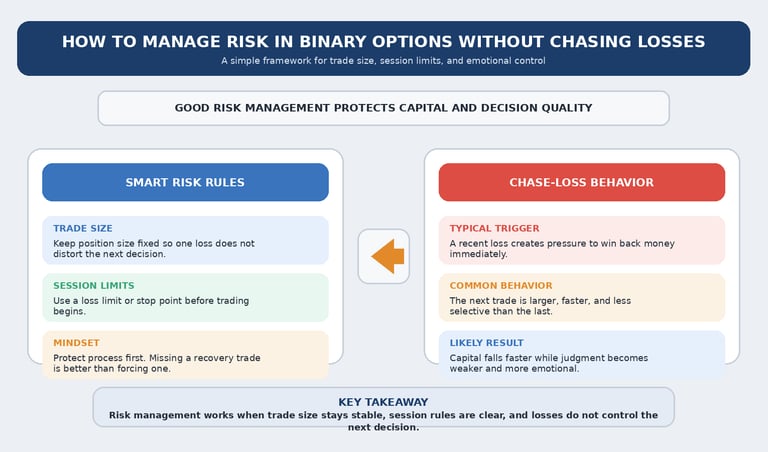
Chasing losses usually begins with a simple thought: the next trade will fix the previous one. That idea feels reasonable in the moment, especially after a setup that looked close to working. But once the goal shifts from taking a good trade to recovering money quickly, decision quality changes. The next entry is often faster, less selective, and more emotional than the last one.
This is what makes chase-loss behavior so damaging. The problem is not just the loss itself. The problem is that the trader gives the loss control over the next decision. In binary options, that often leads to larger trade size, shorter expiry choices, weaker market reading, and more impulsive execution. One bad trade turns into several because the process is now driven by recovery rather than discipline.
Losses are part of trading. Chasing them is optional. That distinction matters.
What real risk management looks like
Real risk management begins before the session starts. It is not something added after the market becomes stressful. A trader should already know how much to risk per trade, how many losses are acceptable in one session, and when trading stops for the day. These decisions should be made calmly, not while trying to recover from a bad result.
Fixed trade size is one of the most important foundations. When position size stays stable, a single loss remains manageable and does not distort the next decision. Traders who start increasing stake size after losses usually believe they are solving the problem faster, but they are actually increasing pressure at the exact moment they need more control.
Session limits matter just as much. A daily loss limit or a clear stopping point protects both capital and mental discipline. Once frustration reaches a certain level, it becomes much harder to assess setups objectively. This is why good risk management is not only financial. It is behavioral.
Why structure reduces emotional mistakes
Risk management works best when it is part of a wider process. A trader with no clear plan will struggle to manage losses well because there is no structure to fall back on. Everything becomes reactive. That is why this topic fits directly with How to Build a Simple Binary Options Trading Plan. A plan gives losses context. It reminds the trader that each result is one outcome inside a larger process, not a crisis that must be fixed immediately.
This also connects to overtrading. Traders who chase losses often start taking more trades than the market justifies. They move from one asset to another, shorten expiry, or accept weaker setups simply because they want action. That behavior usually makes the drawdown worse. Our guide on How to Avoid Overtrading in Binary Options explains why frequency often becomes the hidden problem after emotional losses begin.
Even expiry selection can suffer here. Traders who lose patience often move to faster contracts because fast results feel like faster recovery. But poor timing usually compounds the problem. That is why How to Choose the Right Expiry Time in Binary Options remains relevant even in a risk-focused discussion.
How disciplined traders respond to losing trades
A disciplined trader does not treat every loss as a signal to act. Sometimes the correct response to a loss is simply to do nothing for a few minutes. That pause matters because it breaks the emotional chain between the last result and the next decision.
The strongest traders review the quality of the previous trade before entering again. Did the setup match the plan? Were market conditions suitable? Was the expiry logical? If the previous trade was valid and still lost, the answer may be to continue normally. If the trade was emotional or poorly timed, the answer may be to step away and protect the session.
This is an important distinction. Good traders do not try to erase losses emotionally. They absorb them professionally. That means keeping size stable, refusing to speed up just because of frustration, and accepting that no single trade needs to “fix” the session.
What beginners usually get wrong about risk
Many beginners think risk management is only about preventing catastrophic losses. That is part of it, but the deeper role of risk control is to preserve consistency. If trade size changes too often, if session limits do not exist, or if losses keep influencing the next decision, it becomes almost impossible to evaluate real performance.
This is one reason beginners often feel confused about whether their strategy works. They are not measuring the strategy anymore. They are measuring a mixture of valid trades, emotional reactions, revenge entries, and inconsistent sizing. That makes improvement very difficult.
A better approach is simpler. Keep trade size stable. Set a clear daily stop point. Accept that losses will happen. Judge performance across a series of disciplined decisions, not through the emotional weight of the most recent outcome. That logic also sits behind Common Binary Options Mistakes Beginners Make, because chase-loss behavior is rarely an isolated problem. It usually appears alongside weak planning and poor discipline.
Final thoughts
Managing risk in binary options without chasing losses is not about avoiding every losing trade. It is about making sure one loss does not control everything that happens next. Once traders understand that, risk management becomes less about fear and more about structure.
The goal is simple: keep losses contained, keep size consistent, and protect decision quality even when the session becomes uncomfortable. Traders who can do that give themselves a real chance to improve. Traders who keep trying to recover emotionally usually make the drawdown worse.
For the next step, continue through our Trading Guides, compare execution conditions in Broker Reviews, and use Broker Comparisons to find the broker environment that best fits your trading style.
Top Brokers
⚠️ Trading is speculative and involves risk. Consider your financial situation carefully before trading.
Related Articles
Binary Options Scam Red Flags: How to Spot an Untrustworthy Broker