
How to Test a Binary Options Strategy Before Using Real Money
Testing a binary options strategy before going live is one of the most important steps a trader can take, yet it is often handled far too casually. Many traders try a setup for a few sessions, see a small run of wins, and assume the strategy is ready. Others do the opposite. They see a few losses, abandon the idea, and start searching for the next method. In both cases, the problem is not the strategy alone. The problem is weak testing.
A real strategy test is not about finding a few lucky results. It is about learning whether the setup has logic, whether that logic survives across different market conditions, and whether you can execute it with enough discipline to trust it with real money. In binary options, where fixed expiry makes timing especially sensitive, this step matters even more than many beginners realize.
If you are still comparing brokers before going live, start with our Top Brokers, then study platform quality in Broker Reviews and compare providers in Broker Comparisons. This article also fits directly with Best Binary Options Demo Accounts: What Traders Should Test Before Going Live, Why a 55% Win Rate Can Still Lose Money in Binary Options, How Payout Affects Profitability in Binary Options, How to Build a Simple Binary Options Trading Plan, and Binary Options Trade Journal: What to Track and Why.
Why most strategy testing fails
Most bad testing fails for one simple reason: the trader is not actually testing one stable process. The setup keeps changing. The expiry changes after a loss. The entry becomes looser after a missed trade. The market condition is ignored one day and treated seriously the next. By the end of the sample, the trader is no longer measuring a strategy. They are measuring a mix of ideas, impulses, and reactions.
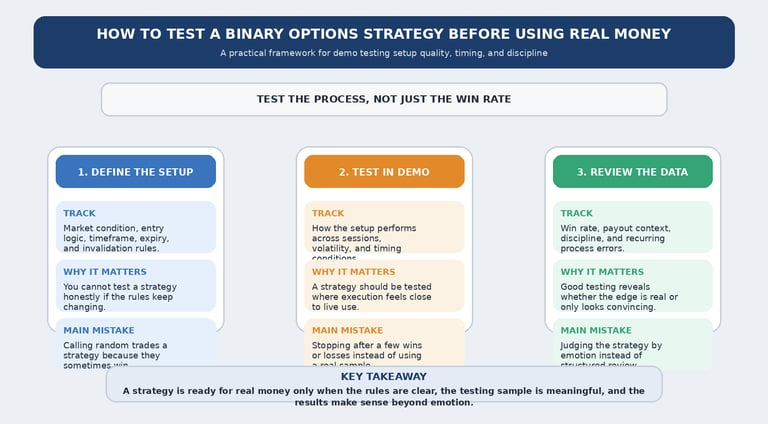
This is why real testing begins with definition. Before you can judge whether a strategy works, you need to know exactly what the strategy is. What market condition does it belong in? What is the entry logic? What timeframe is being used? What expiry is supposed to fit the setup? What invalidates the idea? If those answers are unclear, the test will be unclear too.
That is also why strategy testing belongs inside a wider trading process. A setup cannot be separated from market reading, expiry selection, and discipline. A strategy that “works” only when rules drift constantly is not really a strategy at all.
Define the strategy before you test it
The first step is to make the setup specific enough to be repeatable. A vague idea like “trade good candles near support” is not enough. The strategy should explain what kind of market you want, what level or structure matters, what kind of confirmation is required, and how long the contract should last.
This does not mean the rules need to become overly complicated. In fact, simpler testing usually produces better learning. The goal is not to write a textbook. The goal is to create a setup clear enough that you can recognize when it is present and when it is not.
This is where many of your existing guides connect naturally. A real strategy definition often depends on How to Read Market Conditions Before Entering a Binary Options Trade, How to Choose the Right Expiry Time in Binary Options, How Volatility Affects Binary Options Trade Timing, and How to Use Candlestick Confirmation in Binary Options Entries. Those are not separate ideas. They are part of how a test becomes valid.
Use demo testing the right way
Once the strategy is defined, the next step is to test it in demo under conditions that are close enough to live trading to be meaningful. This is where many traders make another mistake. They use demo only to chase wins instead of to collect useful evidence. The point is not to prove the strategy is exciting. The point is to see how it behaves across a real sample of trades.
A good demo test should include multiple sessions, more than one market condition, and enough trades to reveal whether the setup logic is actually stable. It should also include execution discipline. Did you take only trades that matched the rules? Did you change expiry emotionally? Did the setup still make sense when the market became less comfortable?
This is why Best Binary Options Demo Accounts: What Traders Should Test Before Going Live is so important here. A demo account is not just a place to place practice trades. It is where the strategy and the trader both get tested before real money enters the process.
Test more than win rate
One of the biggest mistakes in binary options strategy testing is treating win rate as the only serious metric. Win rate matters, but it means very little without payout context, expiry logic, and execution consistency. A trader can have a 55% win rate and still lose money if payout is weak or if trade quality breaks down at the wrong moments. That is why Why a 55% Win Rate Can Still Lose Money in Binary Options should be read as part of this process.
Payout also needs context. A strategy may perform well enough on paper, but if it depends on conditions where payout is often unattractive, the real edge may be weaker than expected. That connects directly with How Payout Affects Profitability in Binary Options.
This means a real strategy test should ask better questions than “Did it win?” It should ask whether the setup worked in the right market, whether timing was logical, whether payout made the result worthwhile, and whether the strategy still holds up when conditions shift.
Review the process, not just the outcome
The strongest strategy tests always include review. Without review, traders usually remember results emotionally instead of accurately. A good journal helps prevent that. It shows not just whether the trade won, but why it was taken, whether it followed the plan, and whether the execution made sense.
This is where Binary Options Trade Journal: What to Track and Why becomes essential. A journal turns scattered trades into usable evidence. It helps reveal whether the strategy fails in certain market conditions, whether expiry choices drift too much, or whether emotional decisions are distorting the sample.
Review also keeps traders honest. Sometimes a strategy looks weak when the real problem is discipline. Other times the trader was disciplined, but the strategy itself was too vague or too dependent on one narrow condition. Without structured review, those two situations are easy to confuse.
Strategy testing should include the trader too
A strategy may be valid on paper and still not fit the person using it. This is one of the most overlooked parts of testing. Some setups demand more patience than the trader can realistically maintain. Others require fast execution in environments where the trader becomes emotional or rushed. That does not always mean the method is bad. It may simply mean the fit is poor.
This is why testing should include behavioral questions. Can you follow the setup consistently? Do you keep forcing trades when the market is not right? Do you stay within your plan after losses? Does the strategy encourage overtrading? These issues matter because a strategy is only useful if it can be executed with discipline.
That is exactly why this article fits naturally with How to Avoid Overtrading in Binary Options, When to Skip a Binary Options Trade, and How to Manage Risk in Binary Options Without Chasing Losses. Strategy testing is not only about the setup. It is also about the trader’s ability to handle it responsibly.
When a strategy is not ready for real money
A strategy is not ready for real money when the rules are still changing constantly, when the sample size is too small to trust, or when the results only look good under one narrow set of conditions that the trader does not fully understand. It is also not ready when the trader can only make it work by bending rules after losses or by trading emotionally when pressure rises.
In other words, a strategy is not ready just because it had a good week. It is ready only when the logic is clear, the testing is honest, and the trader can execute the method with enough consistency to believe the edge is real.
This is where patience becomes part of professionalism. Moving to live trading too early often does more damage than traders expect. It creates emotional pressure before the process has earned that pressure.
Final thoughts
Testing a binary options strategy before using real money is not about collecting a few wins. It is about proving that the setup has clear rules, that those rules hold up across a meaningful sample, and that you can follow them without turning every session into improvisation.
The real goal is not confidence based on excitement. It is confidence based on evidence. Once a strategy has been defined clearly, tested honestly, and reviewed with discipline, the decision to go live becomes much more intelligent. Until then, demo is not a delay. It is part of the work.
For the next step, continue through our Trading Guides, review platform conditions in Broker Reviews, and compare broker environments in Broker Comparisons.
Top Brokers
⚠️ Trading is speculative and involves risk. Consider your financial situation carefully before trading.
Related Articles
Binary Options Scam Red Flags: How to Spot an Untrustworthy Broker