
Binary Options Trade Journal: What to Track and Why
A trade journal is one of the most useful tools a binary options trader can build, yet many traders either skip it completely or use it in the wrong way. They record a win, record a loss, maybe add the payout, and assume that is enough. It is not. A useful journal is not just a record of outcomes. It is a record of decisions.
This matters because most trading mistakes are process mistakes long before they become money mistakes. A trader may think the problem is strategy, but the real issue may be poor timing, weak market reading, emotional entries, or inconsistent expiry choices. Without a journal, those patterns stay hidden. With a journal, they start becoming visible.
If you are still comparing brokers, start with our Top Brokers, then study platform quality in Broker Reviews and compare providers in Broker Comparisons. This article also fits closely with How to Build a Simple Binary Options Trading Plan, Best Binary Options Demo Accounts: What Traders Should Test Before Going Live, Why a 55% Win Rate Can Still Lose Money in Binary Options, and How to Manage Risk in Binary Options Without Chasing Losses.
Why a journal matters in binary options
Binary options trading moves quickly. Contracts open and close fast, decisions happen under pressure, and traders can move from one setup to the next without really learning from the last one. That speed makes journaling more important, not less. Without structured review, it becomes very easy to repeat the same mistake across dozens of trades while still believing the problem is random.
A journal slows the process down after the session. It gives the trader a chance to ask what actually happened, why the trade was taken, and whether the setup truly matched the plan. This is what turns experience into useful feedback. Without that reflection, screen time alone often becomes repetitive rather than educational.
A good journal also protects the trader from shallow conclusions. One trade proves very little. A larger group of trades, reviewed honestly and consistently, can reveal where the real strengths and weaknesses are.
What a binary options trade journal should actually track
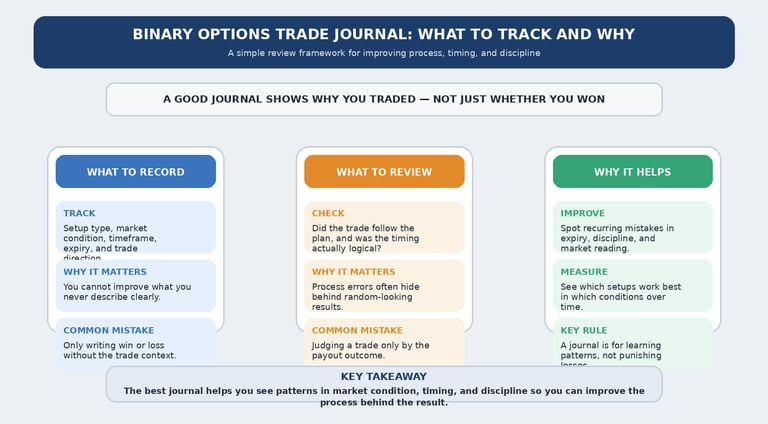
A useful journal should start with the basics, but it should not stop there. The trade result matters, but the setup context matters more. At minimum, traders should record the asset, the market condition, the setup type, the timeframe used, the expiry selected, and the trade direction. Those details create the structure that makes later review meaningful.
It is also important to record why the trade was taken. This is where many journals become too shallow. A trade should not only say “call on EUR/USD.” It should explain whether the trade came from a continuation setup, a support reaction, a clean rejection candle, or some other defined logic. Without that explanation, results become difficult to interpret.
Emotional state is another powerful journal category. A trader should know whether the trade was calm, rushed, frustrated, or influenced by a recent loss. This may feel uncomfortable at first, but it often reveals patterns that technical notes alone cannot show.
Why journaling should focus on process, not just outcome
One of the biggest mistakes traders make is using the journal like a scoreboard. They focus only on whether the trade won or lost. That creates a misleading view of performance because a winning trade can still be badly executed, and a losing trade can still be well executed.
This is especially important in binary options because fixed-time outcomes can make short-term results look more dramatic than they really are. A well-structured trade can still lose because the move developed too slowly. A poor trade can still win because price moved in the right direction briefly before expiry. If the journal only tracks profit and loss, those differences are lost.
A better journal asks stronger questions. Did the trade follow the plan? Was the market condition suitable? Did the expiry make sense for the setup? Was the entry patient or forced? These questions help the trader improve the process behind the result, which is where real consistency comes from.
What patterns a journal can reveal over time
The real power of a journal appears after a meaningful sample of trades. Over time, the trader can begin to see which setups perform best, which market conditions create problems, and which personal habits keep damaging otherwise reasonable decisions. This is where journaling becomes much more than administration. It becomes a tool for pattern recognition.
For example, a trader may discover that continuation trades perform much better than reversal trades. Or that short expiry contracts work during active sessions but fail repeatedly in quiet conditions. Or that losses become more common after a certain level of frustration appears. None of those insights are easy to trust without written evidence.
This is why a journal supports so many of the other guides on your site. It connects directly to How to Read Market Conditions Before Entering a Binary Options Trade, How to Choose the Right Expiry Time in Binary Options, How to Avoid Overtrading in Binary Options, and Common Binary Options Mistakes Beginners Make. A journal helps traders see whether they are actually applying those ideas consistently.
How journaling improves risk and performance analysis
A trade journal also helps traders evaluate performance more honestly. Many retail traders focus too heavily on win rate and ignore the wider relationship between payout, risk, and execution quality. That is one reason journaling fits naturally with Why a 55% Win Rate Can Still Lose Money in Binary Options and How Payout Affects Profitability in Binary Options.
A journal helps place those numbers in context. A trader may see that a 55% win rate came from weak discipline and unstable conditions, which makes it less trustworthy than it first appears. Another trader may discover that one setup produces slightly fewer wins but much cleaner decision quality. Without journaling, both situations can be misunderstood.
Risk behavior also becomes easier to evaluate. Traders can see whether they follow their plan after losses, whether position size stays stable, and whether emotional decisions begin to rise during difficult sessions. That makes journaling a practical support tool for How to Manage Risk in Binary Options Without Chasing Losses.
What beginners should keep simple
Beginners do not need a complicated journal from the start. In fact, overcomplicated journaling often leads to inconsistency because it feels too time-consuming to maintain. A simple structure works better: record the setup, the market condition, the timeframe, the expiry, the reason for entry, the emotional state, and whether the trade followed the plan.
That is enough to begin learning. The goal is not to build a perfect database immediately. The goal is to create enough clarity that repeated mistakes stop hiding inside vague memory. Once journaling becomes habitual, it can become more detailed if needed.
This is also why demo trading and journaling should work together. A journal is especially valuable in practice mode because it helps traders learn which setups deserve real-money trust later. That is one reason Best Binary Options Demo Accounts: What Traders Should Test Before Going Live belongs in the same internal-link cluster.
Common trade journal mistakes
One common mistake is journaling only the result. Another is writing notes that are too vague to be useful later. Statements like “bad trade” or “market weird” may feel honest in the moment, but they do not create enough clarity to improve future decisions.
A third mistake is using the journal emotionally. Some traders turn it into a place for self-criticism rather than analysis. That weakens its value. A journal should be a review tool, not a punishment tool. It is there to show patterns, not to create guilt.
A fourth mistake is inconsistency. Journaling only after losses or only during strong weeks creates a distorted record. The value of a journal comes from honest repetition, not from occasional effort.
Final thoughts
A binary options trade journal is one of the clearest ways to turn trading activity into genuine learning. It helps traders track what they did, why they did it, and whether the decision actually matched the method they want to follow. Without that process, mistakes stay hidden behind memory and emotion. With it, weak habits become easier to identify and improve.
The goal is not to build a journal that looks impressive. The goal is to build one that reveals patterns in timing, market condition, discipline, and execution. Once those patterns become visible, traders can improve with much more precision than they can through intuition alone.
For the next step, continue through our Trading Guides, review platform conditions in Broker Reviews, and compare broker environments in Broker Comparisons.
Top Brokers
⚠️ Trading is speculative and involves risk. Consider your financial situation carefully before trading.
Related Articles
Binary Options Scam Red Flags: How to Spot an Untrustworthy Broker