
How to Avoid Overtrading in Binary Options
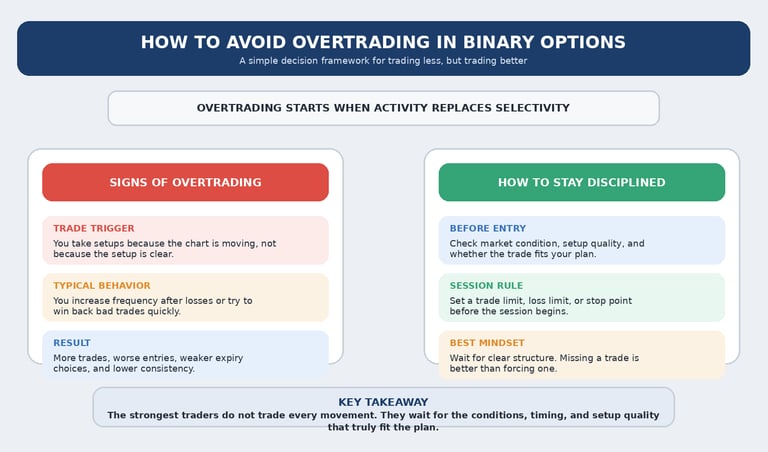
Overtrading is one of the fastest ways to destroy consistency in binary options. Many traders assume their main problem is strategy quality, but in reality the bigger issue is often trade frequency. They take too many setups, lower their standards after a few losses, and start reacting to movement instead of waiting for real opportunity.
This happens because binary options create a fast decision environment. Charts move quickly, contracts settle quickly, and the platform always makes the next trade feel close. That speed can be useful, but it also makes discipline much harder. Once traders stop selecting only high-quality setups and start trading just to stay active, performance usually declines very quickly.
If you are still comparing platforms, begin with our Top Brokers, then study execution conditions in Broker Reviews and side-by-side Broker Comparisons. This topic also connects naturally with How to Read Market Conditions Before Entering a Binary Options Trade, How Volatility Affects Binary Options Trade Timing, and Best Timeframes for Binary Options Trading Strategies.
Why overtrading is so common in binary options
Binary options encourage speed. There is always another candle, another asset, another short expiry, and another chance to recover a loss. That environment makes it easy for traders to confuse activity with progress. They feel productive because they are taking trades, even when the quality of those trades is getting worse.
This is especially dangerous after a losing trade. Instead of reviewing whether the previous setup was valid, many traders respond emotionally and enter again too quickly. They want to recover, stay involved, or prove the last loss was just temporary. That is often the moment discipline breaks down.
Overtrading does not always look dramatic. Sometimes it is simply the habit of taking mediocre setups that would normally be skipped. Sometimes it is changing expiry too often, forcing trades in weak market conditions, or moving from one asset to another without a clear reason. The common pattern is the same: standards drop while trade count rises.
What overtrading actually does to performance
The biggest problem with overtrading is not just volume. It is the damage it causes to decision quality. Once traders start forcing opportunities, entries become weaker, expiry choices become less logical, and the connection between strategy and execution begins to disappear.
This is why overtrading often makes a trader feel lost. They can no longer tell whether the strategy is working because the sample is full of low-quality trades. One part of the session may reflect the real method, while another part is driven entirely by emotion or impatience. That makes improvement much harder because the data itself becomes unreliable.
Overtrading also increases psychological pressure. Every extra trade adds more emotional exposure, more frustration, and more temptation to react instead of think. The result is usually a cycle where too many trades lead to poor outcomes, and poor outcomes lead to even more unnecessary trades.
The link between overtrading and market conditions
A large part of overtrading begins with poor market reading. Traders see movement and assume it means opportunity, even when the chart is choppy or structurally weak. That is why this topic is closely connected to How to Read Market Conditions Before Entering a Binary Options Trade. If the environment is unclear, trade frequency should usually decrease, not increase.
Volatility also plays a role. Fast markets can create the illusion of endless opportunities, but aggressive movement does not always mean tradable movement. In unstable conditions, forcing more trades usually makes timing worse, especially on short expiry contracts. This is why How Volatility Affects Binary Options Trade Timing matters so much when trying to reduce unnecessary trades.
Timeframe choice matters as well. Lower charts generate more signals, but many of them are low quality. Traders who spend too much time on ultra-fast charts often end up reacting to every candle instead of waiting for structure. That is one reason many traders find better discipline on more balanced charts, as discussed in Best Timeframes for Binary Options Trading Strategies.
How disciplined traders reduce overtrading
The first step is to accept that not every session deserves the same number of trades. Some days the market is clean, readable, and supportive of your strategy. Other days it is not. A good trader adapts to that. A weak trader keeps forcing the same activity level no matter what the chart looks like.
The second step is to define a session structure before trading begins. That may mean setting a maximum number of trades, a daily loss limit, or a rule that trading stops after a certain level of emotional frustration appears. These limits are not signs of weakness. They are guardrails that protect decision quality when emotions begin to rise.
The third step is to judge setups more strictly. Before every trade, ask whether the market condition is clear, whether the setup fits the strategy, and whether the expiry still makes sense for that specific environment. If the answer is uncertain, the trade is usually unnecessary. In binary options, the trades you skip often matter as much as the trades you take.
Why beginners should focus on selectivity first
Many beginners believe improvement comes from taking more trades and gaining more experience. Some screen time is useful, but too much unstructured trading usually teaches the wrong lessons. It conditions the trader to act quickly rather than think clearly.
A better approach is to build the habit of selectivity early. That means learning to wait for market conditions that match the strategy, rather than trying to make every chart fit the plan. It also means using demo sessions properly. The goal of demo trading is not to place as many contracts as possible. The goal is to understand which setups deserve execution and which should be ignored. That is why Best Binary Options Demo Accounts: What Traders Should Test Before Going Live remains so important.
Final thoughts
Overtrading is rarely solved by finding a new indicator or a new broker. It is usually solved by improving standards, reducing emotional reaction, and treating trade selection as the real edge. Traders who learn to wait for quality often discover that their results improve not because they found more setups, but because they stopped forcing the wrong ones.
The goal is not to trade constantly. The goal is to trade when the market, timing, and setup all justify the risk. Once that becomes the standard, discipline gets stronger, data becomes cleaner, and consistency becomes much more realistic.
For the next step, continue through our Trading Guides, compare broker environments in Broker Reviews, and use Broker Comparisons to narrow down the platforms that best fit your trading style.
Top Brokers
⚠️ Trading is speculative and involves risk. Consider your financial situation carefully before trading.
Related Articles
Binary Options Scam Red Flags: How to Spot an Untrustworthy Broker