
How to Build a Simple Binary Options Trading Plan
A simple trading plan is one of the most useful tools a binary options trader can have. Many traders think the main path to improvement is finding a better indicator or a better signal, but without a plan, even a decent setup becomes difficult to execute consistently. A trading plan gives structure to your decisions before the session starts, which means you rely less on emotion once the market begins moving.
This matters even more in binary options because the pace of decision-making is faster than in many other markets. Contracts settle quickly, setups appear and disappear fast, and it is easy to move from one trade to the next without stopping to think. A trading plan slows that process down. It does not make trading mechanical, but it makes your decisions more intentional.
If you are still comparing platforms, start with our Top Brokers, then review execution quality in Broker Reviews and side-by-side Broker Comparisons. This topic also connects naturally with How to Read Market Conditions Before Entering a Binary Options Trade, Best Timeframes for Binary Options Trading Strategies, How to Avoid Overtrading in Binary Options, and How to Choose the Right Expiry Time in Binary Options.
Why a trading plan matters
A trading plan creates consistency around things that traders often handle impulsively. Instead of choosing assets randomly, reacting emotionally to losses, or changing expiry from trade to trade without logic, the trader works from a defined process. That process does not guarantee profits, but it does make results easier to evaluate honestly.
Without a plan, every session becomes vulnerable to mood, impatience, and short-term reaction. One losing trade can lead to revenge trading. One winning streak can lead to overconfidence. A plan acts as a filter between market movement and personal emotion. It keeps the focus on what should happen before a trade is taken, not on what the trader feels in the moment.
This is also why traders who want to improve need more than entry rules. They need a framework that covers what they trade, when they trade, how they manage risk, and how they review performance afterward. The plan is what turns isolated ideas into an actual method.
What a simple binary options trading plan should include
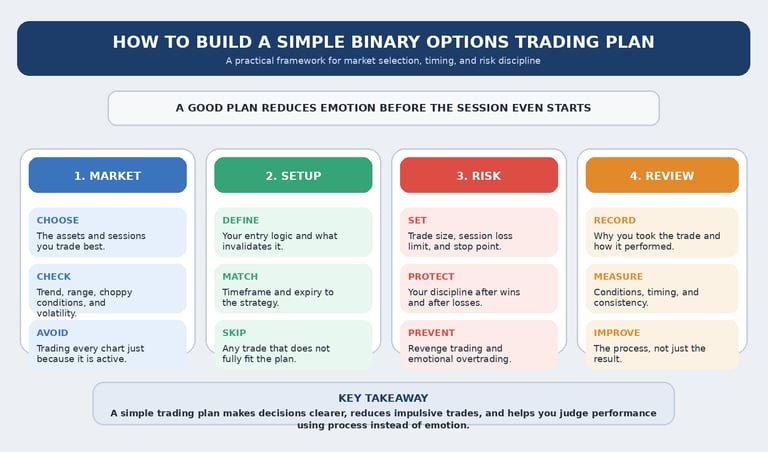
A useful trading plan does not need to be complicated. In fact, simple plans are often better because they are easier to follow under pressure. The first part should define your market focus. That means deciding which assets, sessions, and conditions you trade best. A trader who performs well during quieter periods should not force activity during unstable sessions just because the chart is moving.
The second part should define the setup itself. What has to be present before a trade is allowed? That includes the market condition, the direction logic, the chart timeframe, and the expiry that fits the setup. This is where many traders become inconsistent. They may have a strategy, but they do not clearly define what qualifies and what should be rejected. That is why How to Read Market Conditions Before Entering a Binary Options Trade and Best Timeframes for Binary Options Trading Strategies are so important inside the planning process.
The third part should define risk. This includes position size, session loss limits, and the point at which trading stops for the day. Risk rules are not just for protecting capital. They protect judgment. Once a trader becomes too frustrated, too emotional, or too eager to recover losses, decision quality usually falls fast. This is where planning and discipline become inseparable.
The fourth part should define review. After the session, the trader should know what to record and what to evaluate. That does not need to become a complicated journal at the beginning. It can be as simple as noting the setup, the market condition, the expiry used, and whether the trade actually matched the plan. The goal is to improve the process, not just count wins and losses.
How planning reduces emotional trading
A trading plan is especially valuable because it reduces the number of real-time decisions that need to be made under stress. Instead of asking in the moment whether a setup looks good enough, the trader can compare the chart to a pre-defined standard. Either it fits the plan or it does not.
This is one of the best defenses against overtrading. Traders usually overtrade when activity replaces selectivity. They see movement, feel pressure to participate, and lower their standards without admitting it. A written plan makes that easier to catch. If the setup does not match the plan, there is no real reason to enter. That is why How to Avoid Overtrading in Binary Options should be seen as part of the same process rather than a separate issue.
Planning also improves expiry decisions. Many traders change contract duration emotionally, especially after a loss. But expiry should be tied to strategy and market condition, not frustration. That is why this topic also links closely with How Volatility Affects Binary Options Trade Timing and How to Choose the Right Expiry Time in Binary Options.
Why simple plans work better than complex ones
One of the biggest mistakes traders make is building a plan that is too detailed to follow in real conditions. They create long checklists, too many exceptions, and too many moving parts. On paper, the plan looks sophisticated. In practice, it becomes difficult to apply during a live session.
A better plan is one that stays clear under pressure. It should answer a few essential questions: What market am I trading? What setup am I looking for? What expiry fits it? How much risk am I taking? When do I stop? If those answers are clear, the plan is already doing its job.
Simplicity also makes review easier. When the process is clear, you can see whether the mistake came from the market, the setup, the timing, or your own discipline. When the plan is too complicated, it becomes harder to identify what actually went wrong.
What beginners should focus on first
For most beginners, the best first trading plan is not built around complexity. It is built around restraint. Focus on one or two setups, one small group of assets, one or two preferred market conditions, and clear session rules. The goal is not to create a perfect plan immediately. The goal is to create one you can follow consistently.
This is also where demo testing becomes useful. A plan should be tested before it is trusted. Traders should use demo sessions to see whether the rules make sense in real conditions and whether the setup performs as expected. That is why Best Binary Options Demo Accounts: What Traders Should Test Before Going Live remains such an important guide for traders who are still building their foundation.
Final thoughts
A simple binary options trading plan does not remove risk, but it gives structure to how risk is taken. It helps traders choose better conditions, stay consistent with their setup, control their emotions, and review performance with more honesty. Without that structure, even a good strategy can become unstable.
The strongest traders are not the ones who make the fastest decisions. They are the ones who know in advance what qualifies as a trade and what does not. Once you have that clarity, everything else becomes easier to judge, from timing and expiry to discipline and performance.
For the next step, continue through our Trading Guides, study platform execution in Broker Reviews, and use Broker Comparisons to find the broker environment that best fits your plan.
Top Brokers
⚠️ Trading is speculative and involves risk. Consider your financial situation carefully before trading.
Related Articles
Binary Options Scam Red Flags: How to Spot an Untrustworthy Broker