
The best session depends on your strategy
The best time of day to trade binary options is not simply the hour with the most movement. It is the period when market structure, volatility, and your strategy align well enough to produce cleaner decisions. Many traders assume that more activity automatically means better opportunities, but that is only partly true. Some sessions offer strong movement with good follow-through. Others offer movement without clarity, which can make timing much harder.
This matters because binary options depend on fixed-time outcomes. You are not just trading direction. You are trading direction within a limited window. That means the quality of the trading session affects everything else: entry timing, expiry selection, volatility exposure, and emotional control. A setup that works well during one part of the day may become much weaker during another.
If you are still comparing brokers, start with our Top Brokers, then review execution quality in Broker Reviews and compare platform differences in Broker Comparisons. This topic also connects naturally with How Volatility Affects Binary Options Trade Timing, How to Read Market Conditions Before Entering a Binary Options Trade, Best Timeframes for Binary Options Trading Strategies, and How to Choose the Right Expiry Time in Binary Options.
Why time of day matters in binary options
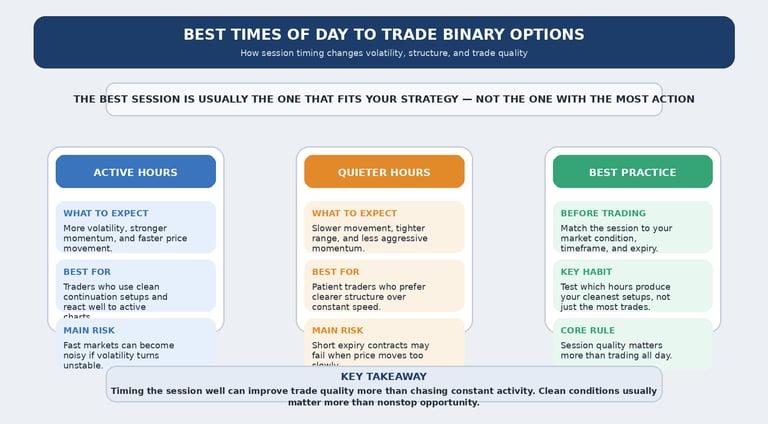
Different parts of the trading day produce different market behavior. Some periods are more active, with faster movement and stronger momentum. Other periods are quieter, with smaller ranges and less urgency. This changes how traders should approach entries and timing.
In more active hours, price often moves enough to make continuation setups and shorter expiries more practical, but only if the movement is clean. In quieter hours, the market may offer better structure but less speed, which means traders often need more patience and more realistic expiry choices. The key is understanding that session timing is not just about convenience. It changes the actual character of the chart.
This is one reason many traders feel inconsistent. They use the same setup all day, then blame the strategy when performance changes. But often the real variable is the session itself. The chart may simply behave differently at different times.
Active hours can be useful, but not always safer
Many traders are naturally drawn to the most active parts of the day. That makes sense. Active hours often bring higher volatility, faster movement, and more visible opportunities. For traders who rely on momentum or continuation logic, those sessions can be productive because price reaches target areas more quickly and offers clearer bursts of direction.
The danger is that active does not always mean clean. Some high-activity periods also create unstable volatility, sudden reversals, and a much faster decision environment. Traders who are not selective can easily mistake speed for quality. That usually leads to rushed entries, poor expiry choices, and overtrading.
This is why session timing should be matched to the strategy rather than treated as a universal rule. A trader who performs well in structured movement may do well during active hours only when the chart remains orderly. If the session becomes chaotic, more movement can actually make trading worse.
Quieter hours can improve clarity, but reduce speed
Quieter parts of the day are often underrated. They do not always offer dramatic price movement, but they can create a calmer environment where structure is easier to read. Some traders perform better during these periods because they feel less pressure, see levels more clearly, and avoid the emotional rush of very fast markets.
The tradeoff is obvious. Slower sessions can make short expiry contracts less practical because price may not move far enough before the contract closes. A trader who insists on very fast trades during quiet conditions is often forcing timing that the market does not support.
This is where session awareness becomes useful. The goal is not to choose the most exciting part of the day. The goal is to choose the part of the day where your setup has enough movement to work, but not so much instability that quality breaks down.
The best session depends on your strategy
There is no universal best hour for every trader. A momentum-based trader may prefer more active market periods because the strategy depends on directional movement developing quickly. A trader who relies more on cleaner support and resistance reactions may prefer conditions that are slightly calmer and easier to read. A trader using medium timeframes may benefit from a different session rhythm than someone watching ultra-fast charts.
That is why session choice should come after strategy logic, not before it. Ask what your setup needs in order to work well. Does it need fast momentum, or does it need stable structure? Does it depend on a quick reaction, or can it develop more slowly? Once those questions are answered, the best time of day becomes much easier to identify.
This is also why this topic sits so closely beside Best Timeframes for Binary Options Trading Strategies. Timeframe and session timing influence each other. A very fast chart during an already aggressive session can become difficult to manage. A more balanced timeframe may work better because it absorbs some of that noise.
Why session timing affects expiry selection
Time of day also changes how traders should think about expiry. In active periods, price may move enough to justify shorter contracts, but only when the structure is still clean. In slower sessions, longer expiry often becomes more logical because price needs more time to reach the expected direction. This is exactly why How to Choose the Right Expiry Time in Binary Options belongs in the same cluster.
Volatility matters here as well. Active sessions are often more volatile, but that volatility may be clean or unstable depending on the conditions. Quiet sessions may reduce noise, but they may also reduce opportunity. This is why How Volatility Affects Binary Options Trade Timing and How to Read Market Conditions Before Entering a Binary Options Trade both support this subject so strongly. Session timing is not separate from market reading. It is part of it.
Common mistakes traders make with time-of-day decisions
One common mistake is assuming that the busiest hours are always the best. That belief usually leads traders to sit in front of the most active charts whether or not those charts actually fit their style. If the session becomes too fast, the trader may end up reacting emotionally rather than reading structure.
Another mistake is trading at random hours without noticing how performance changes. Traders often think their results are inconsistent because of the strategy itself, when in fact the same setup behaves very differently depending on the session. This is one reason journaling and structured review matter so much.
A third mistake is trying to trade all day. Long screen time usually lowers selectivity. Once fatigue and boredom appear, even a decent setup becomes harder to execute properly. For many traders, narrower trading windows produce better results than constant availability.
What beginners should do first
For most beginners, the best approach is to simplify. Instead of trying to trade every session, focus on one part of the day and learn how the market behaves there. Watch whether volatility is stable, whether levels hold more cleanly, and whether your preferred expiry actually fits the pace of movement.
This is also where demo testing becomes valuable. Traders should compare how the same setup performs during different parts of the day rather than assuming that results will be the same in every session. That makes Best Binary Options Demo Accounts: What Traders Should Test Before Going Live especially useful here.
The goal is not to find a magical hour. The goal is to find the session that consistently gives your strategy the best chance to work.
Final thoughts
The best time of day to trade binary options depends less on excitement and more on fit. Some traders will perform better during active periods because their setups depend on strong momentum. Others will do better during calmer sessions because structure becomes easier to read and execution becomes more controlled.
The important point is to stop thinking about time of day as a background detail. It is part of the trading environment. Once you start treating session timing as a real variable, it becomes easier to choose better conditions, better expiry, and better overall trade quality.
For the next step, continue through our Trading Guides, compare platform conditions in Broker Reviews, and use Broker Comparisons to find the environment that best suits your trading style.
Top Brokers
⚠️ Trading is speculative and involves risk. Consider your financial situation carefully before trading.
Related Articles
Binary Options Scam Red Flags: How to Spot an Untrustworthy Broker