
How to Trade Breakouts in Binary Options Without Chasing False Moves
False breakouts are one of the most common ways binary options traders get trapped. A level breaks, momentum appears, and the move looks clean for a moment. That is exactly why it feels tradable. But then price stalls, slips back into the old range, and the breakout that looked strong a few seconds ago turns into a low-quality entry.
This is a serious problem in binary options because fixed expiry leaves very little room for hesitation. A weak breakout may still move in the expected direction briefly, but if it cannot hold beyond the level, the contract often expires before the move becomes reliable. That is why spotting trap setups early matters so much. It protects traders from confusing fast movement with real breakout quality.
If you are still comparing platforms, start with our Top Brokers, then review broker quality in Broker Reviews and compare execution conditions in Broker Comparisons. This topic also connects directly with How to Trade Breakouts in Binary Options Without Chasing False Moves, How to Use Support and Resistance in Binary Options Trading, How to Read Market Conditions Before Entering a Binary Options Trade, and When to Skip a Binary Options Trade.
What a false breakout really is
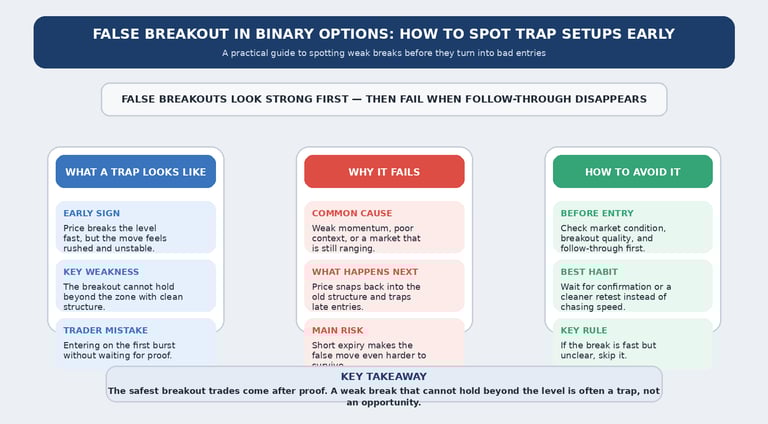
A false breakout happens when price pushes through an important level, creates the appearance of a genuine break, and then fails to continue. Instead of holding above resistance or below support, price quickly falls back into the previous structure. The breakout looked real at first, but it lacked the strength, follow-through, or market context needed to keep moving.
This is why false breakouts are so dangerous. They do not usually look weak at the beginning. In fact, they often look convincing enough to attract impatient entries. That is what makes them traps. They create urgency first and reveal weakness only after traders are already committed.
In binary options, this matters more than it does in many other forms of trading. A trader does not have unlimited time to wait and see if price eventually recovers. If the false move collapses quickly, the contract often becomes difficult to save.
Why false breakouts happen so often
Most false breakouts happen because the break itself was stronger in appearance than in structure. Price pushed through the level, but the move had no real capacity to sustain continuation. Sometimes that happens because the market is still fundamentally ranging. Sometimes it happens because volatility is unstable and produces spikes without clean direction. Sometimes it happens because traders chase the first candle before price proves that the level is actually broken.
This is why context matters so much. A breakout attempt inside a choppy market is far less trustworthy than a breakout forming in a structured trend or at the edge of a clear range with real pressure behind it. Traders who ignore market condition often enter false breaks simply because they see the line break and assume the setup must now be valid.
That is exactly why How to Read Market Conditions Before Entering a Binary Options Trade belongs so close to this topic. A false breakout is often less about the level itself and more about the environment the break is happening in.
Early signs that a breakout may be a trap
One of the earliest warning signs is that the breakout feels rushed but not stable. Price pushes through the level quickly, but the move looks more emotional than structured. The candle may be aggressive, yet price does not hold cleanly beyond the zone. This often means the move created excitement without real continuation behind it.
Another warning sign is weak follow-through after the initial push. A stronger breakout usually begins to build acceptance beyond the level. A weaker one starts hesitating almost immediately. Price may pause too quickly, drift back into the level, or show rejection that suggests the old structure is still controlling the market.
A third sign is that nearby structure makes continuation difficult. If price breaks a level but immediately runs into another important barrier, the breakout may not have enough room to develop before expiry. That is where traders often confuse the fact of the break with the quality of the trade.
Why traders keep falling into false breakout entries
The main reason is emotional pressure. Breakouts create the feeling that if you do not enter now, the move will be gone. That pressure makes traders act before the market has actually proven anything. Instead of waiting for confirmation, they enter because the chart looks fast and the level has already been crossed.
This is why many false-breakout losses are really decision-quality losses underneath. The trader did not lack technical information. The trader simply accepted too little proof. A line break became enough to justify entry even though the market was still undecided.
That behavior becomes even more dangerous on short expiry. Traders often combine the weakest kind of breakout entry with the most demanding timing requirement. If price snaps back even briefly, the contract can fail before the breakout has any chance to recover. That is why How to Choose the Right Expiry Time in Binary Options supports this topic so well. A questionable break with aggressive expiry is usually a bad combination.
How to avoid trap setups more effectively
The first improvement is to stop treating the first breakout candle as automatic confirmation. A stronger approach is to wait for proof that price can actually hold beyond the level. That proof may come through cleaner follow-through, a stable close beyond the zone, or a more structured retest that confirms the old level has truly changed role.
The second improvement is to judge the breakout in context. Is the market trending, ranging, or choppy? Is volatility supportive or unstable? Is the break happening from a meaningful level or from a weak one? These questions matter far more than the visual excitement of the first candle.
The third improvement is to accept that some moves should be skipped. Not every break deserves a trade. If the market looks rushed, the structure is weak, or the move feels like urgency without clarity, the best decision is often to stay out. That is why When to Skip a Binary Options Trade should be read alongside this article.
The role of confirmation in false breakout filtering
Confirmation is one of the best defenses against trap setups. Traders who wait for a clearer response from price often avoid many of the weakest false breaks automatically. This does not mean every confirmed breakout will work, but it usually means the entry is based on stronger evidence than the first impulse alone.
This is where How to Use Candlestick Confirmation in Binary Options Entries becomes especially valuable. Price reaction near the broken level can reveal whether the market is truly accepting the breakout or already starting to reject it. That small delay in entry can often improve decision quality more than traders expect.
It also creates a more logical relationship between breakout trading and retest trading. Some of the best breakout entries do not come from the first push. They come after the market proves the break has held.
What beginners should focus on first
For most beginners, the safer path is to become highly selective. Focus on obvious levels, cleaner market conditions, and breakout attempts that still look strong after the first burst of movement is gone. Do not try to catch every break. That usually leads to overtrading and confusion.
It also helps to review false-breakout trades carefully in demo. Notice whether the trap formed in a range, during unstable volatility, or near weak structure. In many cases, the signs were visible, but the urgency of the move made them easy to ignore in real time. That is one more reason Best Binary Options Demo Accounts: What Traders Should Test Before Going Live remains important. Demo is where these patterns can be studied without emotional damage.
Final thoughts
False breakouts are dangerous because they look strong before they fail. They create the appearance of momentum, attract impatient entries, and only reveal their weakness after the trade is already exposed. In binary options, that sequence is especially costly because fixed expiry punishes hesitation and unstable continuation.
The better mindset is simple. Do not trade the first burst of price just because it feels urgent. Trade the breakout only when the market proves it can hold, continue, and make sense within the contract window. That shift alone can remove many trap setups from your decision-making process.
For the next step, continue through our Trading Guides, compare broker environments in Broker Reviews, and use Broker Comparisons to find the platform that best fits your trading style.
Top Brokers
⚠️ Trading is speculative and involves risk. Consider your financial situation carefully before trading.
Related Articles
Binary Options Scam Red Flags: How to Spot an Untrustworthy Broker