
When to Skip a Binary Options Trade
One of the most underrated skills in binary options trading is knowing when not to trade. Many traders spend most of their time learning how to enter, but far fewer learn how to reject weak conditions before they cause damage. In practice, this is one of the biggest differences between random activity and disciplined execution.
This matters because binary options make action feel easy. There is always another chart, another candle, another expiry, and another chance to click. That constant availability creates the illusion that opportunity is always present. In reality, many losses happen not because the trader missed a signal, but because the trader should have stayed out entirely.
If you are still comparing brokers, start with our Top Brokers, then review execution quality in Broker Reviews and compare platform differences in Broker Comparisons. This topic also links naturally with How to Read Market Conditions Before Entering a Binary Options Trade, How to Avoid Overtrading in Binary Options, How to Build a Simple Binary Options Trading Plan, and How to Manage Risk in Binary Options Without Chasing Losses.
Why skipping trades is part of the edge
A trade is only valuable when the setup, market condition, timing, and discipline all support the decision. If one of those pieces is weak, the trade may still look tempting, but the actual quality drops quickly. This is where many traders make the wrong assumption. They believe that being active improves their results. Often, the opposite is true.
Strong traders do not define success by how many trades they take. They define it by how well they protect standards. That means rejecting setups that are unclear, emotionally driven, poorly timed, or disconnected from the broader market context. In other words, the trades you skip are often part of the edge, not evidence that you missed something.
This is one reason low-quality trades are so costly. A weak setup does not just risk money. It also weakens confidence, creates frustration, and can trigger the next bad decision. Skipping the wrong trade protects more than one result. It protects the session.
Skip the trade when the market condition is unclear
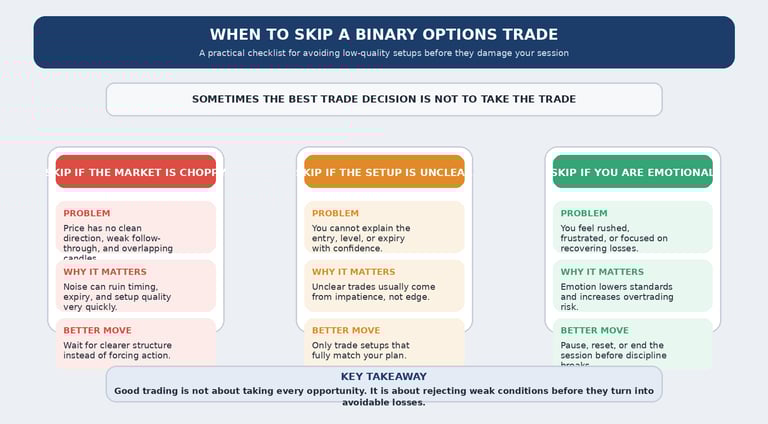
The first major reason to stay out is poor market structure. If the chart is choppy, inconsistent, or lacking follow-through, the trade is already starting from a weaker foundation. Many traders see candles moving and assume that movement alone is enough. It is not. A moving chart is not the same as a tradable chart.
This is why market reading comes first. If you cannot clearly tell whether the market is trending, ranging, or simply noisy, there is already a problem. Unclear conditions usually create weaker entries and much harder expiry decisions. In binary options, that often means the trade becomes more dependent on randomness than on real structure.
That is exactly why How to Read Market Conditions Before Entering a Binary Options Trade sits so close to this topic. Traders who misread the environment often end up forcing trades that never had enough structure to justify entry in the first place.
Skip the trade when the setup does not fully fit your plan
A second major reason to stay out is that the setup is only half there. This is one of the most common problems in real trading. The trader sees one part of the pattern and fills in the rest emotionally. Maybe the level is there but the reaction is weak. Maybe the trend exists but the entry is late. Maybe the expiry feels rushed but the trader takes it anyway because the chart looks active.
That is not discipline. It is compromise. And compromise usually leads to inconsistency because the trader is no longer following a method clearly enough to judge it honestly.
This is where a trading plan becomes essential. A plan should tell you what qualifies as a real trade and what does not. If the chart only partially fits the setup, the best decision is often to pass. That is why How to Build a Simple Binary Options Trading Plan matters so much here. Good plans are not just entry frameworks. They are also filters that stop weak trades from entering the session.
Skip the trade when you are trading emotionally
The market is not the only thing that can invalidate a trade. Your own state of mind can do it too. If you feel rushed, frustrated, impatient, or focused on recovering losses, the quality of the next decision is already at risk. This is one of the hardest truths in trading because many people want to believe they can stay objective while emotionally activated. In reality, emotional pressure usually lowers standards before the trader notices it happening.
This is why a good setup can become a bad trade in the hands of the wrong mindset. The entry may still exist on the chart, but if the trader is acting out of tension rather than clarity, the decision process becomes unstable. Expiry may be chosen too aggressively. Entry may be rushed. Position sizing may start drifting. What looks like one trade problem is often a discipline problem underneath.
This is also where overtrading begins. Emotional traders usually want action, not quality. That is why How to Avoid Overtrading in Binary Options and How to Manage Risk in Binary Options Without Chasing Losses both support this topic so strongly. Many unnecessary trades begin after the trader should already have paused.
Skip the trade when volatility and expiry do not match
A setup can look reasonable and still be worth skipping if the timing does not make sense. In binary options, the market not only has to move in the right direction. It has to do it within the contract window. If volatility is low, short expiry may leave no room for the setup to develop. If volatility is unstable and aggressive, the same expiry may become too exposed to noise.
This is one reason many traders force trades they should leave alone. They like the idea on the chart, so they ignore the fact that timing is wrong. But expiry is not a secondary setting. It is part of the trade logic itself.
That is why How to Choose the Right Expiry Time in Binary Options and How Volatility Affects Binary Options Trade Timing remain essential internal links here. Sometimes the right read is not “take the trade with a different expiry.” Sometimes the right read is simply “this setup does not deserve a trade at all right now.”
Skip the trade when you are trading for action, not for quality
Many low-quality trades happen because the trader wants involvement more than opportunity. This is especially common after a quiet stretch, a missed trade, or a losing streak. The urge to stay active starts replacing the need for clarity. Once that happens, almost any chart can start to look tradable.
This is where self-honesty matters. Ask a simple question: would you still want this trade if you had not been waiting, losing, or feeling bored? If the answer is uncertain, the trade may be more about emotional need than real edge.
This idea is closely connected to Common Binary Options Mistakes Beginners Make because many beginner errors come from trying to force progress through activity. But progress in trading usually comes from selectivity, not volume.
Why skipping a trade is not “missing out”
One reason traders struggle to stay out is fear of missing the move. They imagine the setup will work without them and feel pressure to be involved. But missing a trade is not the same as making a mistake. A mistake is taking a trade that should not have been taken. That distinction matters.
The strongest traders understand that a skipped trade can still be a good decision, even if the market later moves in the expected direction. The quality of a decision should be judged by what was known at the time, not by hindsight. If the setup was unclear, the market was weak, or your discipline was slipping, skipping it was still the right call.
This is one of the healthiest ways to think about trading. You are not trying to capture every move. You are trying to participate only when conditions justify the risk.
Final thoughts
Knowing when to skip a binary options trade is not a passive skill. It is one of the core parts of disciplined trading. Traders improve not only by learning how to enter well, but by learning how to reject trades that are unclear, poorly timed, emotionally driven, or unsupported by market structure.
The goal is not to become hesitant. The goal is to become selective. Once you understand that, skipping a trade stops feeling like lost opportunity and starts feeling like professional judgment. In many cases, the best trade decision is the one that protects your standards before the damage begins.
For the next step, continue through our Trading Guides, compare broker environments in Broker Reviews, and use Broker Comparisons to find the platform that best suits your trading style.
Top Brokers
⚠️ Trading is speculative and involves risk. Consider your financial situation carefully before trading.
Related Articles
Binary Options Scam Red Flags: How to Spot an Untrustworthy Broker