
Trend Continuation vs Reversal in Binary Options: Which Setup Is Safer?
One of the most important decisions in binary options trading is whether to follow the current move or try to call a turning point. This question appears simple on the surface, but it affects almost everything that follows: entry quality, expiry selection, timing pressure, and overall risk. In practice, many beginners lose money not because they cannot read a chart at all, but because they try to fade strong movement before the market is actually ready to turn.
That is why this comparison matters. Trend continuation and reversal setups are not equal in difficulty. Both can work, but they ask for different skills. Continuation trades usually rely on the idea that the market is already showing direction and may continue after a pullback or pause. Reversal trades depend on the market stopping, exhausting, or rejecting a move strongly enough to change direction within the contract window. In binary options, where time is fixed, that difference is huge.
If you are still comparing brokers, start with our Top Brokers, then review execution quality in Broker Reviews and compare platforms more closely in Broker Comparisons. This topic also connects directly with How to Read Market Conditions Before Entering a Binary Options Trade, How to Use Support and Resistance in Binary Options Trading, How to Choose the Right Expiry Time in Binary Options, and How Volatility Affects Binary Options Trade Timing.
What a continuation setup really means
A continuation setup is built on the idea that the existing direction is still intact. In an uptrend, that usually means waiting for a pullback, a pause, or a small reaction and then looking for price to continue higher. In a downtrend, the logic is the same in reverse. The trader is not trying to predict a major turning point. The trader is trying to rejoin the current move.
This is one reason continuation setups are often safer. The broader market is already doing part of the work for you. Momentum, structure, and direction are already visible. If the trend is clean, the trade does not need to fight the market. It only needs price to resume the same general path it was already following.
That does not make continuation trading easy, but it often makes it more logical. The trader can focus on whether the pullback is healthy, whether the market condition remains strong, and whether the expiry fits the expected continuation. In binary options, that usually creates a more forgiving decision than trying to call the exact moment a strong move will fail.
What makes reversal setups harder
A reversal setup tries to identify when price is likely to stop moving in one direction and begin moving the other way. This can happen at strong support or resistance, after exhaustion, or when momentum clearly weakens near a meaningful level. When it works, it can produce excellent trade location. But the difficulty is timing.
That is the real problem. A reversal idea can be right too early and still lose. The market may eventually turn, but not before the contract expires. This is especially dangerous in binary options because many traders see a stretched move and assume it must reverse immediately. In reality, strong momentum can continue much longer than expected, especially in trending or high-volatility conditions.
This is why reversal trades usually need more confirmation than continuation trades. The level alone is not enough. The market has to show some evidence that the move is actually weakening. That is where How to Use Support and Resistance in Binary Options Trading becomes especially relevant. A level only matters when price reacts to it in a way that supports the trade.
Why continuation is usually safer for most traders
For most retail traders, especially beginners, continuation setups are usually the safer starting point. The main reason is simple: they trade with the dominant structure instead of against it. When the market is already trending, the trader does not need to predict a major change. The trader only needs to identify a reasonable place to join the move.
This reduces one of the hardest parts of binary options trading, which is precise turning-point timing. Reversal trades often demand cleaner confirmation, stronger patience, and more experience reading exhaustion. Continuation setups still require discipline, but they usually provide a more stable framework because the market direction is already visible.
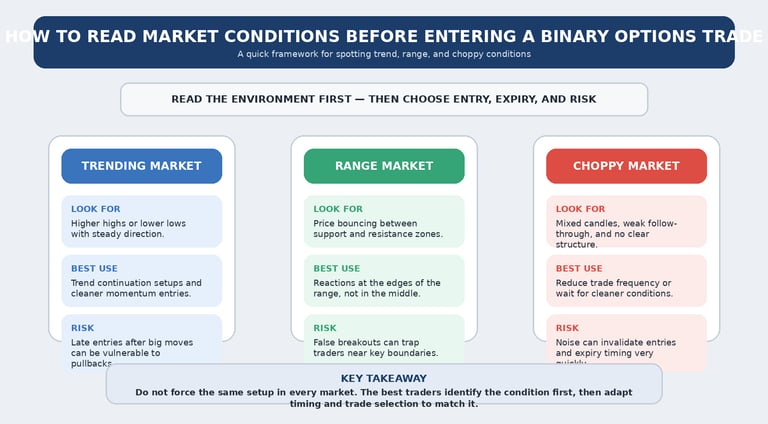
This also links directly to market condition reading. If a trader cannot clearly identify whether the market is trending, ranging, or choppy, both continuation and reversal trades become weaker. That is why How to Read Market Conditions Before Entering a Binary Options Trade should be treated as a foundation piece before this one.
When reversal setups make more sense
Reversal setups are not bad. They simply demand more selectivity. They tend to make more sense when price reaches a strong support or resistance zone, the move is extended, volatility begins to shift, and the chart starts showing clear rejection or loss of momentum. In those moments, a continuation trade may actually become the weaker choice because the trend is no longer clean.
This is why reversal trading is often more situational. It works best when several pieces of context align together. The trader should know where price is, how strongly it arrived there, whether the level matters, and whether the market is truly beginning to reject the move. Without that alignment, reversal entries often become guesses disguised as analysis.
Timeframe matters here as well. On very fast charts, reversals can look convincing for a moment and then disappear in noise. On slightly cleaner charts, the structure becomes easier to read. This is one reason Best Timeframes for Binary Options Trading Strategies supports this discussion so well.
The role of expiry in continuation vs reversal
Expiry selection makes this comparison even more important. Continuation trades often fit naturally with the current market flow, so the contract only needs enough time for the existing move to resume. Reversal trades are often more sensitive to timing because the change in direction must happen quickly enough to matter before expiry.
A trader might correctly identify that a market is overextended, but still lose because the reversal developed too slowly. In other words, reversal setups often put more pressure on expiry quality. That is why How to Choose the Right Expiry Time in Binary Options becomes much more important when traders start fading moves rather than following them.
Volatility makes the difference even sharper. In high-volatility conditions, continuation can stay strong much longer than expected, making early reversals dangerous. In calmer conditions, reversals near strong levels may become easier to manage. That is exactly why How Volatility Affects Binary Options Trade Timing belongs in the same internal-link cluster.
Common mistakes traders make with both setups
The biggest mistake with continuation is entering too late. Traders see a strong move, feel afraid of missing out, and enter after the clean part of the move is already gone. At that stage, the setup may still be trend-based, but the location is weak and the market becomes more vulnerable to pullback.
The biggest mistake with reversal is entering too early. Traders assume a move is “too high” or “too low” and try to fade it without confirmation. This is one of the most common ways beginners lose. They are not trading a proven reversal. They are trading discomfort with how far price has moved.
Another mistake is trying to force the same preferred setup in every market. Some traders want to trade only reversals because they like the feeling of catching the top or bottom. Others only want continuation because it feels simpler. Stronger traders adapt. They choose the setup that matches the condition, not the setup that matches their ego or habit.
What beginners should do first
For most beginners, the better path is to focus on continuation setups first. They are usually easier to understand, easier to time, and easier to connect with market structure. This does not mean reversal trading should be ignored forever. It simply means continuation is often the better foundation for learning how price behaves.
A beginner who can already identify trend structure, choose a reasonable expiry, and avoid overtrading is in a much stronger position to experiment with reversals later. But starting with reversal trading too early often creates avoidable frustration because the timing demands are higher and the risk of guessing is much greater.
This also fits naturally with Common Binary Options Mistakes Beginners Make and How to Avoid Overtrading in Binary Options. Many bad trades come from trying to call reversals in conditions that never justified them.
Final thoughts
Trend continuation and reversal setups can both work in binary options, but they do not carry the same difficulty. Continuation is usually safer because it works with the market’s existing direction and demands less precision in calling a turning point. Reversal can be powerful, but it requires better context, stronger confirmation, and more careful timing.
The goal is not to choose one style forever. The goal is to understand which setup the current market actually supports. Traders who can do that consistently are usually far more selective, more disciplined, and less likely to force low-quality entries.
For the next step, continue through our Trading Guides, review platform conditions in Broker Reviews, and compare broker environments more closely in Broker Comparisons.
Top Brokers
⚠️ Trading is speculative and involves risk. Consider your financial situation carefully before trading.
Related Articles
Binary Options Scam Red Flags: How to Spot an Untrustworthy Broker