
How to Use Retests in Binary Options Entries
A retest is one of the most useful concepts in binary options trading because it can turn a fast, emotional move into a more structured entry. Many traders see price break a level and rush into the trade immediately. Sometimes that works. But in many cases, the better opportunity comes a little later, when price comes back to test the broken level and shows whether the move is actually strong enough to continue.
This matters because binary options are highly sensitive to entry timing. A breakout can look convincing at first and still fail before expiry. A retest helps solve part of that problem. It gives traders a second chance to judge whether the breakout level is truly holding, whether the market still supports continuation, and whether the trade has a more logical location than the first burst of momentum offered.
If you are still comparing platforms, start with our Top Brokers, then review broker quality in Broker Reviews and compare conditions in Broker Comparisons. This topic also connects directly with How to Trade Breakouts in Binary Options Without Chasing False Moves, False Breakout in Binary Options: How to Spot Trap Setups Early, How to Use Support and Resistance in Binary Options Trading, and How to Use Candlestick Confirmation in Binary Options Entries.
What a retest really means
A retest happens when price breaks an important level and then returns to that zone before deciding whether to continue. In an upside breakout, old resistance may be tested again from above. In a downside breakout, old support may be tested again from below. The key idea is that the market is revisiting the broken level to reveal whether it can now behave like a new support or resistance area.
This is why retests are so useful. They create a second layer of evidence. The breakout itself shows that price has enough force to push through the level. The retest shows whether the market can actually hold beyond it. In many cases, that makes the entry more stable than the first breakout candle.
For binary options traders, this is especially valuable because fixed expiry leaves less room for guessing. A retest does not guarantee success, but it can make the trade logic much clearer than chasing the first fast move.
Why retests often create better entries
The biggest advantage of a retest is trade location. Traders who enter on the first breakout candle are often paying the highest emotional price for the move. They are entering after speed has already appeared, when price may be extended and more vulnerable to hesitation or snapback. A retest often offers a calmer entry point because price has already shown the level, left it, and then come back to prove whether it still matters.
This improves selectivity. Instead of trading every breakout, the trader can wait for the market to show whether the broken level is being accepted. That small difference often filters out weaker moves. If price cannot hold the level during the retest, the breakout may not have been strong enough in the first place.
This is one reason retest logic fits so well with breakout trading. It does not replace the breakout. It refines it. It helps traders stop confusing the first burst of price with a high-quality opportunity.
Why retests do not always work
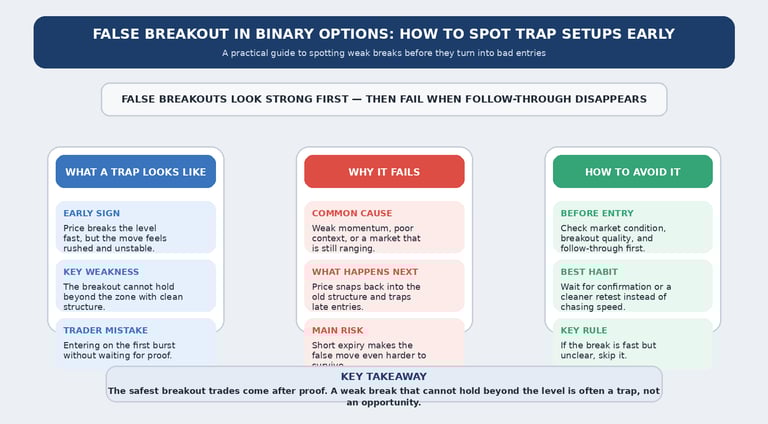
A retest is useful, but it is not automatic confirmation. Some retests fail because the original breakout was weak. Others fail because the broader market condition was never supportive. Price may return to the level, hesitate briefly, and then slide back into the old structure. When that happens, the retest is revealing weakness, not strength.
This is why retests need context. A clean retest in a structured trend or at the edge of a well-defined range can be meaningful. A messy retest in a choppy market often says very little. Traders who treat every return to a level as a valid setup usually end up taking too many weak entries.
That is why this article sits closely beside How to Read Market Conditions Before Entering a Binary Options Trade. A retest only becomes valuable when the environment around it supports continuation.
How to judge a better retest
The first question is whether the original level was meaningful. A retest works best when the broken zone mattered before the breakout happened. If the level was weak or arbitrary, the return to it may not tell you much. This is why support and resistance quality still comes first.
The second question is how price behaves when it comes back. A stronger retest usually shows some sign that the level is being respected. That may be a cleaner rejection, a more stable hold, or candlestick behavior that supports the idea that the old level has changed role. This is where How to Use Candlestick Confirmation in Binary Options Entries becomes especially useful. The retest is not just about touch. It is about reaction.
The third question is whether there is still room for the move to develop. If price retests the level but runs immediately into nearby structure, the trade may still be too crowded to justify a fixed-time contract. In binary options, good location alone is not enough. The move still needs time and space to work before expiry.
Retests and expiry selection
Retests often improve expiry decisions because they provide clearer timing than a raw breakout spike. A breakout candle may happen too fast to judge properly. By contrast, a retest often gives the trader a more readable moment to decide whether the setup is actually beginning to continue.
That does not mean every retest calls for the same contract length. If the reaction is clean and the market is active, a shorter expiry may make sense. If the retest develops more slowly, the setup may need more time. What matters is that the retest helps the trader choose timing from structure rather than from urgency.
This is exactly why How to Choose the Right Expiry Time in Binary Options and How Volatility Affects Binary Options Trade Timing belong in the same internal-link path. The usefulness of a retest depends not only on the level but also on the pace of the market.
Common mistakes traders make with retests
The first mistake is assuming every breakout must be traded on a retest. Some breakouts never offer a clean return. Others return in such a weak or chaotic way that the better decision is simply to skip the trade. A retest is not a guarantee. It is an opportunity to assess quality.
The second mistake is entering on the retest without checking whether the breakout itself was valid. If the original move lacked structure, the retest may only be the beginning of the failure rather than proof of continuation.
The third mistake is ignoring candlestick behavior at the retest. Traders often wait for price to come back to the level, then enter automatically. But the reaction still matters. A good retest should show at least some evidence that the market is respecting the new structure.
The fourth mistake is treating messy retests like clear ones. If price keeps crossing the level back and forth without conviction, the setup is usually losing quality. In that situation, patience is more valuable than participation.
Why retests help reduce chasing
One of the best things about retest trading is psychological. It helps traders avoid the urge to chase the first fast candle. That alone can improve decision quality. Instead of feeling forced to enter before the move is “gone,” the trader begins to wait for the market to prove more.
This does not mean retests remove emotion entirely. But they often shift the trader from reactive behavior to more structured observation. That is a big step toward better execution. It also connects directly with How to Avoid Overtrading in Binary Options and When to Skip a Binary Options Trade. Many unnecessary trades come from breakout chasing that a simple retest mindset would have filtered out.
What beginners should focus on first
For most beginners, the best way to use retests is to keep them simple. Focus on clear levels, obvious breakouts, and retests that still show structure when price comes back. Do not try to trade every return to every level. Start with the cleaner cases where the logic is visible.
It is also worth testing retests in demo before trusting them with real money. Watch how price behaves after breakout, how often the retest holds, and how often the return reveals weakness instead. That is one more reason Best Binary Options Demo Accounts: What Traders Should Test Before Going Live remains such a useful supporting guide.
Final thoughts
Retests can make binary options entries much better when they are used with discipline. They help traders avoid chasing the first breakout spike, improve trade location, and add one more layer of confirmation before the contract begins. But they only work well when the breakout, the level, and the market condition all support the same idea.
The real value of a retest is not that it creates more trades. It is that it helps filter for better ones. Once traders understand that, retests become less about finding action and more about improving decision quality.
For the next step, continue through our Trading Guides, review broker conditions in Broker Reviews, and compare platforms more systematically in Broker Comparisons.
Top Brokers
⚠️ Trading is speculative and involves risk. Consider your financial situation carefully before trading.
Related Articles
Binary Options Scam Red Flags: How to Spot an Untrustworthy Broker